Tuesday, 26 April 2016

Ruzanuvol : Birra artigianale in Spain


In the Ruzafa area of Valencia is an unexpected outpost for Italian beer. Ruzanuvol is a fairly shiny-looking and new bar, minimalist whilst retaining a certain cosiness and atmosphere; there are families eating a meal, old Italian men sipping a dayglo-green liqueur and the guy who owns the place seemingly pouring himself an awful lot of double IPA - a great vibe. Now, my usual policy when travelling is to drink the local beer, or at least beer from the country I'm visiting, wherever possible. But I'm endlessly intrigued by Italian beer, partly because I encounter very little of it in the UK and partly because the examples I have been able to try have been very good, and the beers on offer here – four from Birrificio Italiano and one from Birrificio Lambrate – are from particularly highly regarded breweries. Having sampled my fair share of Spanish brews while I'm here, I decide to allow myself the diversion.

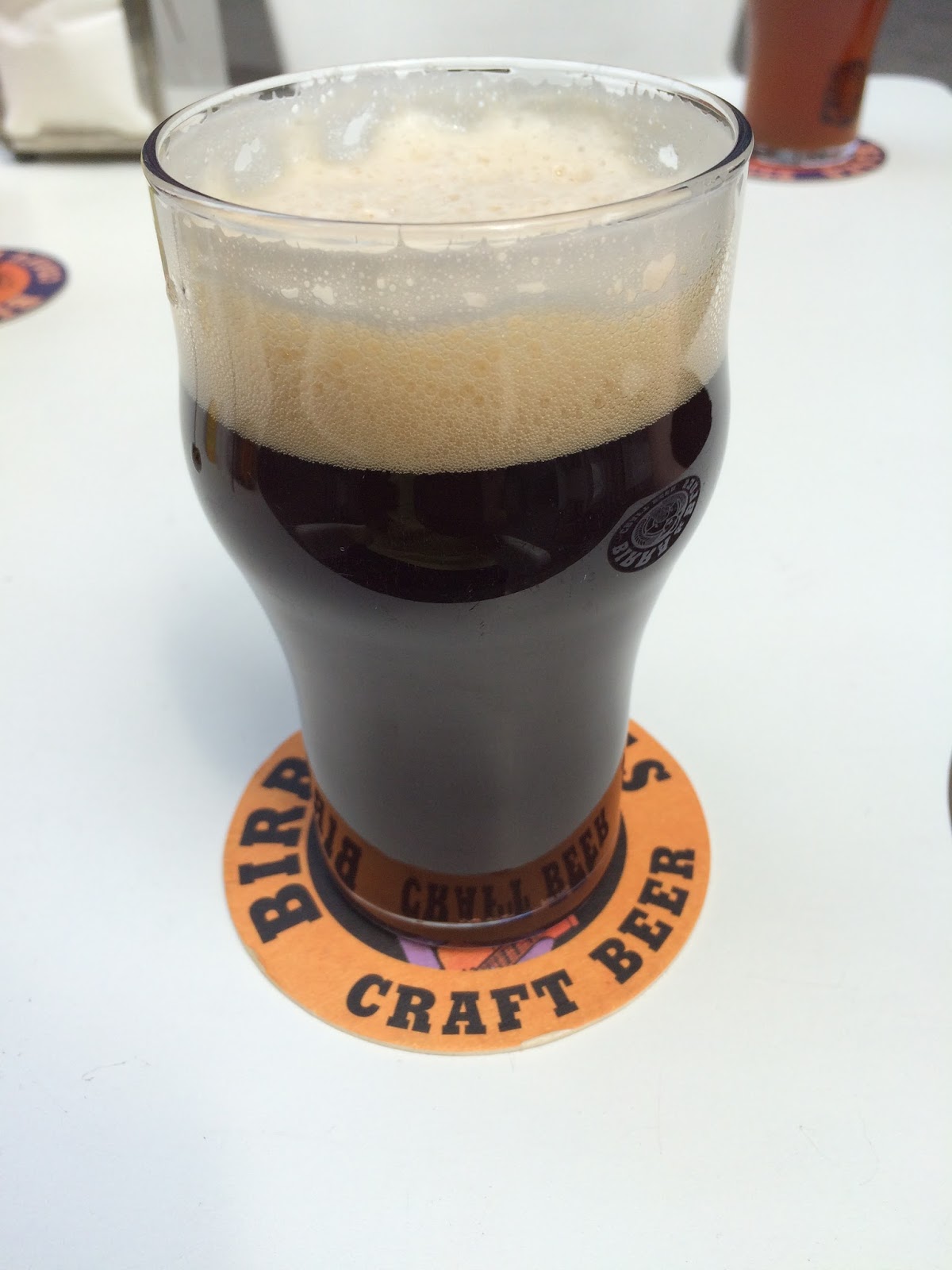
There’s an exciting moment when I spot Tipopils on the bar. Having tried this once before in bottled form, I was underwhelmed, but this only made me more determined to try it on draught – people rave about this lager, so I wasn't going to write it off on the basis of one tired bottle. Though initially disappointed to see a nonic pint glass being pulled out for my beer – I hate these at the best of times, but they’re especially crap for lager – I'm soon enchanted by the crown of loose, moussey foam extending from the glass. Taking a first thirsty glug and feeling the fresh, grassy hops hit my palate, I have to consciously stop myself from knocking it back in one. This is hoppy lager at its best – satisfying all of the pleasures you want from the style and giving a vibrant, herbal hop hit without excessive bitterness or overly fruity flavours that confuse the clean lager base. I would love to drink pint after pint of this, but there are other taps to consider.

Even a butt-ugly nonic pint glass looks attractive with this Mr. Whippy-style head
Various sources suggest that Birrificio Italiano's Amber Shock is available only in bottles. Assuming I wasn't sold some sort of bootleg beer, this must have changed at some point as it was pouring from the keg. A festival of malt, this is soft and comforting beer. There's a little of the candy floss flavour I often notice in beers of this colour, but it stops well short of cloying sweetness, and some treacle-like burnt bitterness and boozey warmth in the finish keep things interesting. Asteroid 56013, the brewery's IPA, is glorious, reminiscent of The Kernel's excellent IPAs at home. There's a big, resinous hop hit which suggests tropical fruit whilst maintaining a certain savoury quality - I guessed at Mosaic, but it's actually Cascade. This is notable for two reasons - 1) I should stop trying to guess what hops are in beers, especially as I never get it right, and 2) I associate Cascade with the herbal and grapefruit flavours of Sierra Nevada and Liberty Ale, but this beer is much more modern in character and proves that it's not just newer hop varieties that make the difference, but the way hops are used. Most importantly, it hits that sweet spot of bitterness which invites you to drink more but stops short of unpleasant washing up liquid sensations.

Finally, Quarantot from Birrificio Lambrate. This is what the owner has been liberally sipping throughout the evening, becoming increasingly friendly and singing along to Italian music as he goes. I can't blame him - it's a big beer at 9% but doesn't necessarily drink like it. There's a little sweetness, which can be a deal breaker in a double IPA for me, but here is delicately managed, preventing the super juicy hops from completely overpowering.

Visiting Ruzanuvol has made me all the more determined to continue seeking out great Italian beer, and I'd highly recommend a visit if you're in Valencia.

Sunday, 17 April 2016

La cerveza artesanal en Valencia

When I visited Seville last year, I drank some very fine Spanish beer. Spain’s beer culture is young, and this is particularly true in Seville; Ratebeer now lists four breweries or brewpubs within the city, but at that time there were just two. Valencia is the larger, hipper and more cosmopolitan of the two cities and beer culture here is far more established, with a handful of local breweries and a fine choice of bars and pubs. You’re likely to simply stumble upon good beer in this town, where bottle shops and brewpubs mingle with tourist attractions in the city centre and restaurants may include ‘cerveza artisanal Valenciana’ sections on their drinks menus.


Birra & Blues is probably the most visible beer spot in Valencia, located in the heart of the old town just moments away from the central indoor market. Though it looks like the beer is brewed in a different premises, the bar is very much in the vein of a US brewpub – clean and bright, family friendly, and doing a good trade in tapas and coffee as well as beer. Indoor seating was, as far as I could see, fairly limited, but it’s a great place to stop by for an al fresco afternoon beer whilst wandering around the city centre.

La Negra, their brown ale is very good despite some problematic branding. It’s full of cocoa, raisins and dates, with a faint suggestion of coffee and some peach-skin earthiness before a finish which is ‘nutty’ in that it recalls the dry, bitter sensation of biting into a nut. John Lee Blues, a dry-hopped amber ale, has a strong candy sugar character along with some caramel, and just enough savoury toasted cereal notes to reign in the sweetness. The hop profile brings peaches, apricots  and mango and there’s a gentle bitter finish. Sadly only available in bottles, Black Blues Abbey is their interpretation of the Belgian abbey style, which is a strange experience – initially bland, it then becomes dry and quenching before a very late and very big burst of flavour. There’s blackberry, blackcurrant and cola along with a little phenolic bubblegum, and finally some gentle roast and ash. It’s not much like any Belgian beer I’ve tasted, but it’s an accomplished and interesting beer with complexity far beyond its modest 5.4% ABV.


The aforementioned Mercat Central also houses Las Cervezas del Mercado, a bottle shop which is astonishingly well stocked given its limited space - pick up some Spanish beers along with your smoked paprika, saffron and delicious juicy oranges. On the other side of the old town is the bizarrely named Beers and Travels – the shop is very much geared towards the beer side of things, though their website suggests they do book beery trips too. Here I picked out CCCP, a classic session IPA from local brewery Tyris, which is beautifully dry and full of pine and citrus zest – the sort of IPA that’s becoming unfashionable in this era of ever-later dry hopping and rapidly receding bitterness, but still holds a lot of charm in the afternoon sun. 


In the younger, more bohemian environment of Ruzafa is Olhöps, an achingly hip craft beer bar decked out in a Scandinavian minimalist style that reminds me of restaurants in modern art galleries. The likes of Mikkeller and Brew By Numbers are on tap alongside the Spanish beers, and there’s a small but tastefully curated selection of bottles to take away. Here I go for Zeta Hell, a lager from Valencia’s Zeta brewery, which is a delight – clean and full bodied with plenty of quenching carbonation and a spicy edge. Like Birra & Blues’ brown ale, Paqui Brown – the name puns on Jackie Brown with the nickname of a Valencian footballer - from Tyris also has questionable branding. It’s questionable in other ways, too – so pale that I can’t believe I’ve been served the right beer. Wondering whether the wrong keg has been attached to the tap, I enjoy the caramel-coloured beer anyway – approached as an amber ale, it has a pleasant peach and sherbet hop character over a smooth caramel malt backbone.


At the nearby Valencia on Tap, the mystery is solved. As the owner talks me through the beers on tap, he comes to Paqui Brown, explaining – “it’s a brown ale – well, they call it a brown ale, really its amber.” This place has a lot more in common with the unfussy locals bars you see everywhere in Spain, but with ten taps of great beer from the likes of Founders and Hitachino Nest in place of the solitary condensation-soaked Estrella Galicia font. Despite the name, the beers go beyond the strictly local – I try Achtung! Imperial Porter, a collaboration between Yria , from Noblejas in the Toledo province and the Bavarian Hanscraft & Co. which appears to have been brewed at Domus in Toledo. This is a beer of great complexity – earthy and slightly tart, it’s full of black cherries and dark berries, with a dryness that recalls cocoa powder before some dusty, musty barnyard flavours round it out. Garage IPA from Barcelona’s Espiga is a glorious burst of lemon peel, pine needles and herbs – there’s a particular zingy citrus flavour here which I also find in Beavertown’s Neck Oil and certain BrewDog beers – Simcoe, perhaps? The body is full, even verging towards creamy, and extremely satisfying.


My overall impression of Valencia suggests a beer culture that's catching up to where are in the UK in terms of visibility. The likes of Mahou may still dominate, but a focus on local and artisan produce in general benefits beer - you can, for example, fill growlers with Tyris pale ale at the central branch of El Court Ingles. Not all the beers were hugely exciting, but I certainly encountered nothing rough, amateurish or marred with off-flavours. Valencia may be some way off becoming a beer destination, but for a holiday of exploring by day and boozing by night, I'd highly recommend it.

Thursday, 31 March 2016

"Just beer"; struggling for words to describe pale lager


Recently, after enjoying a bottle of Hell from Bamberg’s Keesman brewery, I attempted to throw together some quick tasting notes for an Untappd check-in. Here’s what I eventually came up with;

“Fresh biscuits & steamed broccoli aroma. Tangy biscuit malt, refreshing carbonation, mineral bitterness in the finish. Wish I had another.”

I threw in the last sentence because I felt that those preceding it failed to a) communicate that I had actually very much enjoyed the beer, or b) make it sound like anything anybody would ever want to drink. Whilst these notes accurately represent my experience of drinking the Hell (I didn't claim to be tasting things I wasn't really tasting), the truth is I was desperately grasping for anything to usefully say about it. That doesn't mean it was boring or unremarkable – I'm just starting to realise that I have a hard time describing the experience of pale lager.

One reason for this might be that pale lager is pretty much my base point for what “beer” means. Since lager is the dominant beer in our culture, this is not unusual; a Google image search for the term ‘beer’ results in pages and pages of  images of foaming glasses of lager, sometimes joined by other glasses of varying ale-like colours but never absent. The first beers I ever tasted were lagers, and lager was almost all I drank between my teenage years and my early twenties.
The result of this is that lager is, often, “just lager”. In my discovery of good beer (revelatory pint of Camden Hells notwithstanding), it took a long time to separate good lager from bad, even if the contrast is night and day to me at this point. I would argue that the differences between macro fizz and properly brewed lager are far more subtle than between, say, Punk IPA and (what I then perceived to be) a boring cask bitter.

But then lager is subtle, even at its most sublime. And that’s definitely part of why I'm lost for words when it’s time to write about one – I recently had the same issue trying to write about mild, a similarly non-imposing style. The complexity of a barrel-aged imperial stout means that tasting notes write themselves. Drinking one, there’s so much going on that you hardly have time to jot down one thought before another hits you. Lager is comparatively simple – this is a large part of its appeal, but it doesn't make for great writing.

There are certain stock phrases and descriptors I keep going back to in my blundering attempts to describe the lager experience, of which crisp is probably the laziest. I know what I mean by it – a suggestion of freshness as well as refreshment, like biting into a juicy, crunchy apple. But in this context, the word has a whiff of corporate copy about it – words like ‘crisp’, ‘cool’ and ‘refreshing’ are often used in advertising macro lagers, presumably as they divert attention away from the lack of actual flavour in most of these products.

Similarly, I know what I mean when I say a lager is clean. A well-made lager given plenty of time to mature has a certain purity to it, and those brewed with less attention to quality don’t – they often have distracting notes of sweetcorn or cabbage, or are weirdly, synthetically sweet or metallic. But it doesn't apply to all great lagers; I love Pilsner Urquell, but it’s big ol’ scoop of diacetyl adds a complexity which, whilst it might not be exactly dirty, isn't clean either.

I mentioned biscuits in reference to the Keesman beer that prompted this post, and variations on biscuity seem to pop up often in tasting notes. There are probably more varieties of biscuits than there are styles of beer, making this about as useful a statement as ‘tastes like beer’. But it does, at least for me, mean something specific. Think of Maltesers. Now, ignore the chocolate (or imagine you've nibbled it off) and focus on the biscuit ball within. There is a specific malty tang within that biscuit that is exactly what I'm referring to when I say ‘biscuity’, and I find that particular flavour in a lot of lagers (obviously malt flavour is part of it, but there’s more to it than that). Until I can find a way to sum that up succinctly and pithily, lager will remain forever ‘biscuity’ for me.


So pale lager, much as I love it, probably won’t be inspiring any upcoming poetry collections.  

Saturday, 26 March 2016

Thornbridge Hall Double Scotch Ale


The impulse to hoard beer is a strange one. Some beers seem too special to just drink - they demand some ceremony, a special occasion, some good news. The trouble is that these occasions arise all too rarely and, when they do, you may find you're not in a position to transfer a bottle from your stash into the fridge and gather an ensemble of admirers to share it with you. And, if I'm perfectly honest, sometimes I'm glad about that. However much I might scan my beer cupboard wondering what the contents will taste like, the thought of eventually dropping the bottle into the recycling bin is a little sad. I want to have my beer and drink it.

You can justify the cobwebs on your bottle collection by telling yourself that flavours are developing all the time, that the beer you're not drinking now will be so much better by the time you finally crack it open. But if you find you're actually pushing the limits of best-before dates, as was the case with the bottle of Thornbridge's Double Scotch ale that I pulled from the cupboard last night, the only thing to do is to tell yourself you're worth it and pop the damn cap. This beer, a Scotch ale aged in Auchentoshan casks, was bottled in 2014 under the ultra-artisan Thornbridge Hall sub-brand produced at the original brewery site. It's technically almost two months out of date, but tastes so glorious I highly doubt I could have caught it at a better time.

The aroma jumping from the glass suggests a rich, port wine-like booziness, along with a big burst of blackcurrants. These are joined by raspberries on first taste, along with some musty, woody notes and some milk chocolate. Some whiskey flavour from the cask carries over, and the faint suggestion of peaty smoke is an element of this flavour, but the resulting toasted character is key to this beer's complexity as well as its moreishness. It seems to suggest a whole collection of flavours which aren't necessarily actually there - vanilla, coconut, fudge, coffee - which lighten what could be a heavy, overbearing beer. The complexity in this toasted finish has me coming back for more and more.

This is a master-class in barrel ageing - a simple beer made fascinating with time in the wood, neither element threatening to overpower the other. Thornbridge were an important brewery for me as I first discovered great beer, and whilst I often admire their beers as solid examples of particular styles, these days I'm rarely strongly moved by a Thornbridge offering. This makes the triumph of the Double Scotch all the more exciting, and I'm now determined to seek out Eldon, their latest foray into barrel-aging.

Another great excuse to open an interesting bottle is Open It!, a Twitter tasting event in aid of the Evalina Children's Hospital. It's on Saturday 16th April and further details are here.

Sunday, 20 March 2016

Sussex CAMRA beer festival 2016


Last weekend saw the 26th Sussex CAMRA branches beer festival at Brighton’s Corn Exchange. Here are some thoughts on my experience of the festival and the beers I drank.

The beer

With over 170 beers at this year’s festival, the 13 mild ales on offer might not seem much. But I’d all but declared mild extinct in this part of the country - admittedly, many of the examples here are from further afield (further North), but there’s a certain type of beer geek that’s inexplicably drawn to such unfashionable styles, and I’d proudly count myself among them – so 13 milds in one room is pretty exciting to me.

That said, I drank only a few as there were so many other beers I wanted to try, but they were all very tasty and extremely moreish (mild isn't best suited to third-of-a-pint servings) and helped clarify my idea on what mild means. First was Leeds’ Midnight Bell, an elegant beer with a lightly roasty malt backbone and some earthy, vegetal hops adding depth. The hoppy bitterness is bigger than I expected from the style, possibly due to the unusual addition of Willamette hops. Kissingate’s Black Cherry Mild is, obviously, also atypical, though it does have a similar light roasty foundation. It’s too sweet for my tastes, although it does taste like real cherries rather than a sticky, syrupy synthetic flavouring. Arundel’s Black Stallion , a mild that actually does hail from Sussex (though they seem reluctant to refer to it this way), was another solid offering, and I really hope I get to become properly equated with a few pints of it some time. Finally, Summer Wine’s Resistance was the best of the bunch - beautifully balanced between sweet toffee-like malt and bitter hops, with a hint of vanilla adding depth. I've unjustly ignored this brewery for no good reason for too long, and I’ve clearly been a fool.

Stewart’s 80/, a Scotch ale, isn't so different to some of these milds – a little sweeter with next to no discernible hop bitterness, it’s a big, soft, fluffy, malty comfort blanket of a beer. Brighton Bier’s Freshman, an IPA in the Vermont style, is at the other end of the spectrum – super pale malts imparting as little character as possible, accentuating the big, juicy hop hit I’ve come to expect from this brewery. It’s all about hop aroma and flavour, and bitterness is consequently low – it’s exactly the kind of IPA I love, and Brighton Bier’s most accomplished beer yet.

There was also plenty to appeal to fans of smoked beer like myself. Gun Brewery, from Heathfield in East Sussex, have often impressed me, and the new Smoked Rye they've brought with them is excellent – an authentic swirl of Bamberg-style smoke, with a wonderful herb-like finish recalling oregano and rosemary. Langham’s Aegir porter also brings a hefty dose of smoke, alongside a smooth, slightly sweet malt character. Brigid Fire from Celt Experience is a smoked rye IPA that slightly disappoints in the smoke department, and doesn't present itself as particularly hoppy either. Its interesting feature for me is the bierre de garde yeast, which imparts the kind of honeyed sweetness you find in a beer like 3 Monts, or the marzipan character of Jenlain Ambrée. It’s a complex beer that I pondered carefully with every sip.

And finally, some big hitters. Hammerpot’s Baltic porter was smooth and full bodied, with a rich tang suggesting port wine. Kissingate’s Murder of Crows was my undisputed highlight of the festival -  a huge, double-mashed imperial stout, reportedly aged for a year before release. It’s rich and sweet with muscovado sugar and clementine flavours, but also slightly tart and tangy, resulting in a balsamic sweet and sour character reminiscent of a Flanders Red. It’s a very special beer, and one you absolutely must order if you’re lucky enough to see it out in the wild.

Alongside some great beers, the event was well organised – all beers in tip-top condition, very few not ready in time for the opening session – and the volunteers were great, everyone enthusiastic and friendly.

Room for improvement

There’s definitely room for improvement, though. I’d love to see the introduction of key kegs (as per the recent CAMRA festival in Manchester), especially as increasing numbers of local breweries are beginning to experiment more with kegged beers. Although I was happy to stand throughout the session and saw plenty of free seats, it’s a shame the seating has to be tucked away around the edges of the room, isolated from the atmosphere of the festival, and seats with tables would be especially practical. I accept that this is a necessary compromise given the space available at the Corn Exchange, and the choice of venue may well explain my other complaint – the food.

The food is, I think, provided by the venue’s in-house catering, and it’s possible that they won’t let the festival bring in outside food vendors, although that wouldn't make much sense considering they’re bring in hundreds of casks of beer from outside. Most of it looked fine, but the festival website and programme both promised vegetarian and vegan options. When I asked about the vegetarian option, I was given a choice of a cheese and onion pasty or chips. The pasty offering was a bit crap, but consigning any vegans to nothing but a plate of chips is just an insult, and especially annoying since it would have taken very little effort to knock up a vegan alternative to the food that was already there – a vegetable chilli alongside the meaty equivalent, vegan sausages (which are available in pretty much any supermarket) for hot dogs. Don’t claim to cater to dietary requirements if you can’t be bothered to do it properly, or even better, ask one of the innumerable vegan-friendly food businesses in Brighton to do it for you.

Whilst it’s not the CAMRA festival’s fault, it’s a shame that so many beer events in the city coincided in such a short space of time. Tiny Rebel’s ‘town takeover’ at various pubs across the city overlapped, and the Thursday night session that I attended clashed with a Siren tap takeover/meet the brewer event at Craft Beer Co. BrewDog Brighton also organised a Sussex keg beer event which I’d have been keen to check out if it wasn't for their continual childish CAMRA baiting in promoting it – there are plenty of us who like cask and keg beer and don’t drink the BrewDog Kool-Aid any more than we pay regard to the conservative faction of CAMRA, so why alienate these drinkers?

Several of these events stretched across the whole weekend if not longer, so in theory interested parties could have attended all of them. But if, as in my case, time and money are limited resources, this isn’t realistic. A little forward planning would benefit everyone.

Monday, 7 March 2016

Scandalously rare: an ode to Walker's pickled onion crisps


This post is not about beer, but it is about one of beer’s close companions – crisps.

Was it a distant memory, or a strange dream?

I'm sitting in my parents’ car outside a provincial post office, probably 6 years old. In my hands is a pale green crisp packet. At the time, Golden Wonder produced a spring onion flavour in similar packaging – itself an all but forgotten flavour – and I assumed that’s what I’d been handed. But on closer inspection, the brand wasn't Golden Wonder, but Walker’s. And the flavour was, in fact, pickled onion.

I can’t remember tasting them, although I'm sure I’d have been a fan since, even as a child, I loved sour flavours and rarely ate anything unless it was soaked in lashings of malt vinegar. But then Walker’s pickled onion flavour disappeared completely. It was at least a decade before I saw another packet and, in the meantime, I begun to question whether they’d ever existed at all.

What’s baffling about the Walker’s pickled onion situation is that a company of this size would bother to put a particular product on the market, but barely distribute it. At one time, their treatment of their Worcestershire sauce flavoured products revealed a similarly cavalier attitude; they were so scarcely seen that enthusiasts like myself were wise to purchase a packet whenever possible, because the next sighting might be months away. They seem to have seen the light in this instance, and Walker’s Worcestershire sauce crisps can now thankfully be found with relative ease.

Meanwhile, that lime-green packet that featured in my childhood memory remains scarcely seen. The rarity of the pickled onion flavour is such that some people baulk at the suggestion of it even existing. But it pops up in weird places; Brighton bagel shop Bagelman stocks them, for example, as does the student union shop on the Sussex university campus, but next to no corner shops or supermarkets. I found them in an off license in Hove once, but when I returned for more, they were gone. When a work colleague told me he had a friend who worked for a crisp distribution company, I asked him to enquire as to what the hell was going on, but I think he forgot. So no closure there.

I posed the question to Google one day and found I was not the only one frustrated by these fruitless searches. When some frustrated consumers set up a forum by the name Ripped Off Britain, it must have seemed inevitable that a brave user would eventually use this outlet to take on the pickled onion injustice. Surely enough they did, and their enquiry is worth quoting verbatim;

“I have recently tried to purchase Walkers Picked onion flavours crips [sic], but for some reason you can’t seem to get them anywhere now?

So I e-mailed walkers cisps [sic] and asked if they still produce this flavour, the first e-mail said, try asking your local store to stock this flavour! 

Not happy with this reply I e-mailed walkers again.

There second reply said “YOU CAN ONLY BUY WALKERS PICKED ONION FLAVOUR IN SCOTLAND!!!!

Are they trying to make a smoke screen to us all by actually not admitting that this flavour has been WITHDRAWN. Does withdrawing a flavour show weakness in the company?”

This post is pure poetry to me for several reasons. Firstly, despite strong opinions on the subject, the spelling of the actual word ‘crisps’ alludes this poster not once, but twice. But that can be forgiven, since he soon reveals that he is typing through a mist of sheer rage. To be fair, he was well and truly fobbed off by Walker’s with that reply – rare as they may be, the pickled onion flavour is absolutely not confined to Scotland. They just made that up.

A happier conclusion to my own pickled onion woes came at Christmas two years ago. I’d recently started dating Sidony, my girlfriend, and as is customary in early courtship, I’d regaled her with my opinions on various crisps and maize snacks, including a brief lecture on the inadequate supply of Walker’s pickled onion. As our first annual ‘fake Christmas’ rolled around (allowing us to exchange presents before returning to our respective families), she presented me with a box of 48 packs of the blighters. You know someone really ‘gets’ you when you receive a present like that.

As this is supposed to be a beer blog, I had planned some sort of analogy to a rare beer, but I can’t come up with one that works – most rare beers are released with some fanfare, and usually considerably more expensive than your average drop. Perhaps Walker’s pickled onion could be the crisp world’s answer to Westvleteren 12? A beer made in smallish quantities, not actively promoted by the brewery, not particularly expensive if you can find it. You don’t have to make a phone call and schedule an appointment to buy packets of the crisps, but if that was an option, I’d sure as hell give it a try. And there aren't legions of crisp geeks hyping Walker’s pickled onion as the best crisps in the world, but there ought to be.

How about a beer match for the crisps? Having found a semi-reliable source (Brighton folk – it’s the wonderfully named Well Done, at the bottom of North Street – leave some for me), I decided to give it a try. It’s more difficult than you might think – the vinegar tang isn't very appetising with most beers as it recalls the sour flavour of a stale pint. Pilsner Urquell’s full body and dose of buttery diacetyl seems to neutralise this somewhat, and makes a good match.

So, should a flash of lime-green catch your eye from the crisp display in your local corner shop, I urge you to act fast and embrace the oniony tang whilst you have the opportunity. And if Gary Lineker is reading this, then why not put some of that famous magnetism to good work and make pickled onion the staple flavour it deserves to be?



Friday, 26 February 2016

Witbier-inspired ice cream

In a reversal of the normal way of these things, my New Year’s resolution was to eat more ice cream. More specifically, I vowed to finally use the ice cream maker I've had in a cupboard for months and months, since I now have a freezer big enough to hold the bowl. Inevitably, it didn't take long for me to contemplate ways in which I could incorporate beer into my recipes. I came up with lots of fun ideas, some of which I’ll hopefully get round to in the coming months. My favourite, though, was an ice cream inspired by and witbier – not containing any beer, but  evoking the orange peel, coriander and spicy esters found in the style and, hopefully, complimenting those flavours when the ice cream and beer are consumed together.

The first step was to drink a wit to narrow down exactly what those flavours should be. As is well known, wit is brewed with orange peel and coriander, so these ingredients were a no-brainer. Drinking a bottle of Hoegaarden (not the most exciting example, but the only one I could easily get hold of on a whim, and actually better than I imagined it would be), I also detected hints of clove, black pepper and nutmeg and, conveniently for my ice cream recipe, a suggestion of vanilla in it’s dry, sweet finish.


I adapted the basic vanilla recipe included in ice cream maker’s instruction manual, which involved heating 600ml of single cream until just below boiling, then removing from the heat. Next, I combined 8 egg yolks and 230g caster sugar in a mixer, then added the still-warm cream to the bowl and blended it with the sugar and eggs. This mixture is then returned to the pan, at which point I added my extra ingredients. These were as follows;
  • 2 tbsp dried orange peel
  •    2 tsp coriander seeds, toasted in a dry frying pan beforehand
  •  4 cloves
  • A few black peppercorns
  • A pinch of nutmeg
  • The ‘caviar’ from one vanilla pod, scooped out with the end of a sharp knife    
I heated this mixture until steamy, then poured it into a large mixing bowl and added 600ml whipping cream and a pinch of salt. Leaving the spices and orange peel to infuse, I covered the bowl and left it to chill, transferring it to the fridge once it was cold and leaving it overnight. The next morning, I passed the mixture through a sieve, which removed the extra ingredients but retained the specks of vanilla caviar, and added it to the pre-frozen bowl of my ice cream maker and churned for about 20 minutes before scooping into containers and placing in the freezer.

The resulting ice cream is delicious. The orange and coriander flavours don’t jump from the bowl – you could use more if you wanted, but I like the fact that, as with witbier itself, these flavours are subtle. The vanilla is clean-tasting and fresh, far preferable to the synthetic essence recommended in the recipe, and the spice and orange peel brings a slightly floral, perfumed edge and a toastiness that recalls marshmallows.


Since it was ready just in time for pancake day, I decided to try some crepes with a tiny dusting of sugar and orange juice in place of lemon, with the ice cream served on the side. This was paired with the white IPA brewed by Adnams for Marks & Spencer, a beautiful marriage of witbier and IPA. It's hopped with what tastes to me like Sorachi Ace, which brings out the orange notes even more. The fresh orange juice livens up the ice cream, and the slightly herbal edge of the beer adds an interesting dimension. The bitter finish maybe wasn't perfect for this particular dish, but there’s a lot to like in the pairing.


And then it was time to try the ice cream with a witbier and, although Orval obviously isn't a wit, I couldn't resist using the branded glass as a sundae dish. I chose St. Bernadus wit, which I'd never tried before - it's relatively heavy on the coriander, very strongly carbonated and has a slight metallic edge which recalls rhubarb or lemon. It works with the ice cream, though not spectacularly. The real fun began when I poured a little beer into the ice cream dish, treating the beer like the espresso in an Italian affogoto.

The coriander and orangey flavours are accentuated, as I'd hoped, but the flavours in the St. Bernadus that I wasn't expecting are actually more successful here. The lemon tang in the beer kind of reminds me of lemonade, as does the high level of fizz, and these elements conjure up ice-cream floats from childhood. The creaminess and vanilla have a suggestion of custard which marries nicely with the sharp rhubarb notes in the wit.

For my next experiment, I think some beer might make its way into the ice cream maker. I'm thinking over some ideas involving dunkelweisse, brown ale and milk stout which, depending on how successful they are, may turn up here in the coming months.