Showing posts with label beavertown. Show all posts

Friday, 16 December 2016

Golden Pints 2016


Best UK Cask Beer
After first drinking Kissingate's Murder of Crows at the Sussex CAMRA festival in March, I was lucky enough to sample it three more times, always in situations where a 10% monster was a foolhardy choice. But if it's on the bar, I have to order it, because it hits the perfect balance between straight-up delicious and fascinatingly complex. Rich coffee, caramel and muscovado sugar form its foundation, before a balasmic sweet and sour tang takes over, finally wiped out by a dry, tannic finish. A decadent treat.

Best UK keg beer
I'm awarding this to the keg beer most firmly imprinted on my memory - Wylam's Club of Slaughters, which stopped me in my tracks. The malt character is conventionally smooth and warming, all chocolate and berries, but acts as a vehicle for blue cheese funk and deep, savoury, lingering peat smoke.

Best UK bottled/canned beer
At the stroke of midnight on New Year's Eve, I opened a bottle of Wild Beer's Squashed Grape, starting as I meant to go on. This beer has the weirdest discrepancy between smell and taste; the aroma is of neglected public toilets and damp, which makes for a pleasant surprise when the taste is vibrant, refreshing and unusual. Sweet, then dry, tannic and quenching, with a final kiss of tart grapefruit.

Best Overseas Draught
Birrificio Italiano Tipopils. Having previously been let down by a limp bottle, I was delighted to find this on draught at Ruzanuvol in Valencia, and on top form. I often daydream about its bubble-bath head and deep smack of grassy hops. 


Best Overseas Bottled/Canned Beer
Oude Gueuze Tilquin á L'Ancienne at Craft Beer Co. in Brighton after receiving some good news. Who needs champagne? Beautifully balanced between tart and sweet, with a savoury, husky fruit skin quality and a very crisp, dry finish. Simply beautiful.

Best Collaboration Brew
Three's Company, an IPA born of collaboration between Cloudwater, Magic Rock and J.W. Lees and utilising the latter's 4709th generation yeast strain. A glorious beer all round but conceptually, I love the idea of ultra-modern and established traditional breweries sharing ideas and learning for one another. Let's see more of this sort of thing.

Best Overall Beer
2016 was the year of the double IPA - a bandwagon style, but one that I rarely tire of when done well. Cloudwater led the way, and of their efforts I particularly enjoyed v3, v5 and v7. Brew By Numbers' 55|03 with Citra, Mosaic and Wai-iti was right up there, and Gun's Sorachi Ace DIPA was an absolute dream for those like me who can't get enough of this odd, divisive hop. However, Beavertown's Double Chin was the pick of the bunch, and gets extra props for amplifying an existing beer (their Neck Oil session IPA) without losing the essence of the original. 


Best UK Brewery
I've always held Burning Sky in high esteem, but they're on fire lately. All of their beers - from sessionable cask classics to IPAs to mixed-fermentation saisons - demonstrate great delicacy, and their ambition and imagination is astonishing. They introduced a few new beers in 2016, amongst them Gaston, which is probably the most accomplished use of an estery Belgian yeast strain I've yet encountered from a UK brewery. They've also just announced that they'll be installing a koelschip next year, so 2017 promises even more excitement.

Best Overseas Brewery
I'm not sure whether Stone Berlin really counts, being more of a European outpost of an American brand than a brewery in its own right. They're my pick, anyway, with the important caveat that I don't unreservedly love any of their beers. However, Stone was one of the first US brands to fascinate me as a beer novice, and I was repeatedly let down by stale bottles and lifeless kegs before giving up altogether. Cracking open a fresh can of Ruiniation, I felt a wave of boyish excitement and even if the palate-pumelling bitterness isn't really to my taste these days, I had to smile because my younger self would have been blown away. 


Photo: Rebecca Pate @ Brewing East

Pub/Bar of the Year
The Evening Star again. It's the pub I go to the most, and the one I'd insist all visitors to Brighton must visit, both for the beer and the people-watching. An honourable mention for The Westbourne in Hove - a smaller but lovingly curated cask and keg selection, good food and a friendly atmosphere. 

Independent Retailer of the Year

Trafalgar Wines, as ever. Scandi minimalism and growler stations are all well and good, but I prefer the unpretentious approach here - it's basically a small room packed to the rafters with beer. Prices are reasonable, and if I go in for something particular, I'll almost always find it. I'll also give Beer Shop St. Albans a shout for their always interesting selection, particularly on 750ml curiosities. 

Online Retailer of the Year
I don't need to rely on online retailers, but I put in at least one order to Beers of Europe every year, primarily for their German and Belgian selection which is slightly lacking locally.

Best Beer Book or Magazine
It didn't come out this year, but I've been really enjoying Jeff Alworth's Beer Bible. I'll use it for reference in the future, as it's well researched, but it's also a joy to read in cover-to-cover because Jeff is so fun to read.

Best Beer Blog or Website
Alec Latham's Mostly About Beer was a happy discovery this year. Nobody is writing about beer the way Alec does - pub crawls that verge on psychogeography, a beer festival write-up that includes an ode to a gas container, and so on. He's certainly never boring. 

Monday, 8 February 2016

Who shares wins pt. II


With a couple of months passing since our last meeting, this weekend was time for another informal bottle share. Here's what we popped open.

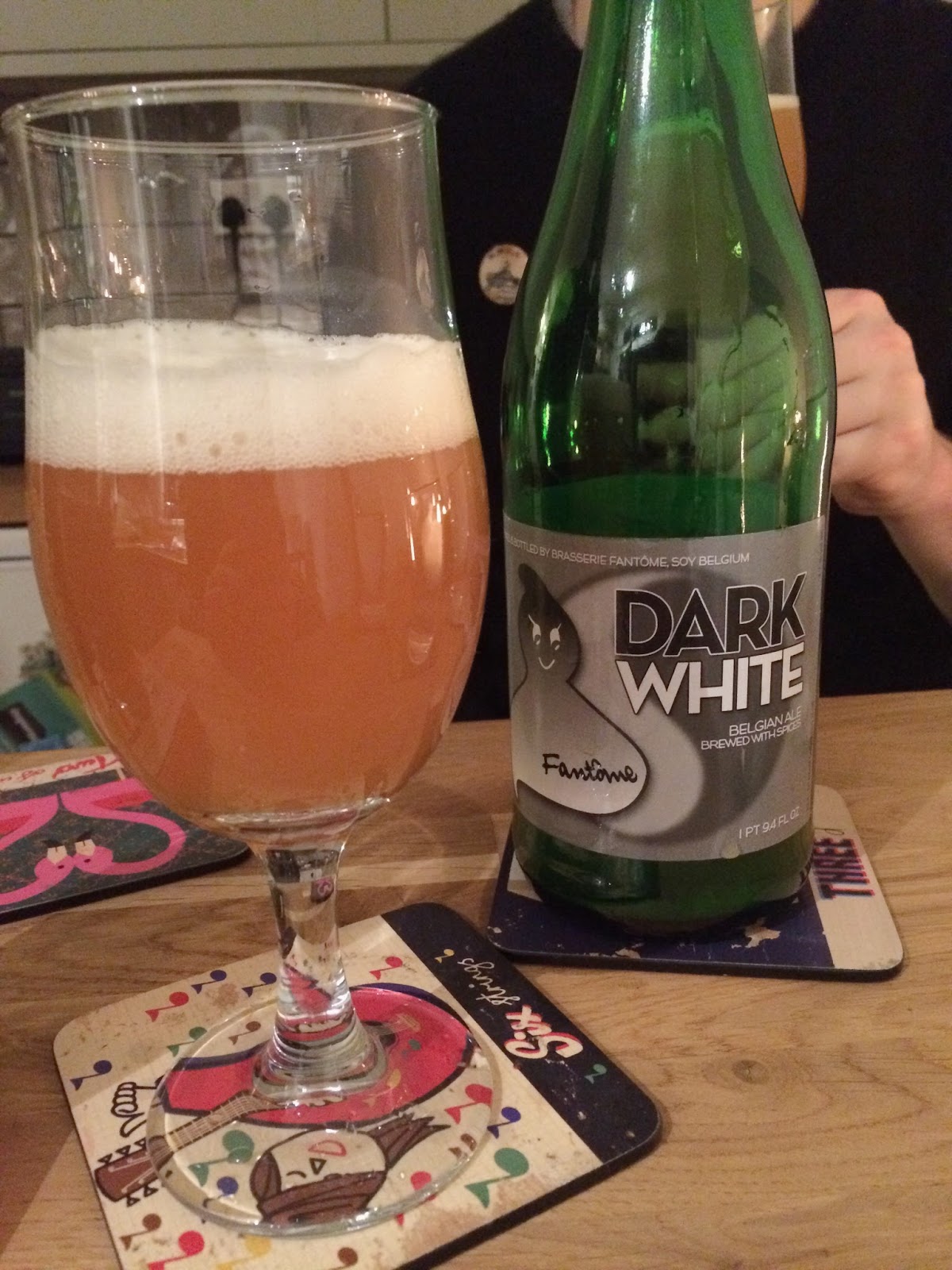
First up was one of my contributions, Dark White from Brasserie Fantôme. There's something appealingly mysterious about Fantôme - the bizarre, amateurish branding somehow draws me in, for one thing. There's the use of unusual ingredients - dandelions, for example, or a green tea which produces a beer that looks like a mad scientist's potion. The brewery's reputation is intriguingly patchy, too - Fantôme have their fanatic followers, but even these seem happy to use adjectives like "rough" and "dirty" to describe the beers. Those who are less keen seem to suggest that brewer Dany Prignon carelessly throws together his recipes with little thought as to what works and what doesn't.

Personally, this is my first taste of Fantôme - billed as a saison with spices, it appears to be brewed with black pepper. It pours a murky orange, possibly as a result of spending time in a suitcase as my Dad and brother brought it home from Brussels for me - it's had plenty of time to settle since, and there were no noticeable pieces of sediment floating around, but few pictures online look anything like as soupy as mine. The substantial white head is lively and fluffy and it has a strong nose of boiled orange sweets and farmyard funk. There are more oranges in the taste, along with oregano and pepper. The addition of pepper is deftly judged - it could easily be overdone, but rather than washing out the other flavours, it accentuates that classic saison dryness, combining with a lingering, zesty fruitiness in a quenching, bitter finish. Carbonation is surprisingly low here - I often think of brisk carbonation as a key feature in a saison, but this is a defining example of the style even without the bracing fizz. It's beautiful, and I'll be seeking out more Fantôme on the strength of Dark White.

Next was Samuel Smith's Yorkshire Stingo, a strong ale aged in oak casks that, if anything, seems to drink beyond it's 8% ABV. It's almost still, and we're not able to produce much of a head on our glasses, both factors contributing to the spirit-like nature of the beer - it does, at times, feel like something that should be sipped in small measures from a chunky tumbler. There's lots of treacle and toffee going on, along with raisins, some faint vanilla and an oaky depth from the barrel. Though it isn't as viscous or sticky as beers like this can be, the booziness is a little overwhelming - although bottle conditioned for a year before release, I'd be interested to see if another couple of years might pull it together.


Partizan Huff followed. A mysterious beer in that the label gives no indication as to style or any other information beyond the eye-popping 14% ABV. It is, in fact, a recreation of a particular ale brewed at Winchester College, which you can read more about here. Although a government laboratory analysed the beer, giving Partizan some guidelines as to what they hoped to achieve, I doubt the historical huff would have tasted much like this. Amongst others, a saison yeast has been used to simulate the original beer's dryness. The resulting character is strongly Belgian, not unlike the Fantôme saison, or leaning towards a strong tripel. The stated aim to highlight hop aroma whilst keeping bitterness low is certainly achieved, and there's an earthy hop background complimenting the flavours of candied orange peel and candy floss. Tasty as it is, it's a little hot, and would probably be more enjoyable at about half its strength.

I also had a chance to taste Beavertown and Evil Twin's XXX, an 'imperial mild' which I recently included in a round-up of bottled milds. Having written fairly exhaustively about it there, I won't repeat myself, but the beer's character has changed in the month or so since I tried it - the zesty grapefruit flavours from the hops have died down a lot, and we're firmly in barley wine territory now. It's still enjoyable, but I preferred it first time round.

Whilst the others shared a Kernel export porter and something from Innis and Gunn which was apparently reduced to pennies in a supermarket, I switched to water and concentrated on banishing an attack of hiccups. Another successful bottle share - though I'll be eating a more substantial meal before we start next time.

Thursday, 7 January 2016

Going mild

Perhaps unconsciously inspired by Boak and Bailey’s recent bottled mild taste-off, I seem to have amassed a small collection of these myself. Mild has always been a curiosity to me, fuelled by the fact that it’s rarely seen at all in this part of the country. Bottled mild also seems to be uncommon – as I learnt recently, this probably dates back to the time when breweries primed their mild for bottling and labelled it brown ale – though brown ale was not necessarily always the same as mild, bottled mild was nevertheless rare. And anyway, mild in its modern form (low ABV and easy drinking) is strongly associated with sessions in the pub rather than supping on the sofa. That’s not to say it doesn't work in bottled form, as proven by the following thoughts on four beers, none of which were less than decent.


In 2012, Pretty Things brewed two milds in collaboration with Ron Pattinson. Both were based on archival Barclay Perkins recipes; the first, from 1838, was strong (7.4%) and highly hopped, whilst the post-Second World War beer demonstrates the effect of the war on brewing, having dropped to just 2.8% and using only a fifth of the hops of the previous incarnation. “This is mild as we know it today”, read Ron’s notes on the label, “a low-gravity, lightly hopped, dark beer.”

Having read about the beer on Ron’s blog, I was excited to find it for sale at Beers of Europe. I had assumed that a second batch had been brewed since then, and might not have taken the punt had I known the bottle was almost four years old. Mild – especially a low-alcohol one with light hopping – isn’t a style for the cellar, and I was a little worried about how it might have held up.

As it turns out, all was well. An initial musty flavour had me fearing the worst but, if I'm not mistaken, this is a characteristic of the hops. I found a similar flavour recently in a pint of Kent’s KGB bitter, an East Kent Goldings-heavy brew. It’s earthy, a little like tobacco with an edge of Shredded Wheat, and it’s not unpleasant. The pour isn't as dark as I expected – a dark amber rather than brown or black, with a fluffy with head. Golden syrup aromas burst from the glass, along with some marmalade. A thirsty first chug is dominated by that earthiness, accompanied by slightly sweet and nutty malty flavours which suggest toffee and marzipan, and the finish is dry and bitter with a slightly chalky, mineral aftertaste.

There’s a tingle of carbonation on the roof of the mouth, but too much – it remains soft and smooth, closer to a cask pint than your usual effervescent bottle, and if the body is a little thin, that smoothness more than makes up for it. I know poncing around with tasting notes, which isn't really appropriate for a mild from 1945 even if I think the beer is interesting enough to justify doing so. But, drinking this, it’s easy to see why modern milds were so popular – it’s tasty, but easy to drink and moreish with it.


Sadly I don’t have a bottle of Pretty Things’ 1838 mild to compare, but I do have this, a 9.5% monster based on an 1839 recipe from an unnamed London brewery. This may be pretty far removed from what we recognise as mild today, but the fact that this beer is billed as an ‘imperial mild’ still raises a smile. Even if we accept the word ‘imperial’ as simply a synonym for ‘strong’, doesn't using an archival recipe suggest that this is just what mild was like at that time? Perhaps with two hip breweries involved, they felt they needed to give the beer a craft makeover.

The pour is a slightly hazy burnt orange, and spicy citrus fruit (more marmalade) and Cointreau aromas rise from the glass. Take a sip and the beer seems to slip around in your mouth, the alcohol revealing itself in a slick, viscous mouthfeel, and orange peel spiciness fizzes on the tongue. There are zesty, bitter grapefruit flavours too which suggest vigorous hopping, alongside savoury bread-like malt notes before a hot, boozy finish that recalls desert wine.

The alcohol is a little harsh for my tastes, and whilst I understand that milds aren't necessarily mild in strength, it’s a bit odd to place a beer that tastes like Fuller’s Golden Pride in amongst beers a third of its ABV. I enjoyed it well enough, but I think its best approached as a curiosity.

On an unrelated note, when I saw that gypsy brewer Evil Twin had collaborated with Beavertown, I assumed the beer was brewed at the London brewery. According to the bottle, though, it was brewed at Westbrook “for Evil Twin”. And, since the recipe wasn't original, I can’t help but wonder what either of the breweries who put their name on this beer actually did towards making it.


I think of mild as primarily a dark beer, though it needn't necessarily be so, and so Thwaites Champion is much more what I expect from a mild than either of the previous beers. It pours a deep brown with deep red edges and beautiful, creamy off-white head which lasts throughout the glass. There’s very little on the nose save for a slightly unpleasant metallic note (I’m not drinking straight from the can, before you ask). Some berry sweetness makes itself apparent immediately, followed by malty caramel. There are some slightly vegetal hops in there, too, and a dry, quenching finish. The body is thin as you’d expect at 3.2% ABV, but that doesn't slip away in an unsatisfying away, instead demanding another thirsty glug. It’s not really a beer to think too hard about, designed as it is to be unchallenging but flavoursome, and it’s doing a good job in that respect. Probably tastes best on the fourth pint.


Another dark-ish offering here, with a little red-brown hue. As I poured it into the glass, an intense fruit ‘n’ nut aroma wafted towards me, recalling Chimay Bleue. As I poked my nose in proper, all I got was caramel, and lots of it. Stout-like roast malt flavour jumps out on the first sip, suggesting liquorice or very dark roasted coffee. Again, there’s some dank, slightly vegetal hops which, even if it doesn’t sound it, is pleasant and adds depth of flavour, and the finish is dry and hugely burnt-tasting and bitter. It’s basically a variation on a stout – an astringent, roasty stout rather than a smooth chocolatey stout, and you certainly can’t accuse the brewery of failing to pack sufficient flavour into a low ABV beer. Given the choice, I’d take the subtlety of Thwaites’ version over this, which is maybe a bit too much of a bitter smack in the mouth to be really sessionable.

Thursday, 7 May 2015

Smog Rocket baked beans


Though I reserve a special kind of disgust for the luminous-orange tinned monstrosity that is commonly sold under the name ‘baked beans’, the rich, tangy, home-made, cowboy-style version of the dish is one of my favourite things to eat. Piled on top of some thick toast with some strong cheddar grated on top, these beans are a perfect winter warmer. Stir in some smoked paprika and cumin and they make a great filling for a Tex Mex-style burrito, too. And whilst the worst of winter might be behind us now, as the weather warms up, I'm still craving those beans. In the US, Boston beans are often served as a side dish to BBQ food; there’s a similar depth of flavour and sweet and sour tang. As the smell of smoke in the air begins to signify summer barbecues rather than winter bonfires, I find myself thinking up ways to replicate the smokiness from the open fire in the dish. The answer is, obviously, beer.

Mark Dredge has made a version of this dish using Schlenkerla Marzen, which looks great.  Whilst acknowledging his idea, I want to use my own recipe for the beans, which is based on various different versions I've tweaked and compiled over the years. When it comes to the beer, I want something dark and rich, smoked but subtle with it. A porter should work with the treacle in the dish, so I'm opting for Beavertown’s Smog Rocket. This beer was originally conceived as a match for BBQ ribs, so it should be especially appropriate. Mark notes that even with a full on rauchbier, he didn't end up tasting much smoke in his beans, so I'm going to use smoked garlic in place of regular garlic, and season with smoked salt, too. I'm reducing the amount of treacle in the recipe, as the beer should add a similar depth of flavour, and whereas I’d normally add some vegetable stock, I'm getting rid of it here to account for the beer.

How does it taste? Beautiful. The smoke is there, just a hint in the background, and would complement barbecued food perfectly – I’ll be making this as a side dish for my back garden BBQs this summer – but the beer’s principal value here is adding richness and deep, moreish flavour.


Ingredients
  • 2 cans of borlotti beans, drained (the classic tinned version of baked beans are haricot, but you could use almost any variety. I particularly like borlotti beans and most recipes suggest them)
  • 1 tsp smoked garlic powder (you can used fresh smoked garlic, but I've found the powder to be more pungently smoky. I buy it in a resealable packet from the specialist ingredient section of Sainsbury’s)
  • 1 onion, chopped
  • 150ml Beavertown Smog Rocket smoked porter
  • 200ml passata
  • 1 tsp black treacle/molasses
  • 2 tbsp tomato puree
  • 1 tbsp soft dark brown sugar
  • 1 tbsp Dijon mustard
  • 1 tbsp red wine vinegar
1. Preheat the oven to about 160°.
      2. Find a pan which has a lid and is suitable for both the stovetop and the oven – a cast-iron casserole or similar is ideal. Fry the onion until soft and golden, then add the garlic powder and fry off for another minute or so.
      3. Keep the beans to one side, and combine all of the other ingredients in the pan to make a sauce. Once combined, add the beans and bring to a boil.
      4.  Once the dish has come to the boil, turn off the hob, place the lid on the pan and put it into the oven. Bake for about 90 minutes, stirring every now and again. Be sure to scrape the stodgy, caramelised, crusty bits from the edge of the pan and stir them back into the sauce, as they’re full of flavour.
      5.  After 90 minutes, remove the lid and check the consistency. By now it should have thickened, with little excess liquid floating to the top. Once you reach this point, remove the lid and return the pan to the oven to reduce further. It may not sound appetising, but this dish tastes best when it’s gloopy, so put it back, uncovered, in the oven until it is a shade of reddish brown, thick and looking almost crusty on the surface. Remove from the heat and stir before serving.