
Showing posts with label seville. Show all posts

Tuesday, 7 April 2015

Spanish beer haul pt.2; Lupulópolis


The following beers were purchased at Lupulópolis in Seville.

A very lively pour from this bottle, with deep black beer foaming insistently into the glass and settling into a thick, lasting beige head. The aroma is richly savoury, an intense nose full of toasted malt, and the first sip is satisfyingly full bodied with a beautiful viscous mouthfeel. The trio of US hops (Amarillo, Simcoe and Cascade) bring bitterness, but not a huge amount of juicy fruit flavour, which is fine by me as they never threaten to step on that malt backbone. There’s a slight tonic-like tang in the finish, which only encourages you to go back for more, and the beer’s 8.5% ABV reveals itself in a lasting boozy warmth. It’s subtle for a black IPA, but it’s a well-made beer all the same.

A mid-strength porter although, amusingly, it says 4.8% on the front label and 5.6% on the back. The aroma is weak, with a hint of the tart, malt vinegar tang I associate with Harvey’s beers, and which is never inviting even if the beer is good once you taste it. Yunque has some very unusual flavours going on; I don’t get the usual treacle or coffee, with the roasted malt flavour taking a bit of a back seat whilst hazelnuts and big vanilla dominate. It tastes good, but I’ve never had a porter quite like it, and it’s not really what I’m looking for from the style.

Cárdenas Stout (Dos Hermanas)
This is the most local of all the bottled beers I picked up in Seville, brewed in Dos Hermanas just 15km outside the city. It’s an inauspicious start, as unfortunately there’s a lot of floating sediment in the glass, though the bottle has remained upright and I poured slowly. Even worse, the aroma is positively pungent, and not in a pleasant way. I don’t mean to be harsh, but it really does smell like a well-used chemical toilet, with a note of toothpaste in the background. I almost don’t want to taste it, though it’s not terrible when I do – just very, very strange. The roasted malt flavours are in the background, and the most prominent flavour is mint. As with the Kettal porter, it’s not that it tastes awful, it just isn’t anything like a stout should be. Compared to some of the other Spanish beers I’ve tried alongside it, this is, sadly pretty unaccomplished brewing.


I don’t mind admitting that I selected this beer from the fridge based mainly on the wacky label and the fact that I love guinea pigs. Words cannot describe the joy this label brings me; I want a print of it on my wall, I want it on a T-shirt. Anyway,  Guinea Pigs! is based in Madrid, but works as a contract brewer, and Hopvana was brewed at Domus in Toledo. Whilst it’s a broadly American-style IPA, some interesting and creative decisions have been made here; for example, the hop bill mixes German Herkules and Saphir with Australian Summer, with Cascade being the only US hop included. The beer’s unusually dark colour can be attributed to the inclusion of chocolate malt alongside pale ale and crystal. The resulting flavour is both familiar and surprising at the same time; mango and sweet oranges, pink grapefruit and candy floss, balanced by a solid malt profile. I may have chosen it for dubious reasons, but Hopvana was nevertheless a fine choice!

Guineu/BrauKunstKeller Collabrew Double IPA (Barcelona/Michelstadt, Germany)
Guineu is the only Spanish microbrewery I’d heard of before this trip, and this double IPA is a collaboration with BraunKunstKeller, a German craft brewery. Whilst there are obviously exceptions, the thought of double IPAs sometimes makes me wince, because they’re just too much for me; too bitter, too strong, too demanding. This is not the case here, as the juicy fruit flavour is prominent, but without lip-puckering bitterness, and with a solid malt framework, too. The hops are a mixture of European varieties – Mandarina Bavaria and Hull Melon from Germany – in the kettle, and US – Mosaic and Citra – for dry hopping. It’s full of mango, papaya and pineapple, but built on a  foundation of crisp malt which I’d like to imagine is the German influence. It’s excellent.


Not knowing any of the breweries on offer, I had to make my selections in the bottle shop on very limited data. So I figured, go for the beer with the personified cartoon hop on the label, and you can expect something really hoppy, right? Well, kind of. Take a sip and wait for that lupulin hit, and you’ll be disappointed, because the bitterness in this beer is surprisingly low. Nevertheless, it’s very flavoursome and fruity, with lots of juicy papaya and ripe white grapes. It hides its 9% strength very well, with light carbonation and a modest body that demands another gulp. It’s not at all what I expected, and I can imagine some people being really disappointed by it (the handful of reviews it has on Ratebeer are lukewarm at best, for example) but I loved it.


***
It would be arrogant of me to make any broad claims to know Spanish craft beer based on the beers I've tasted in these posts; the generously stacked shelves in Lupulópolis are testament to the fact that I've barely scratched the surface of a rapidly growing scene. This is all the more remarkable when you consider that Spain, as far as I'm aware, doesn't have much of an indigenous beer tradition.The best beers I sampled are good enough to compete with the best beers coming out of the UK and the rest of Europe, and the ones that weren't so good are hopefully examples from brewers still on a learning curve. I'll happily take a light lager in an ice-encrusted glass from time to time, but on future holidays in Spain, it's great to know that proper beer is out there waiting to be discovered.

Thursday, 2 April 2015

Spanish beer haul pt.1 ; El Court Inglés


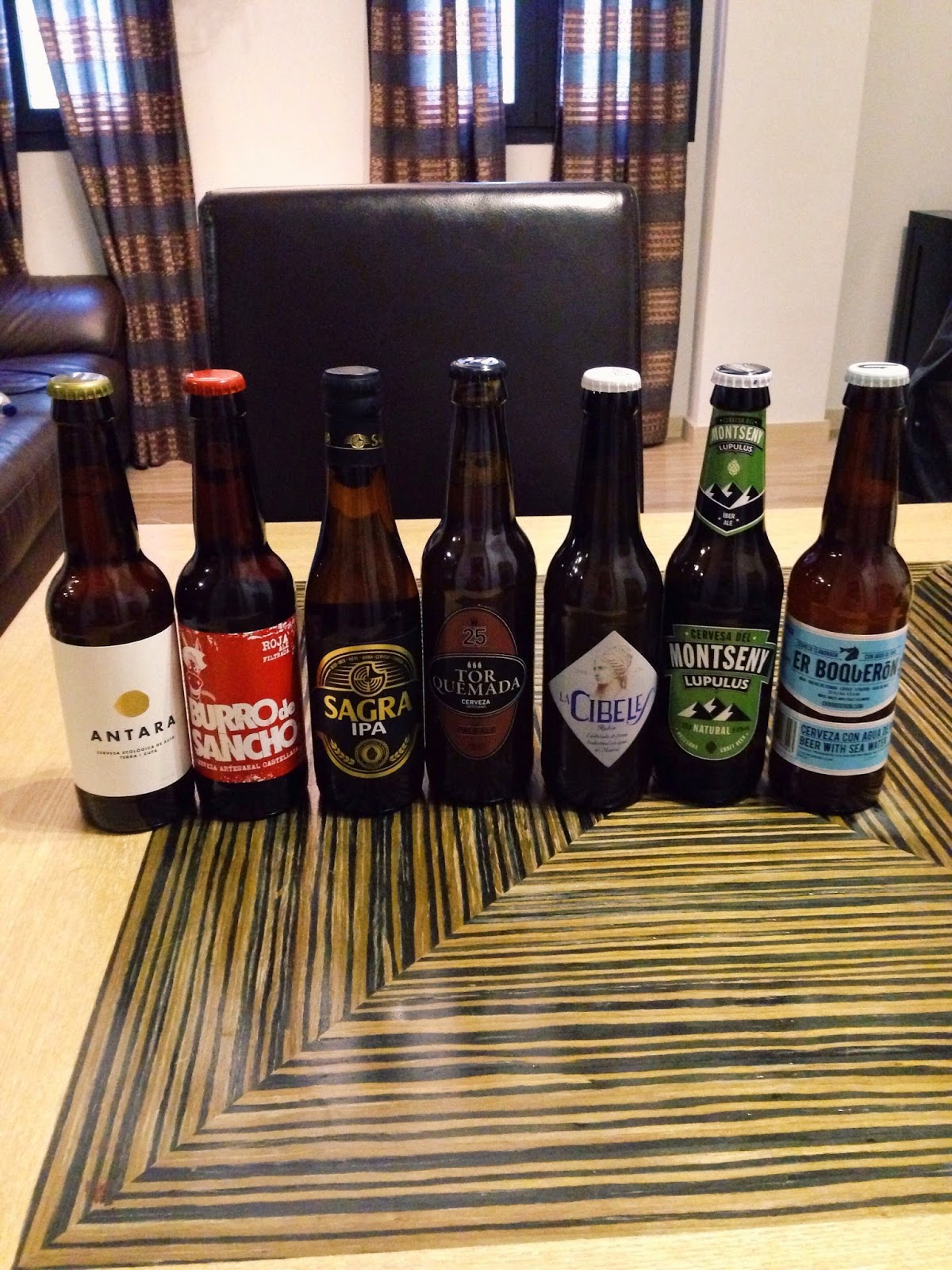
The Spanish department store, El Corte Inglés, stocks a small range of craft beer. The beers featured here are a selection from across the country, and were purchased from the store in the centre of Seville.

Cervesa del Montseny Luplus (Sant Miquel de Balenya, Valencia)
Though brewed with pilsner malt and possessing all of the defining features of a lager, Lupulus is actually top fermented. The motivation is, apparently, a reconnection with the brewing traditions of the Iberians of the Bronze and Neolithic ages. I wouldn’t know much about that, but the beer is surprisingly modern in style, with a flavour profile reminiscent of Camden Pils; clean, crisp and refreshing like a pilsner, but packed with fruity hop flavour. The complex hop bill includes Cascade, Fuggles, Nugget, Styrian Celeia and Target, though the US varieties dominate with juicy mango and mandarin flavours. I’m always partial to beers that combine the refreshment and citrus bite of a pilsner with the moreish complexity of hoppy pale ales, and found this one particularly enjoyable. Accomplished, inventive brewing, and an auspicious start to my exploration of Spanish craft beer.

Though I suspected a gimmick, I couldn’t help but satisfy my curiosity for a beer brewed with sea water. It’s unfiltered and unpasteurised, but even by these standards, the pour is very murky, and the yeast aroma incredibly pungent. I’m expecting it to be undrinkable based on the smell, but it’s a pleasant surprise, full of smooth, subtle yeast flavours reminiscent of wit beer, with notes of pressed apple juice, pineapple and raspberry, and satisfyingly full-bodied. Though you can’t help but search for it, no salt is detectable, though a certain aftertaste does leave you feeling like you’ve recently returned from a walk on the beach. I ended up really enjoying this, despite having bought it principally for the weirdness.

Sagra IPA (Toledo)
Yes, that’s Sagra, not Sagres – there’s no connection to the ubiquitous Portugese lager, despite branding so incredibly similar that I’m not sure how they’re getting away with it. This is the only Spanish IPA on offer on the El Corte Inglés shelves, and I’m immediately sceptical when I get a nose of the beer; it’s dominated by malt, mostly cereals, with no discernible hop aroma. There is a hop presence in the taste, but the overall flavour is cloyingly sweet malt. The bitterness is there in the finish, but the taste of the hops lacks a punch. It’s reminiscent of an English IPA – say, Bengal Lancer – but, although it’s far less robust in flavour, the ABV is 7.2%, which adds nothing but sickly booziness and ruins the beer.

A pale ale, which pours a hazy blonde with an appealing rocky white head. The taste is immediately quite underwhelming, if actually quite pleasant in its subtlety and easy drinking. There’s a little toffee with a strong mineral tang and, weirdly, the closest comparison I can make is the non-alcoholic version of Erdinger. The brewery’s website tells me they use Cascade hops here, but very little hop profile is apparent in my bottle. It’s fine, but not full of character.

Antara (Foios/Venta del Moro)
Antara appears to be the creation of a Valencian organic food company, Terra I Xufa, based in Foios, and is brewed at Fernández Ponz in Venta del Moro. It’s by far the best presented beer of the selection, with a minimal white and gold label that reminds me of Wiper and True’s classy branding. This only makes the strange mess of a beer inside the bottle all the more surprising. It pours an unappealing golden brown, like the colour of apple left out too long and oxidised. The aroma is floral, with perfume and strawberries. A chalky mineral flavour leads to an intense and unpleasant bitterness; it’s not a hoppy bitterness, though – it’s more medicinal, like an alka seltzer. Once this fades, the remaining flavour is a little ‘off’ – ‘barnyard’ might be the kindest way to describe it, but it tastes more dirty to me, especially with the smoky finish that’s closer to cigarette ash than it is to rauchbier. This is one to avoid.

Tor Quemada 25 (Palencia)
This beer is billed as a pale ale, and so I was a little alarmed to discover that it was bottled around a year ago, as the hop flavours I’m hoping for will have lost most of their punch in the meantime. Thankfully, this stretch in the bottle seems to have only improved the beer’s character, as, whilst it is technically and ale which is pale, it’s closer to a Belgian golden ale. Though it doesn’t quite reach the same heights, 25’s closest relative is Orval (small complaint as Orval is one of the best beers in the world), though the lactic tang here is sharper. It pours a dirty blonde colour with a big, lively, fluffy head. The aroma is sour apples counteracted by sweet pear drops, and the first sip is full of those tart apples amongst a bold yeast presence. The finish is very dry and moreish, accentuated further by brisk carbonation. It’s absolutely not to style, but it’s a very good beer nevertheless.


The Burro de Sancho range immediately caught my eye, as their labels quite flagrantly rip off Brewdog’s style prior to their recent rebrand. Closer inspection reveals that Burro de Sancho is a subsidiary of the Sagra brewery who, evidently, have previous in their blatant “inspiration” from other breweries’ branding. This is the first filtered beer of the bunch, and pours a clear amber with a quickly receding head. The initial aroma is a quite frightening combination of bitter chocolate and tomato. A little bitter chocolate flavour is apparent, too, along with some toast. There’s a spicy, very savoury quality here, and what little hop flavour is detectable tastes stewed. I find this is not uncommon amongst red ales, but I don’t find it very pleasant, and can’t recommend this beer overall.


The beers I bought from Lupulópolis, a more exciting place to buy beer in Seville, will follow in another post soon.

Saturday, 28 March 2015

Cerveza artesanal en Sevilla


Before my trip to Bamberg in January, I hadn’t ever travelled specifically for beer. A holiday is a holiday, and if there’s a chance to drink good beer whilst I’m abroad, I will. Often, there isn’t, and that’s fine; the popular idea that beer should be cold and refreshing and not much else might be severely limiting, but it isn’t totally misguided, and if you approach it in this manner, even a bland European lager can be very satisfying in the afternoon sun. I’ve had perfectly enjoyable holiday romances with strange beers, such as the ‘stouts’ (actually dark lagers) by Sagres and Super Bock in Portugal and the odd malty-chocolate-milkshake-tasting Pelforth Brun in France. Sometimes it’s fun to lower your expectations a little and make the most of these less-than-distinguished beers.

When my mum, my brother and I booked a trip to Seville, I did a little research to scope out the beer situation in the city. I knew that there was good beer in Spain, but didn’t know how easy it would be to find. A quick Google search suggested that craft beer was still relatively new to the region, but there were places to find it, and I happily noted down the one or two locations suggested.

Cruzcampo (brewed by Heineken), dominates Seville, their mock-Bavarian logo jutting out from the countless bars and cafes that line the streets. I had a couple of glasses, and there are certainly worse macro lagers. It does the job, which is to be cold and thirst-quenching – incredibly, teeth-chatteringly cold and once, without exaggeration, with a layer of ice floating in the glass. The most you’ll pay for a bottle is €1, so the price is right in a country with a severely unhealthy economy. But the city is also covered in adverts for Cruzcampo Gran Reserva, a tastefully presented 6.4% lager, which suggests that even the largest Spanish brands are starting to recognise a growing market of drinkers who demand more character from their beer.

Search for Seville under the ‘places’ section of Ratebeer.com, and the only recommended location is El Corte Inglés, a large department store with a branch in most Spanish cities. It happens to be very near our apartment, so we stop by to stock up on food and check out their beer section while we’re there. Alongside German, Belgian and British imports, the vast isle carries a small selection of offerings from Spanish microbreweries. Those that we tried will be featured in a separate blog post to follow. As I’ll mention later, there are better places to buy beer in the city, but if you’re nearby, it’s worth a stop.


Our first craft beer location proper is Taifa, a microbrewery housed in a stall in an indoor market on the other side of the river from the city centre, nestled amongst fruit and veg sellers, fishmongers and small cafes. They’ve been brewing here since 2012, and it remains a modest set-up, with three very small fermentation tanks and currently two Taifa beers available only in bottles. We start with the pilsner, which is solid, easy drinking, clean and crisp tasting. There’s a spicy, zesty flavour from the addition of peel from Seville oranges, the same variety used for marmalade in the UK. This is an excellent twist, adding a unique character to the beer without deviating from the essential qualities of the style, and taking inspiration from local flavours at the same time. The second, a pale ale, is similarly sessionable, with a respectable hop bitterness, but lacking a real punch. I prefer my pale ales a little more robust, but it’s still really enjoyable. Especially in the summer months, I can imagine a retreat to the cool, shady market for a couple of these bottles is a perfect way to get refreshed without sacrificing on flavour.


These were the only two locations gleaned from my Google searches but, in the apartment one afternoon whilst double checking the address for Taifa, a blog jumps to the top of the search results that, for some reason, hadn’t been there before. Whilst some sites refer to Taifa as the only brewery inside the city, this one directs me to Maquila, a brewpub that opened in December 2014, as well as a promising-looking bottle shop. When I can find opening times at all, information varies from source to source, so we head out for dinner nearby and hope that the bar will be open after we’ve eaten. We’re probably too early by Spanish standards, and it isn’t.


Undeterred, we decided to stock up at Lupulópolis, a bottle shop/bar, and take our findings back to the apartment. This is an amazing destination if you’re looking for a broad range of Spanish craft beer; though they supposedly do stock imports, I didn’t see any, and the shelves are lined with countless intriguing domestic bottles. There is also one draft beer available, and a well-stocked fridge, so you can hang out, drink your beers and listen to records in the comfy shop. Our Lupulópolis haul will also receive its own dedicated post at a later date.
The next night, we’re determined to make it to Maquila, the quality of many of the beers we’d sampled from Lupulópolis only increasing our thirst. Leaving for dinner a little later in the evening this time, we happily arrive after our food to find the bar very much open, and buzzing with atmosphere. Large fermentation tanks are visible through glass behind the small kitchen (which, incidentally, produces reportedly fantastic food). The bar itself is sparse in the East London hipster fashion, but with a great, friendly atmosphere and some actual character, something I often find lacking in achingly hip concrete-and-stainless-steel bars that look like they’re still being built.
The house brand is Son, and their immaculate American pale ale really hits the spot, tasting something like Dark Star’s might if it was on keg. There are also two beers from Valencian brewery Montseny – theirs was the best of the bottles we tried from El Corte Inglés, so we try both. The IPA is bizarre at first; so full of cloyingly sweet peach flavour that it actually tastes like someone’s poured squash into the beer. A couple of sips later and this sweetness fades into a beautifully balanced, smooth IPA. As a nightcap, we opt for their monster imperial stout, which is incredibly rich, creamy and boozy, a desert of a beer. If some of the Spanish offerings we’d sampled gave me the impression that the Spanish beer scene is a little behind where we are in the UK right now, Maquila makes me think that that distance is rapidly reducing.
As I said at the start of this post, I didn’t travel to Seville for the beer, and neither should you. You should go because it’s a stunningly beautiful city, rich in history. But whilst you’re there, look beyond the Cruzcampo. 

Many thanks to Becoming Sevillana for tipping me off to Maquila and Lupulópolis, which I doubt I'd have stumbled upon otherwise. Information on further craft beer destinations I didn't make it to can be found there.

El Corte Inglés -  Plaza del Duque de la Victoria 8
TaifaMercado de Triana, stall 36
Lupulópolis - Calle José Gestoso 12
Maquila - Calle Delgado 4