Showing posts with label Newcastle brown ale. Show all posts

Thursday, 14 January 2016

Brown ale: some final observations


Since starting this blog, I've rattled on about brown ale a fair amount. I feel I've done the subject to death, but I've also spent so much time obsessing over it that I still have things to say. Despite the stylistic diversity of brown ale, there are noticeable trends within the style. As the final word on brown ale for this blog, I propose a series of sub-categories. Bear in mind I'm not taking myself totally seriously in this – brown ale is obscure enough as it is without being chopped up into micro-styles. It’s just a way of presenting the continuities across the various examples of the style I've tasted in the past year or so.

I still try any new brown ale I see. If a local pub tweets that they’re serving one, or a brewery announces they’re making one, I’ll be making mental calculations as to how I can get to try it. It’s a uniquely fascinating style precisely because nobody seems to agree on exactly what it is. 
***
Your average beginners guide to beer styles tends to split brown ale into two categories – the sweet, low-gravity ales of the South of England, and the stronger, dry brown ales of the North. The truth is more complex; from the re-emergence of the style in the 1920s onwards, the beers were diverse and did not observe this imaginary north/south divide.

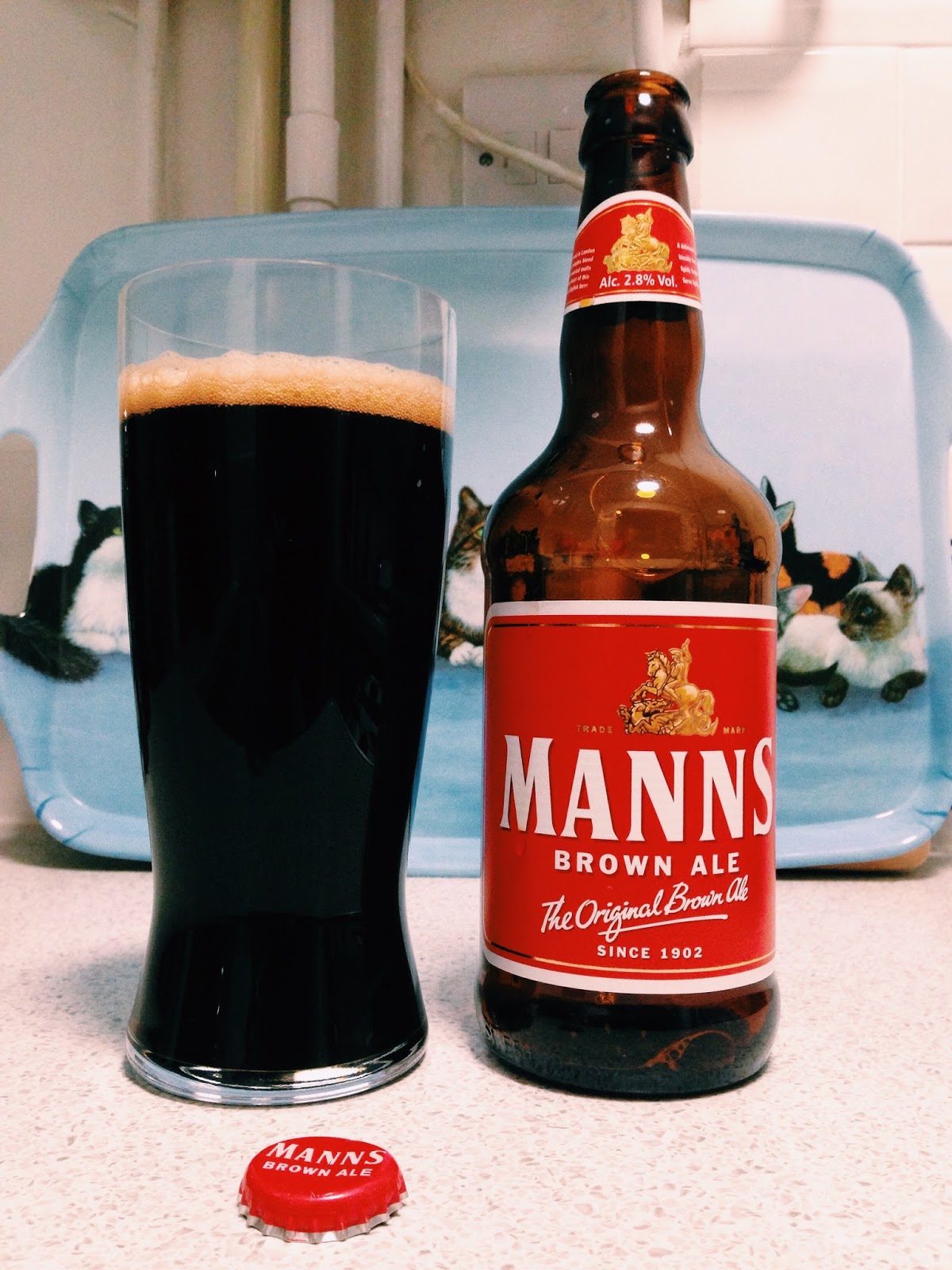
As brown ale stands today, archetypal examples of both the sweet/mild and strong-ish/dry versions remain. Mann’s Brown Ale, despite originating as one of the strongest examples of the style, now sits at 2.8% ABV and tastes largely of cola, treacle and toffee. Harvey’s Bloomsbury Brown, also at 2.8% has a strong caramel flavour, and may well be a relic of the days in which brown ale got its colour from caramel. I've never encountered any further examples of the low-gravity version of brown ale, and it’s easy to see why they fell out of favour – they’re interesting as a curiosity, but are bland and not very beery.

Newcastle Brown Ale remains the most commonly cited example of the stronger version. These beers are often dry and often described as ‘nutty’, although I've always thought this this is the power of suggestion at play – the phrase ‘nut brown ale’ is sometimes used to refer to the colour, but I've rarely detected a nutty taste. Newky Brown isn't a good beer, and it’s a shame it’s the only example of the style you’re likely to find in mainstream outlets. Far better is Samuel Smith’s Nut Brown Ale, which has a very dry quality that even veers towards red wine, and a deep, savoury malty body. (Edit; see here for some further interesting background on Newcastle Brown Ale from Martyn Cornell - "not, in any meaningful sense, a brown ale.")

Modern craft breweries have reinterpreted brown ale in several ways. The first sub-group pays homage to the traditional English brown ale, whilst not belonging to either the Mann’s or Newcastle camps. These beers are defined by a soft, comforting malt profile, which might include hints of caramel or toffee, milk chocolate, blackcurrants or blackberries or cola. A little roasted malt may creep in, but this will be more restrained than a porter or stout, and the beers are of a medium body. New-world hops might add a bitter, citrus finish but this will be subtle. Good examples I've tasted recently include Dirty Kitty by Denmark’s Beer Here and Maduro from Cigar City. Port Brewing’s Board Meeting deserves a mention for using these qualities as a foundation for a massive hit of coffee and rich chocolate – it’s terrific.

The ‘American brown ale’ style will take these characteristics and significantly amp up the hops, but not in a way that overpowers the malt backbone. Dark Star’s Rockhead is the best example of this I've tasted, and Fourpure's Beartooth is excellent, too.


Some beers call themselves ‘India brown ale’. What you’re getting here is obvious – a big hit of hops. This is generally my least favourite incarnation, though some are better than others, mainly because the brown ale base is wiped out and you end up with something closer to a black IPA. I would place BrewDog's recent “hopped-up brown ale” prototype in this category – I thought this was a poor beer all round, and tasted of little except overly bitter hops that left a citrus washing-up liquid taste that lasted for ages. Others whose tastes I trust found a lot more to it, so maybe I had an off bottle or my taste buds had an off day - either way, I stand by the assessment that the hop profile dominates everything else. Weird Beard’s No More Bright Ideas, whilst it tastes great, offers little to the brown ale enthusiast – it’s a very dry beer, bursting with vibrant and zesty hop character, but this renders the malt base irrelevant.

There is also a small breed of what appear to be brown ales, but aren't. When I wrote about Brighton Bier’s Free State, billed as “21st century brown” here, I remarked that the nevertheless delicious beer had very little ‘brown’ quality. Brewer Gary Sillence got in touch with me to clarify his intentions - “My main ambition was the break down the mainstream perception that brown beer means dull or old fashioned”, he said, and the beer was never intended to be received as a brown ale as such – his alternative tagline was “brown beer for a new generation”.  Magic Rock’s The Stooge, though billed as an American Brown Ale, seems to be doing much the same thing. It’s a far lighter shade of brown than most examples of the style. You might call its shade 'chestnut' – closer to a bitter (that's it in the photo at the very top of the first, if you'd like to see for yourself). And it drinks like a bitter, too, albeit one hopped with assertive US varieties alongside earthy British staples – the luscious malt character has an easy-drinking crispness to it that doesn't belong to brown ale. Are we at a point when the agonisingly unglamorous name ‘brown ale’ is more fashionable than ‘bitter’?
***

I don’t know it just seems this way because I've been actively looking for them, but I'm sure I'm seeing more brown ales than ever recently. With talk of a hop shortage, are breweries falling back on malt-driven styles such as this? In any event, I promise not to drone on about it any longer.

Monday, 17 August 2015

Brown ale roundup

In my last brown ale round-up, I linked to a Beervana article about the use of caramel colouring in Newcastle Brown Ale. I may have misunderstood the situation - I thought the controversy was based on the use of an additive to obtain the beer's colour, but in fact it was based on health concerns around the colouring in question, 4-MEI. In any case, we hopefully all agree that artificial colourings used in the likes of Coke and Pepsi don't belong in beer.

Another thought-provoking development in the world of brown ale is this post from Ron Pattinson, in which he shares a recipe for Adnams XX mild from 1950. Here, Ron says that Adnams Nut Brown Ale would likely have used the same recipe, though primed differently for the bottle. This reminded me of a conversation I had with @WestBromEL after my initial brown ale posts. He'd always been told that brown ale was essentially bottled mild, and it is true that mild is rarely bottled. No beer books on my shelf mention any such link between mild and brown ale, but clearly there was such a relationship at one time. Anyway, here are some brown ales I've been drinking lately, starting with an old classic.


For months, I couldn't find Mann’s Brown Ale anywhere. I wanted to include it when I did my initial brown ale round-up in the early days of this blog, but nowhere near me stocked it. Eventually, I found myself in one of those enormous ASDA superstores when I clocked Mann’s bottles on the shelves, and became consumed with excitement which I knew, even at the time, would inevitably outstrip the quality of the beer. I was mainly just curious – Mann’s is often cited as an example of a now near-extinct breed of brown ale, a counterpart to the likes of Newky Brown. You’ll find little bitterness and no dry finish to Mann’s – it was reportedly considered close to a soft drink at one time, which I can understand. It’s not just the meagre 2.8% ABV, it’s also the sweetness and easy drinkability. It is refreshing and thirst quenching, but in much the same way water is, and not very much like beer is. It also tastes an awful lot like cola to me, with a finish that recalls sparkling mineral water, and hints of treacle and toffee flavour.  I can’t imagine anyone ever thinking “I think I’ll have a nice beer” and then enjoying drinking this.

Thornbridge Charlie Brown (peanut butter brown ale)
My hand has often hovered over Charlie Brown in bottle shops, but something always stopped me taking the plunge. It’s a brown ale with peanut butter and, whilst I love brown ale and love peanut butter, I somehow couldn't quite believe it could be as great as it sounds. Still, I eventually had to try it. Upon pouring, the peanut aroma is immediately evident – it doesn't really smell of peanut butter, but more like raw peanuts with the husk still on. I was expecting more peanut on the initial taste – this is more like a brown ale that heightens the peanut butter flavours that are usually to be found somewhere in beers of this style, rather than providing a massive peanut butter hit. That’s fine – I still want it to taste of beer, otherwise I’d just eat a peanut butter sandwich.  Trouble is, I'm not overly enamoured with the base beer – the body is too thin to work with the peanut butter richness, and there’s an unpleasant, slightly vinegary acidity in the background that also clashes. I was a little disappointed, but not because brown ale and peanut butter don’t go together – I just don’t think this is a great brown ale to begin with. 


North Laine Brewery Deadwood
This one is currently available in cask-conditioned form at Brighton's North Laine brewpub so, if you're interested, you should probably get over there and try it while you can. And it is definitely worth a try, even if my pint wasn't without flaws. The beer is aged in bourbon barrels (edit: it's actually aged on bourbon-soaked oak chips, not in a barrel), which in principle is an excellent idea - it's usually stouts that get this treatment but, since your average brown ale is a little lighter-bodied, you're less likely to end up with anything so thick and oily as certain barrel-aged stouts. The bourbon profile in Deadwood is expertly judged, never overpowering the beer - the whisky brings honey and vanilla, and the time in the wood brings a dry, red wine-like finish. The further down the glass you get, the less prominent the bourbon notes, and bitter chocolate and grassy hops come to to foreground. Unfortunately, my pint was let down by a lack of body - it lacked the smooth, substantial mouthfeel I'm looking for from cask ale, and felt thin and watery. I'm hoping to try it again while its around - perhaps my complaints are simply due to the inconsistency of the cask, and it is otherwise a very good beer.

So far I've mainly been interested in British-brewed brown ales but, since there aren't huge numbers of them, I'm going international with this time. I’d heard some good things about Norway’s Lervig, but unfortunately, their brown ale is a dud. There’s a little toffee, a little chocolate and, if you swill the beer around in your mouth desperately looking for it, a touch of hop bitterness. But overall, it’s watery and bland.

I was expecting a powerfully hopped American brown ale from this, but it’s actually a more nuanced beer. The recipe is inspired by brown ales from the brewery’s past which, in turn, shows a strong British influence – liquorice, treacle, caramel and fruit cake are all in there, bringing to mind something like Harvey’s Bloomsbury Brown if it were twice as strong. A more modern twist is the use of Citra hops, which didn't exist when Anchor was brewing these early beers. Initially, I couldn't get any of the hop flavour at all, but it comes out as the beer warms, with a subtle gooseberry tang. It may not have the hop hit I was expecting, but this is a great beer.

I have a big soft spot for Triple fff, as they are responsible for what I think was my first ever encounter with cask ale, many years ago. Whilst a little south of legal, I once entered an establishment in the brewery's home town of Alton, Hampshire and, in a bid to convince the barman I was surely of proper drinking age, asked for a beer recommendation. He suggested Moondance, their Best Bitter. I professed to love it at the time, though I wonder now how much I truly liked it and how much I was just pretending to be a grown up. I’d certainly love to try it again.

And, perhaps fittingly, Triple fff are the outfit behind what I think is my first taste of cask brown ale – all the others I’ve tried have been from kegs, bottles or cans. In fact, I think hoppy brown ales might work best from casks; I’ve always found well-hopped beers softer and more rounded in cask form compared to the spikier, punchy keg equivalents. Both versions have their merits, but the smoothed-out hops in this beer work nicely with the malt flavours – the balance is perfect. The malt brings caramel and toffee along with a big hit of wafer biscuits, with tangerines from the hops. It’s excellent.


The Kernel Brown Ale
The Kernel's interpretation of brown ale pours disappointingly black. I'm worried I'm in for a thin-bodied porter. But then, as I go for a sip, dark ruby colours slosh around in front of me - that's better. The nose is a big whack of cereals, and the first sip is full of roasty, toasted malt flavours. It actually is a little like a porter, though perhaps medium-bodied where a darker beer might be thicker. In fact, it's the perfect body for a brown ale according to my preferences. Some caramel and toffee inch the beer away from porter territory, and there's a citrus zing in the finish; although the label doesn't tell us which hops are included, I'd guess something American and beginning with C. This is delicately done, though - it's not an American brown ale, it's a modern British version which looks to the US for influence. I like it a lot.

***

I've also recently come across a couple of brown ales with the audacity to call themselves 'imperial'. They'll get their own post next week.


Tuesday, 6 January 2015

Brown ale pt. 2 : Three 'traditional' brown ales


Brown Ale #1 - Newcastle Brown Ale


It makes sense to start here, doesn't it? Newcastle is likely to be the principle point of reference in many people’s idea of what brown ale is. It is also the only brown ale I was able to find in any supermarket or mainstream off license in Brighton. And, aside from anything else, I haven’t tasted it in years. After deciding to include it in this post, I had to think about whether I knew I didn't like it, or simply suspected it wasn't very exciting. I know I've drunk it before, but I think my main motivation for doing so was to appear more interesting by choosing something other than lager; I didn't make any tasting notes, put it that way.  Still, I’m determined to give it a fair chance and reserve judgement before I objectively taste it.

The first thing you’re likely to notice about Newcastle Brown Ale is that it isn't especially brown. When I imagine this beer, I’m picturing something akin to the water in the River Tyne; murky, maybe even a little gloopy. In fact, there’s an attractive translucence about it, and indeed the brewery are said to have tinkered with the colour for some years in an attempt to make it more visually appealing. This might explain the clear glass bottle, too. I don’t think I’ve ever tasted a lightstruck beer, but nevertheless, clear glass is always a warning sign for indifferent brewing.

The nose is dominated by malt, and actually reminds me of lager more than anything. As the beer warms, the aroma gets a little grassier, maybe with a little hay, too, but there’s not much going on here. And the taste isn't exactly a revelation, either. It’s surprisingly sweet, and again, the most prevalent flavours are those you’d expect from a much lighter beer; lager-like malt dominates, with a slight lingering bitterness from the hops. If you try really hard, you might detect the slightest notes of stewed apples, ground almonds and hazelnuts. But that might just be wishful thinking. Imagine a drink that’s half Belgian dubbel and half tap water and you’re getting close.

Bland though it may be, this beer is at least refreshing, especially considering its usually consumed at temperatures far below those usually recommended for ale (mine spent about 45 minutes in the fridge before drinking, for what it’s worth). But my bottle is borderline flat, and the mouthfeel is thin and flimsy; it makes for easy drinking, but it’s fundamentally unsatisfying.


Would I drink it again? I might, if I happened to be stuck in a terrible pub where the only alternatives were awful mass-produced lagers. But I’d rather drink almost anything else. The bar is certainly set very low for the remaining brown ales in my selection.


And to follow, how could I resist Harveys' tongue-in-cheek “tribute”, featuring the eponymous castle on the label? My relationship with Harvey’s has been up and down; I've found some of their beers extremely disappointing and bland and some of them wonderful. I despised their Best Bitter for years until a revelatory few pints just before Christmas (in a student bar serving nothing but Best, Carlsberg and Guinness, of all places) confirmed that it is a terrific beer worthy of its reputation, and I suspect my disappointment with it in the past was due to poor conditioning in local pubs.

Harvey’s version of brown ale pours much darker than Newcastle’s. It is almost opaque, looking something like a porter or stout. The aroma shares characteristics with several of the brewery’s beers – perhaps it’s the house yeast I’m recognising here. It’s slightly vinous, or maybe closer to malt vinegar. The taste, thankfully, is more palatable than this would suggest, however, with black treacle, plums and some bread and cereal notes.  There’s a little sweetness, especially as the beer warms, with the slightest hint of chocolate. The mouthfeel is much more substantial than the Newcastle, thicker and with a pleasing tingle of carbonation on the tongue.

Given the choice, I’d probably opt for the more robust porter from the same brewery, but this is a very enjoyable beer, particularly well-suited to a wintery Sunday afternoon on the sofa.


If you’re looking for traditional examples of pretty much any indigenous British beer style, Samuel Smith’s beers tend to provide a good guide. Not every beer in their portfolio is great, but several are; Taddy Porter is a favourite, and I’m also very partial to their Imperial Stout, full of flavour at a very low ABV for the style. It makes sense that they’d brew a straight-up brown ale and, somehow making it sound even less exciting than it already does, they call it Nut Brown Ale.

It pours a caramel colour, far darker than Newcastle but nowhere near stout territory. The nose has more of that vinous quality I noted in the Harvey’s, mixed in with treacly malt and a little walnut. The flavour recalls wholemeal bread, and actually reminds me of biting into a nut; it’s very dry and bitter. If that doesn’t sound like a ringing endorsement, I’d also point out that it’s very refreshing. The lingering bitterness in the finish and aftertaste reminds me very much of red wine, and drinking this I even get a little of the warm feeling in the chest that I get whenever I stray from the grain over to the grape.

It’s not the most exciting beer in the world, but for sheer drinkability, I’d rate Sam Smith’s the highest of the three traditional brown ales I've tasted. The red wine comparison and absence of overly bold and intrusive flavours make me think that this could accompany a wide variety of foods, and indeed the label suggests pairing it with dishes as diverse as roast grouse and biryani.

To conclude… it’s difficult to take a great deal away from this mini-tour of traditional brown ales. Newcastle Brown Ale has very little in common with the other two beers I tasted, but that’s to be expected from a beer produced by a multinational corporation rather than a small regional brewery. There were some characteristics shared by both Harvey’s and Sam Smiths; that molasses-like malt flavour is present in a somewhat muted form in certain porters, but is a key feature of both of these brown ales. Could it be a defining feature of the style? Both beers have a certain moreish dryness, too. Beyond that, there’s not much going on to define what I mean what I say brown ale. I’d try more to get a broader cross section if I could, but further traditional examples are simply not available in my area (I had hoped to sample at least Mann’s, which I understand is sweeter, but it doesn't seem to make it down to Brighton.) For the ‘modern’ breweries I’ll be sampling next, the canvas is almost blank.

Monday, 5 January 2015

Brown Ale pt. 1


Brown is used in craft beer circles as a synonym for boring. Admittedly, people are usually talking about bitter (Boring Brown Bitter) when they use this slight, but there is a clear preference for beers that are either decidedly pale or decidedly dark. And let’s face it, the humble brown ale hardly screams “glamour”, does it? New Zealand’s 8-Wired brewery, whose Pacific-hopped Rewired is an excellent interpretation of the style, wonder, have the mass brewing companies driven the style into oblivion by claiming it for their most unattractive products?” They might have a point there – the rather undistinguished Newcastle Brown Ale is probably the prominent example for British readers.

Brown ale remains a bit of a blind spot for me. I feel as though I like the style based on some versions I’ve tried – Brew By Numbers’Willamette and Summit variety was memorable on keg, and a bottle of Brooklyn Brown Ale really impressed – but I almost never see it around. So I decided I should fill in some gaps and seek out some current examples of the style. I’ve tasted six beers, split into two very broad categories – ‘traditional’ and ‘modern’.

Now, allow me to acknowledge the flaws in my own plan before someone else does; some of these ‘modern’ examples use US hops, and may even be billed as American Brown Ale. This is a flaw in that it isn’t exactly fair to compare a beer spiked with US hops to an example using all British varieties, especially if I confess a preference for assertive New World hops. However, I think it’s valid in that it follows the evolution of the style – like so many other half-forgotten British beers, US craft brewers have made their own interpretations and this in turn influences the current wave of small British breweries. If I was doing a similar round up with IPAs, for example, I’d be tempted to include both Worthington White Shield and Punk IPA, because these two very different beers would give you a sense of the way the style travels and is constantly reimagined. So there.

Part 2, featuring three 'traditional' brown ales, will follow tomorrow.

(Incidentally, I hit upon this idea before discovering Boak and Bailey’s excellent porter taste-off, but you should definitely read that too.)