Showing posts with label thornbridge. Show all posts

Thursday, 29 December 2016

12 Beers of Christmas - Day Ten - Thornbridge Love Among the Ruins

Day Ten - Thornbridge Love Among the Ruins (UK, 7%)


As I've mentioned before on this blog, I regularly underestimate Thornbridge, and tend to mentally file everything they do as "solid but unexciting". This is vastly unfair, and beers like Love Among the Ruins demonstrate that their restraint and subtlety are actually their strongest attributes.

'Sour red ale' is the descriptor on the label, and whilst I can appreciate why they might hesitate to use the term, style-wise its closest relative is the Flanders red. There's a similar complexity and balance between sweet and sour flavours, wild yeasts and bacteria bringing acidity whilst residual malt sweetness and addition of cherries mellow this out beautifully. This recalls balsamic vinegar, and there's also a slight botanical or herbal edge which comes off like old fashioned cough sweets, and a touch of clementine in there, too. The wild elements contribute a hint of musty leather, but nothing especially funky, and the lengthy barrel ageing results in a very dry and tannic finish.

The brewery excel in lager styles, and there's a similar perfectionism and patience at play in this beer. It's a much-needed reminder to drink more Thornbridge in 2017.


Friday, 9 September 2016

Biére de garde : A brief survey


“Devotees have long regarded this style as a minor classic, and in recent years it has become more widely recognised, especially in Britain and the United States.”

Such was Michael Jackson’s introduction to biére de garde in his Beer Companion in 1993. If this resurgence in popularity really occurred, it’s hard to say how long it lasted. Some fourteen years later, K. Florian Kemp heralded a similar resurrection in an article for All About Beer. Today, though, biére de garde seems to be in a bit of a slump. Sure, your average post-Jackson beer nerd may be familiar with a couple of the classic examples, but you’ll see few contemporary takes on the style on Britain’s bars.

Biéres de garde are often grouped with saisons under the banner of ‘farmhouse ales’. Farmhouse brewing traditions extend way beyond France and Belgium — as Lars Garshol’s fascinating blog consistently demonstrates — but nevertheless, the biére de garde lives in the shadow of the saison style, and whilst the saison booms, its French cousin generates far less interest. This is understandable, in a way — if the dry, peppery quality of a saison in the Dupont vein invites dry hopping, mixed fermentation and other ‘crafty’ goings on, the soft, sweet, malty character of many biéres de garde hardly screams experimentation. However, appreciation of simple beers is a fine thing, and in my view, some examples have more complexity than they’re given credit for. If nothing else, a handsome corked bottle won’t set you back more than a few Euros in a continental supermarché and will bring far greater rewards than the green stubbies that share the shelf.

The term itself refers to a production practice more than a coherent group of beers — the name roughly translates as “beer for keeping”, and these beers were first brewed in the spring and kept for drinking throughout the summer months and harvesting season. The Second World War delivered a further blow to the already waning tradition as many breweries lost their brewing equipment when it was melted down by the occupiers.  Once artificial refrigeration made seasonal brewing obsolete and bottom-fermenting Alsatian lagers gained prominence, biére de garde all but disappeared.

In The Beer Bible, Jeff Alworth suggests that the effect of the Second World War defined modern biére de garde; as breweries recovered, they found that drinkers didn’t want the rustic, vinous farmhouse ales of old, and looked to lager brewing for inspiration. Today’s incarnations of the style are ‘kept’ in the sense that they undergo a lengthy lagering stage —longer than an average ale, not as long as what we think of as lager — which is part of what separates the style from the saisons brewed over the Belgian border. Some modern breweries have also switched to a bottom-fermenting yeast strain.

What, then, does one expect from the style? Well, it depends — biére de garde comes in blonde, ambrée and brune forms, though I have yet to encounter the latter. Michael Jackson refers to the beers as “rich and toffeeish”, with an “ale-like frutiness”, which seems mainly applicable to the ambrée beers. He also notes that “biéres de garde sometimes have a dash of cellar character, with suggestions of oak or cork”, which applies mostly to the dry, vinous blonde examples.


Amongst the blondes, 3 Monts (St. Sylvestre) is the most complex and by far my favourite. A pilsner malt backbone carries a gentle, semi-sweet marzipan and honey flavour before a dry finish reminiscent of white wine. This, along with brisk, palate-livening carbonation, definitely recalls a saison. Jenlain Blonde (Brasserie Dyuck) has a hint of barnyard in the aroma, and similarly has marzipan along with a crisp, lager-like malt flavour. There’s a dry, vinous finish here, too, with a bitterness that’s gentle but lingers nevertheless.  La Goudale (Brasseurs de Gayant) is brewed with orange peel and coriander (and, less attractively, rice), but doesn’t exactly come off like a witbier. It’s closer to shandy, its pale malt base merging with an elderflower-like sweetness and a citrusy tang. The bitter finish builds, and is actually quite significant for a beer of this style. It’s a great refresher in the sun, but one that must be handled with care since its 7.2% ABV is not remotely evident in the taste. Ch’Ti Blonde (Castelain) is very sweet, and lacks the dry and bitter finish in these other beers. I don’t like it much.


Ambrée versions of the style have more of a history, however. Brasserie Dyuck was the brewery that revived the biére de garde in the 1970 as their distinctive champagne-style, crowned and corked bottles became popular with students in Lille (their blonde was only introduced in 2005). Their Jenlain Ambrée is probably the closest thing to a style-defining benchmark. It is a heavily malt-forward beer, not a million miles away from an English bitter, except with very little balancing hop character. Its character principally suggests marzipan and vanilla along with tangy citrus fruits. Ch’Ti Ambrée is very similar, whilst La Goudale Ambrée is notable for introducing some faint banana esters. Page 24 Reserve Hildegarde (Brasserie Saint Germain) is from a smaller, perhaps more artisanal brewery. It’s the only bottle-conditioned beer amongst all these examples and perhaps as a result has bolder flavours than most beers of the style. Although the recipe doesn’t contain candi sugar, there’s a definite note of candy floss or cinder toffee, and it is faintly earthy and spicy. The finish brings a citrusy snap recalling a good, hoppy pilsner.

Within France, too, there are certain beers mixing the biére de garde tradition with outside influences. The highly regarded Etoile du Nord (Thiriez) resembles dry, highly attenuated saisons and, unlike most biéres de garde, has a notable hop profile thanks to large additions of Kentish Brambling Cross. Bellerose Biére Blonde Extra (Brasserie des Sources) sells itself as a meeting of biére de garde and IPA, which is a bit much — it doesn’t have anything even close to the hop character of an IPA, but there is a peppery spice before a finish far bitterer than most beers of the style. This bitterness isn’t enough to balance what is a strikingly sweet beer, like a sticky, sugary iced bun.


As I have already suggested, biére de garde isn’t often seen in the UK, but modern breweries will occasionally produce their own interpretations. My first taste of the style was the eponymous example from Thornbridge, which was later re-brewed as Jehanne. As I recall, this was a sweet, malty ambrée with a strong marzipan note. In a slightly curmudgeonly blog post, Thornbridge brewmaster Rob Lovatt suggested that this beer would have sold better if it had been labelled as a saison, the latter being the more ‘fashionable’ style. This seems to be Parizan’s strategy with their Biére de Garde Triskel, which is labelled as a saison first and a biére de garde in much smaller letters. This is actually an accurate representation of the beer, which leans towards the Belgian style with just a little French influence. It’s full of orange blossom and apricot with some phenolic pepper and clove flavours, and has an exceedingly crisp, dry, vinous finish. The Triskel hops, an Anglo-French hybrid, may be responsible for the grassy, herbal notes, but this is a firmly yeast-driven beer. I wouldn’t recommend it to those wishing to understand the biére de garde, but I would recommend it to fans of delicious beer.


More experimental was Brigid Fire from the currently dormant Celt Experience. This was a smoked rye IPA brewed with biére de garde yeast, a bonkers recipe that almost seemed to have all its elements picked at random. It didn’t wholly work, partly because that yeast overpowered everything else, dominating with toffee, almond and honey flavours.  Also in an inventive vain is a red wine barrel aged edition of Olde Garde, a biére de garde brewed by Cloudwater in collaboration with Burning Sky. I haven’t been lucky enough to try either the original beer or its barrel aged incarnation, but I am pleased to see modern British breweries take an interesting approach to an under-utilised style. In the past few years, we’ve seen impossibly obscure styles blow up in the craft beer world, the rise of the gose being the most obvious example. Perhaps, then, the biére de garde will have its moment in the sun.

Saturday, 26 March 2016

Thornbridge Hall Double Scotch Ale


The impulse to hoard beer is a strange one. Some beers seem too special to just drink - they demand some ceremony, a special occasion, some good news. The trouble is that these occasions arise all too rarely and, when they do, you may find you're not in a position to transfer a bottle from your stash into the fridge and gather an ensemble of admirers to share it with you. And, if I'm perfectly honest, sometimes I'm glad about that. However much I might scan my beer cupboard wondering what the contents will taste like, the thought of eventually dropping the bottle into the recycling bin is a little sad. I want to have my beer and drink it.

You can justify the cobwebs on your bottle collection by telling yourself that flavours are developing all the time, that the beer you're not drinking now will be so much better by the time you finally crack it open. But if you find you're actually pushing the limits of best-before dates, as was the case with the bottle of Thornbridge's Double Scotch ale that I pulled from the cupboard last night, the only thing to do is to tell yourself you're worth it and pop the damn cap. This beer, a Scotch ale aged in Auchentoshan casks, was bottled in 2014 under the ultra-artisan Thornbridge Hall sub-brand produced at the original brewery site. It's technically almost two months out of date, but tastes so glorious I highly doubt I could have caught it at a better time.

The aroma jumping from the glass suggests a rich, port wine-like booziness, along with a big burst of blackcurrants. These are joined by raspberries on first taste, along with some musty, woody notes and some milk chocolate. Some whiskey flavour from the cask carries over, and the faint suggestion of peaty smoke is an element of this flavour, but the resulting toasted character is key to this beer's complexity as well as its moreishness. It seems to suggest a whole collection of flavours which aren't necessarily actually there - vanilla, coconut, fudge, coffee - which lighten what could be a heavy, overbearing beer. The complexity in this toasted finish has me coming back for more and more.

This is a master-class in barrel ageing - a simple beer made fascinating with time in the wood, neither element threatening to overpower the other. Thornbridge were an important brewery for me as I first discovered great beer, and whilst I often admire their beers as solid examples of particular styles, these days I'm rarely strongly moved by a Thornbridge offering. This makes the triumph of the Double Scotch all the more exciting, and I'm now determined to seek out Eldon, their latest foray into barrel-aging.

Another great excuse to open an interesting bottle is Open It!, a Twitter tasting event in aid of the Evalina Children's Hospital. It's on Saturday 16th April and further details are here.

Monday, 9 November 2015

Who shares wins


Sharing beer with friends is great. That sounds obvious, I know, but I hardly ever do it. I sit down to drink with friends often, of course, but beyond the occasional “here, taste this”, or, “can I try a taste of yours?” we don’t share beer, and usually sit together drinking different things. The phenomenon of the bottle share clearly appeals to this desire for a group to experience the same beers together. It’s also a great excuse to actually open some of the special beers in your collection. It’s a near-universally acknowledged truth that once beers have been squirrelled away for a special occasion, this occasion never arrives. Some beers improve with age, but it’s a lot more fun to drink beer than to hide it in a cupboard.

In the absence of a more formally organised bottle share event, I recently invited a couple of friends round for a small but perfectly formed gathering of my own. The idea was to bring a beer that you wanted to share – not necessarily anything expensive or rare, though larger bottles are best, but something that you might not casually crack open and might benefit from some discussion.

We kicked off with Wiper & True’s plum pudding porter. I usually wouldn't start with a dark beer, but before I’d had a chance to raise the issue of sequencing, my friend Scott had eagerly popped the cap off with a lighter. An astringent, roasty bitterness is my first impression – this is something I enjoy in dark beers - followed by a boozy, brandy-like warmth. The plum and other additional flavours are far from overpowering, and in fact I might not have picked them out without being told they were in there. The fruit comes across as a general richness and depth of flavour, and whilst there’s some warming spice in the finish, it stops well short of tacky novelty Christmas beer territory. Classily done.

My own headlining contribution was BrewDog’s latest Born to Die double IPA. Despite having said I wanted to open something from my stash, I decided to go out and buy this instead. I've been reading a lot about US IPAs recently, and reports of fresh pours of the likes of Pliny the Elder and Heady Topper, legendary hop-bombs which I have never been lucky enough to taste, provokes a state in me which I can only describe as anguish. A beer like Born to Die is, I figured, the closest I’ll get for now. And, whilst I find the blundering BrewDog P.R. machine extremely tedious, they do pale and hoppy very well.

Born to Die smells like Haribo, and tastes like fruit juice. It’s very pale – IPAs of this strength are often closer to amber in colour. The object, it would seem, is to produce a beer as pale as possible, with little malt character, to further accentuate those fresh, juicy hops.  It’s citrus zest, pineapple and mango and, despite the hop dominance, to me it’s not excessively dry or bitter or extreme. The slick mouthfeel only makes it more drinkable. This might be my Platonic ideal of an IPA, or as close as I've come to it thus far.

Next was Wild Beer’s Ninkasi. I’ve tried this before and was distinctly impressed, and this occasion is no different. It’s instantly reminiscent of Orval in it’s peppery yeast character and dry effervescence. There’s more tropical fruit hop presence than I remember – as Scott points out, it actually tastes a bit like Lilt. It’s an indulgent, decadent beer, and I'm happy to have another bottle in my possession.


I’d also previously enjoyed Mikkeller’s It’s Alive! –specifically the Grand Marnier barrel-aged edition, which is exactly what my friend Ollie brought along. That was around two years ago, and got me very excited – it was probably the first beer I’d tried with such a prominent Belgian yeast character, and I remember exclaiming “this beer tastes like champagne!” Unfortunately, tonight’s bottle is an example of time being unkind to a beer. All the complexity I remember is gone, leaving behind a beer that’s flat, overly musty with Brett, and tasting overwhelmingly like sherry.

Thornbridge’s Rhubard de Saison followed. The recipe comes from a homebrewer who won the chance to have Thornbridge brew his beer. It smells bizarrely like Sprite (the second fizzy pop comparison of the evening), and my first mouthful seems to taste of almost nothing – it’s unbelievably bland. But the flavour builds and builds, and a beer of significant complexity reveals itself. The ever-so-slightly tart rhubarb and dry, spicy saison yeast is a perfect marriage, and a medicinal, herbal quality (eucalyptus?) adds depth. The body is a little thin for my liking, but that’s a small gripe.

I stopped taking notes then, though a few more bottles were opened. They were, from memory, Thornbridge and Wild Beer's Tart (disappointingly bland, especially as I really enjoyed it on keg), Duvel Tripel Hop 2015 (still great, though the hemp-like hop dankness has mellowed since I last tasted it, and more of the classic Duvel flavour shone through) and Buxton’s New World Saison (simply a beautiful, harmonious beer).


So if, like me, you haven’t made time to share beer with your friends in too long, clear a Saturday night and fill the fridge. It’s a lot of fun.

Monday, 17 August 2015

Brown ale roundup

In my last brown ale round-up, I linked to a Beervana article about the use of caramel colouring in Newcastle Brown Ale. I may have misunderstood the situation - I thought the controversy was based on the use of an additive to obtain the beer's colour, but in fact it was based on health concerns around the colouring in question, 4-MEI. In any case, we hopefully all agree that artificial colourings used in the likes of Coke and Pepsi don't belong in beer.

Another thought-provoking development in the world of brown ale is this post from Ron Pattinson, in which he shares a recipe for Adnams XX mild from 1950. Here, Ron says that Adnams Nut Brown Ale would likely have used the same recipe, though primed differently for the bottle. This reminded me of a conversation I had with @WestBromEL after my initial brown ale posts. He'd always been told that brown ale was essentially bottled mild, and it is true that mild is rarely bottled. No beer books on my shelf mention any such link between mild and brown ale, but clearly there was such a relationship at one time. Anyway, here are some brown ales I've been drinking lately, starting with an old classic.


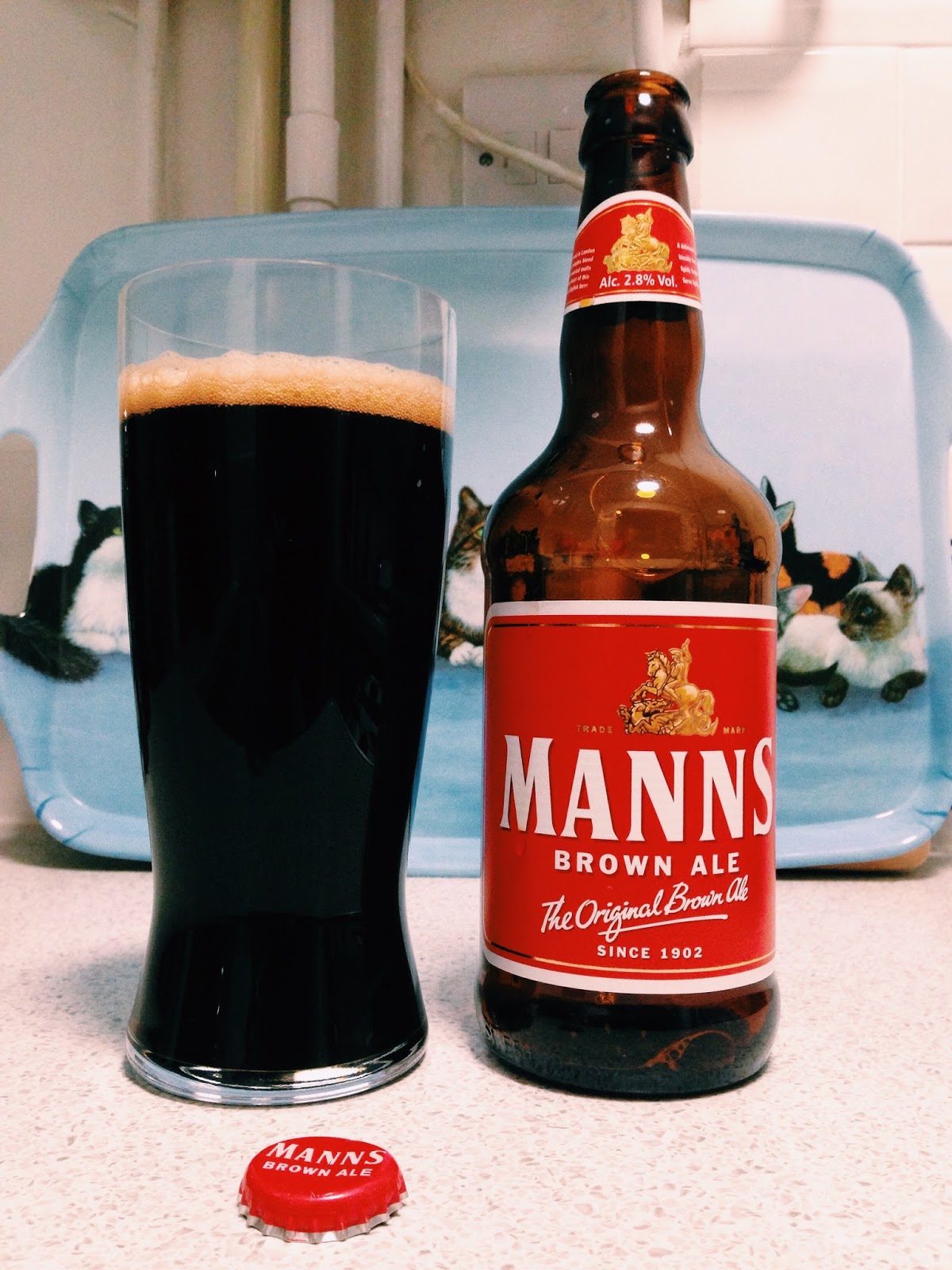
For months, I couldn't find Mann’s Brown Ale anywhere. I wanted to include it when I did my initial brown ale round-up in the early days of this blog, but nowhere near me stocked it. Eventually, I found myself in one of those enormous ASDA superstores when I clocked Mann’s bottles on the shelves, and became consumed with excitement which I knew, even at the time, would inevitably outstrip the quality of the beer. I was mainly just curious – Mann’s is often cited as an example of a now near-extinct breed of brown ale, a counterpart to the likes of Newky Brown. You’ll find little bitterness and no dry finish to Mann’s – it was reportedly considered close to a soft drink at one time, which I can understand. It’s not just the meagre 2.8% ABV, it’s also the sweetness and easy drinkability. It is refreshing and thirst quenching, but in much the same way water is, and not very much like beer is. It also tastes an awful lot like cola to me, with a finish that recalls sparkling mineral water, and hints of treacle and toffee flavour.  I can’t imagine anyone ever thinking “I think I’ll have a nice beer” and then enjoying drinking this.

Thornbridge Charlie Brown (peanut butter brown ale)
My hand has often hovered over Charlie Brown in bottle shops, but something always stopped me taking the plunge. It’s a brown ale with peanut butter and, whilst I love brown ale and love peanut butter, I somehow couldn't quite believe it could be as great as it sounds. Still, I eventually had to try it. Upon pouring, the peanut aroma is immediately evident – it doesn't really smell of peanut butter, but more like raw peanuts with the husk still on. I was expecting more peanut on the initial taste – this is more like a brown ale that heightens the peanut butter flavours that are usually to be found somewhere in beers of this style, rather than providing a massive peanut butter hit. That’s fine – I still want it to taste of beer, otherwise I’d just eat a peanut butter sandwich.  Trouble is, I'm not overly enamoured with the base beer – the body is too thin to work with the peanut butter richness, and there’s an unpleasant, slightly vinegary acidity in the background that also clashes. I was a little disappointed, but not because brown ale and peanut butter don’t go together – I just don’t think this is a great brown ale to begin with. 


North Laine Brewery Deadwood
This one is currently available in cask-conditioned form at Brighton's North Laine brewpub so, if you're interested, you should probably get over there and try it while you can. And it is definitely worth a try, even if my pint wasn't without flaws. The beer is aged in bourbon barrels (edit: it's actually aged on bourbon-soaked oak chips, not in a barrel), which in principle is an excellent idea - it's usually stouts that get this treatment but, since your average brown ale is a little lighter-bodied, you're less likely to end up with anything so thick and oily as certain barrel-aged stouts. The bourbon profile in Deadwood is expertly judged, never overpowering the beer - the whisky brings honey and vanilla, and the time in the wood brings a dry, red wine-like finish. The further down the glass you get, the less prominent the bourbon notes, and bitter chocolate and grassy hops come to to foreground. Unfortunately, my pint was let down by a lack of body - it lacked the smooth, substantial mouthfeel I'm looking for from cask ale, and felt thin and watery. I'm hoping to try it again while its around - perhaps my complaints are simply due to the inconsistency of the cask, and it is otherwise a very good beer.

So far I've mainly been interested in British-brewed brown ales but, since there aren't huge numbers of them, I'm going international with this time. I’d heard some good things about Norway’s Lervig, but unfortunately, their brown ale is a dud. There’s a little toffee, a little chocolate and, if you swill the beer around in your mouth desperately looking for it, a touch of hop bitterness. But overall, it’s watery and bland.

I was expecting a powerfully hopped American brown ale from this, but it’s actually a more nuanced beer. The recipe is inspired by brown ales from the brewery’s past which, in turn, shows a strong British influence – liquorice, treacle, caramel and fruit cake are all in there, bringing to mind something like Harvey’s Bloomsbury Brown if it were twice as strong. A more modern twist is the use of Citra hops, which didn't exist when Anchor was brewing these early beers. Initially, I couldn't get any of the hop flavour at all, but it comes out as the beer warms, with a subtle gooseberry tang. It may not have the hop hit I was expecting, but this is a great beer.

I have a big soft spot for Triple fff, as they are responsible for what I think was my first ever encounter with cask ale, many years ago. Whilst a little south of legal, I once entered an establishment in the brewery's home town of Alton, Hampshire and, in a bid to convince the barman I was surely of proper drinking age, asked for a beer recommendation. He suggested Moondance, their Best Bitter. I professed to love it at the time, though I wonder now how much I truly liked it and how much I was just pretending to be a grown up. I’d certainly love to try it again.

And, perhaps fittingly, Triple fff are the outfit behind what I think is my first taste of cask brown ale – all the others I’ve tried have been from kegs, bottles or cans. In fact, I think hoppy brown ales might work best from casks; I’ve always found well-hopped beers softer and more rounded in cask form compared to the spikier, punchy keg equivalents. Both versions have their merits, but the smoothed-out hops in this beer work nicely with the malt flavours – the balance is perfect. The malt brings caramel and toffee along with a big hit of wafer biscuits, with tangerines from the hops. It’s excellent.


The Kernel Brown Ale
The Kernel's interpretation of brown ale pours disappointingly black. I'm worried I'm in for a thin-bodied porter. But then, as I go for a sip, dark ruby colours slosh around in front of me - that's better. The nose is a big whack of cereals, and the first sip is full of roasty, toasted malt flavours. It actually is a little like a porter, though perhaps medium-bodied where a darker beer might be thicker. In fact, it's the perfect body for a brown ale according to my preferences. Some caramel and toffee inch the beer away from porter territory, and there's a citrus zing in the finish; although the label doesn't tell us which hops are included, I'd guess something American and beginning with C. This is delicately done, though - it's not an American brown ale, it's a modern British version which looks to the US for influence. I like it a lot.

***

I've also recently come across a couple of brown ales with the audacity to call themselves 'imperial'. They'll get their own post next week.


Wednesday, 15 April 2015

Thornbridge vs. Schlenkerla: Battle of the Bocks

I’ve often thought that one of the Thornbridge brewery’s strongest suits is their respectful approach to beer styles, along with an interest in slightly more esoteric or niche styles less often attempted by other UK brewers. A copy of Michael Jackson’s Beer Companion and access to Thornbridge beers can teach a novice beer drinker an awful lot – I know, because I learnt a lot this way myself. Craft Beer Co. in Brighton seems to have at least two of their brews on at any one time and so as I read about, for example, kolsch beer, I was able to sample Tzara – surely the next best thing to a visit to Cologne, and way more satisfying than any imported bottle. Similarly, my first taste of Bière de Garde orginated not in Nord-Pas-de-Calais, but in the Peak District. When my dad returned from a trip to France with a couple of bottles of Dyuck Jenlain Ambrée, I was amazed at how true to style the Thornbridge example, still fresh in my mind, had been.

Considering this, I recently realised I had a bottle of both Thornbridge’s Bamberg and Schnlenkerla’s Urbock in my cupboard. This, I thought, could offer an opportunity to see just how well Thornbridge’s beers hold up in comparison to the classics of their style. And so, I decided to taste the two beers side-by-side. Now, I want to make it clear from the get-go that this is purely a bit of fun. There are many reasons why a comparison of this kind isn’t totally fair, not least the fact that strong smoked beer is kind of a palate scorcher. But the beers are both smoked bocks, with similar ABVs (6.5% for Schlenkerla, 6% for Thornbridge), and Thornbridge are acknowledging the influence of (if not inviting comparison to) Schlenkerla by naming their version after the city that famously houses that brewery. Still, the following is not intended to be anything other than a light-hearted experiment; apart from anything else, the tasting itself was really fun to do.


To help me with this venture, I enlisted the help of my other half, Sidony, who took me to Bamberg earlier in the year and became a Schlenkerla devotee in the process. We began by pouring each bottle into two glasses, after which I attempted a blind taste-test by closing my eyes and asking Sidony to hand me a glass without telling me which of the beers it contained. An unscientific element came into play immediately, however; whilst pouring, the aroma of the Thornbridge beer hit me very strongly. After smelling the two glasses, I predicted the one with the most intense, ham-like aroma was Thornbridge, but my guess was based on this prior information rather than a true blind test. The glass with the more powerful aroma unsurprisingly tasted stronger and smokier, too, and this glass actually turned out to be Schlenkerla.

Schlenkerla’s Urbock is, in every sense, a bigger version of their classic marzen. The meaty smokiness is just as strong, but more nuanced – flavours I haven’t detected in the marzen are apparent here, such as tobacco, oak, liquorice and certain herbal notes, and once the smoke subsides, there’s a poke of citrus sharpness. The elevated ABV is evident and, together with a fuller body and pleasantly oily mouthfeel, this slips down easily and leaves a warmth in the chest. Sidony uses an analogy rarely called upon in the beer world – make-up. There are many types of primer (something that is applied pre make up application). Some are gels & creams that often hit the skin and dry down almost immediately, making whatever comes after it apply roughly, whilst others have a more silicone feeling to them, which lets anything come after it glide on. Drinking the beer is a similarly seamless sensation; it's smooth and silky, slippery, easy drinking.

In comparison, Thornbridge’s Bamberg seems a little puny. To again acknowledge the flaw in this test, it is a little mean to taste this after such an intense beer as the Schlenkerla bock. I rinsed my mouth out with plenty of water in order to best compare them, but my palate was undoubtedly affected by the previous beer’s smoke. The smokiness is far milder here, but Bamberg also seems to me like a much cleaner (if stronger than average) lager than your typical rich, warming bock. The body is noticeably thinner, with more carbonation, and the colour resembles a Vienna lager, far lighter than Schlenkerla’s dark copper. Sidony doesn’t like it at all – for her, it neither warms nor refreshes and it’s neither a summer nor a winter beer. I’m much keener; admittedly, after Schlenkerla, it barely tastes like a smoked beer anymore, but then I think I’d enjoy an unsmoked version just as much, because for me it’s a robust but crisp lager. I’d prefer a slightly lower alcohol content, though, because I don’t feel the boosted ABV brings anything to the beer; the body is no fuller than your average lager, and you don’t get that tingling booze warmth.

As I said at the beginning, this was purely intended as a fun little experiment, and there’s no slight on Thornbridge intended – they remain one of the UK breweries I most admire, and to say that any brewery makes a smoked beer that doesn’t quite measure up to Schlenkerla is truly no insult. Apart from anything else, I really enjoyed Bamberg in its own right, and fully intend on trying it again on its own to appreciate it properly.