Showing posts with label craft beer. Show all posts

Friday, 23 November 2018

Artisautza garagardoa Bilbon


There’s a resinous quality to the air on Goienkale, in Bilbao’s old town. Shops selling studded belts, Dr. Martens and Dead Boys records give this street a certain vibe – like Camden, but not trying so hard – which is completed by the groups of scruffy but friendly-looking young punks crouching outside the bars. The dank aromas might be something to do with them.

When I first visited Bilbao, aged around 14, my main priority was seeking out cheap Ramones CDs. That mission quite likely took me to this part of town, though I can’t really remember. It was probably the gently edgy feel to the place that made me fall in love with the city – it was one of the first places my parents took me on holiday that I actively enjoyed, rather than passively being dragged around between plates of chips and glasses of Coke in continental cafes.

Priorities changes, of course. There seems to be a punk show on at a squatted building down the road; but I’m more interested in wolfing down vegan pinxtos, the Basque equivalent of tapas, in a couple of the local bars. My introduction to Basque beer comes at Tirauki, where a selection of bottled beers displayed on the bar offer a welcome diversion from the Heineken brands on tap. From these, I opt for Pink Porter from local outfit La Txika de la Cerveza. I'm a little taken aback at first, not expecting vanilla and dark sugar that suggest rum ‘n’ raisin ice cream. Served cold and being relatively light of body, this hits a sweet spot between refreshing and interesting.


Moving out of the old town and crossing the river, I head for Café Bihotz. This place is intimate, but very cool in a minimalist, Scandinavian fashion like a hipster coffee shop – which, by day at least, is what it is; in the evening, candles are lit and beer pours from six draught lines. Initially bypassing these, I get stuck into the menu of bottles and cans, starting with Zapaburu from Basque brewery Laugar. Billed a hazy IPA but not especially murky, it has a sticky tropical mandarin edge, balanced with a touch of dankness. Dumbstruck from Jakobsland, a little further afield in Santiago de Compostela, is an ode to Citra hops, bursting with juicy lychee.

Of the draught beers, I plump for the local option -  Basqueland’s Brut Reynolds. Obviously enough, it’s brut IPA, a zeitgeist style at the moment and one I happen to be keen on. Like the best examples, this has a real precision and clarity of flavour, boosted by a very dry and bitter finish. I struggle all the way through the glass to put my finger on the dominant flavour – my best attempt is citrus zest and cannabis, with an earthy pine sap quality. On the way home, in a misplaced effort at sophistication, I stop at a cocktail bar and order almost blindly from a menu written in Spanish. I curse my monoglottism when a mango smoothie-style drink arrives in a milk bottle with a striped paper straw. I mention it because it was accompanied by a sprig of fresh oregano; chew on a leaf and sip the mango puree and the flavour sensation uncannily recalls the IPA from earlier in the evening.


The principal rationale for choosing Bilbao as a destination was the Guggenheim museum, somewhere I definitely did not appreciate on my previous visit as a teenager. It’s sensational, obviously, but a lengthy wander through its galleries builds up a significant hunger and thirst; Basquery is the answer. Though listed on Ratebeer and other sites as a brewpub, it looks to me more like a full-size production brewery with a deli, bakery and restaurant attached. The staff, initially bamboozled by my presence (I think I was maybe slightly early for full lunch service and this was the source of confusion, but I can’t be sure) valiantly overcome a significant language barrier to sort me out with a nice lunch and some impressive beers.

Itsasbeer is a saison incorporating grape must from a local winemaker specialising in the beautifully dry and acidic Basque white, txaokoli.  I’ll admit to being a sucker for almost any beer that straddles the boundary between grape and grain, but there’s something particularly wonderful about the crisp, tannic quality of white grapes in a saison; a gently floral air rounds it out and a dry, peppery finish almost demands another swig. Hitman, an IPA, is less distinctive, but very good, recalling that same mango/oregano interplay I’d found over at Bihotz the previous evening.

An audible buzz of conversation hit me from halfway down the street as I approached Singular. The place is bustling, seemingly fulfilling an important community function as a place for locals to meet for beer and pinxtos. The tap list is short but well curated and boosted by a decent selection of bottles and cans. I choose another from Basqueland, Aupa, and settle down with my book. I’m distracted first by the beer, which has an austere blood orange bitterness about it and a remarkable cleanliness. Then there’s the general ambience of the place, the people-watching potential, and the delightful old beagle scampering about. Before long I’ve put the book down, deciding I need no further stimulation than the beer in my glass and the ambience of the room.


A can of Salda Badago from the unfortunately-named Gross brewery in San Sebastien follows. The flavour is oddly nostalgic – it tastes exactly like Barratt’s Fruit Salad chews. The key elements here are pineapple and vanilla, but there’s a more grown-up edge of sharp tropical fruit and a notable bitterness in the finish. To finish, a small glass of Aupa Tovarisch, from the aforementioned Laugar (‘aupa’, by the way, is apparently a Basque expression meaning something analogous to ‘cheers’). This is a complex imperial stout that I initially find hard work, such is its intensity – my notes read “I will probably feel very pissed by the time I’ve finished this (very small) glass.” A rounded coffee depth of flavour props up notes of maple syrup, orange oil and gingerbread, finishing on a port wine tang. After a good 45 minutes of slow sipping, I decide its excellent and leave before I can be tempted by another.


Penguin Bar has a somewhat familiar feel; with a minimal, faintly industrial vibe and 16-strong tap list chalked on the walk, it's in the mould of craft beer bars in major cities the world over. Personally, I don’t hold that against the place; it's atmospheric with a young, hip crowd amongst whom I obviously feel right at home. There are several house beers, and its not easy to ascertain who brews these – some sources suggest it’s Txorierri Garagardoak, based just outside the city in Sondika. APA Blonde eases me in, and it’s a solid West Coast pale ale with a resinous, piney quality rounded out by some stone fruit.

To follow, I catch up with a couple of Barcelona breweries. I’m excited to reacquaint myself with Appasionada from Barcelona’s Edge, but I'm let down as its vibrant passion fruit aroma is muddied with buttery diacetyl. Beanz, a double IPA brewed in collaboration between Garage Brewing and Ireland’s Whiplash, is straight-up bizarre. I’m taken aback by its distinctly Middle Eastern vibe, which primarily recalls mint tea but with a musty quality redolent of saffron. Tropical fruit lurks underneath, sure, but I’m astonished to look it up and find that it doesn’t contain any kind of wacky adjunct ingredient. Perhaps this is what happens to New England IPAs when the savoury, caraway-type flavours almost completely take over? It’s interesting to begin with, but soon becomes difficult to drink.


Barcelona might be the more obviously fruitful location for beer, but on this evening in Penguin Bar, the Basque country easily has the edge. I’m aware that I end almost every travel post on this blog by saying something along the lines of ‘city X might not be an obvious beer location, but if you’re going anyway, there’s good stuff to be found.” Having spotted this trend, I should now resist it, but the truth is it applies perfectly to Bilbao. The dedicated ticker, such as myself, will gain satisfaction from the fact that the city’s beer locations can all be visited over the course of a weekend. There may be a couple of duds along the way – the worst Spanish beers can be really bad in my experience - but that’s tolerable. And at the very worst, I can heartily recommend sitting with a one-Euro tin of Mahou on the edge of the Nervión river in the sun.

Tuesday, 9 October 2018

Drinking in Vilnius, pt.3 - Lithuania's craft capital

Catch up on my Lithuanian adventure in part one here and part two here.

The concept of 'craft beer' only really makes sense in a particular context. A beer like Sierra Nevada Pale Ale emerged in a marketplace almost entirely dominated by mass-produced lager; the craft beer ideology, which values independence, traditional methods and bold flavour, defined itself against that dominance.

How, then, do we understand this imported American term when applied countries with rich traditions of independent and flavoursome beer? That binary opposition - craft vs mass produced - is complicated when there is a tradition, like cask beer in the UK, that is independent and flavoursome, and yet doesn't sit entirely comfortably within widespread understandings of craft beer. And craft beer is also not necessarily tied to a place - you can travel for thousands of miles in search of local brews, and find IPAs pretty similar to those you enjoy at home.

As this article for October suggests - farmhouse beer in Lithuania is in a precarious position, some of its brightest stars facing the possibility of extinction. It would be a terrible shame to lose these unique brews and find them all replaced by double IPAs. For the time being, though, there is welcome variety on offer in Vilnius. Much as I enjoyed the esoteric traditional beers, I wouldn't want to drink them all the time. The obligatory trendy craft beer bars showcase a modern-minded brewing scene in fine fettle, and in some venues American-style craft and farmhouse styles rub shoulders.

Pluck a bottle of Genys' Tamsus Miškas from the fridges at Bambalyne and you might expect one of the distinctively Lithuanian dark beer labelled as tamsusis. What you actually get is a chocolate porter. And a very good one, too – sweet and creamy with chocolatey decadence, but with a hint of sharp dried fruit, coffee roast and earthy nuts to add complexity. Dark Forest is, I think, the barrel-aged incarnation of the same beer, and has many of the same qualities alongside a sizeable dose of vanilla and a very subtle bourbon aftertaste. I’ve plenty of time for strong, assertive barrel-aged beers, but the strength of this particular one is its subtlety. 


What’s in a name? The moniker Nisha Craft Capital is a statement of intent; their anniversary T-shirt that reads “it’s been 2 years since the day that Vilnius was introduced to beer” even more so. I’m happy to dismissively roll my eyes at that notion – others might be less generous. Obviously enough, there are none of your rustic kaimiškas here. Lithuanian brewers are well represented, however, but working with international styles. You don’t need to travel to Lithuania to drink a Mango Milkshake IPA, for instance, though I was especially taken with the version from Apynys. I ordered it for some silly fun, but what I got was a sophisticated take on the New England IPA – not overly sweet, and using mango almost as seasoning to boost the naturally juicy hop profile rather than as an overbearing adjunct. A grainy, lager-like note in the finish might placate those who complain that modern IPAs “don’t taste like beer.”

A less convincing take on the NEIPA is Blacklights Multijuice. It opens with a sharp tropical aroma, and initially tastes soapy, floral and waxy with a big lemon zest dimension. Some sticky passion fruit emerges eventually, but that’s the only concession to the expected fruit salad effect you’d expect from the style. The good news is that it is, in all other respects, a very good beer; subtle and sessionable with bright flavours that complimented a summery evening beautifully.


I mentioned Dundulis in my previous post, noting that whilst they’re primarily concerned with modern craft styles, they make the occasional nod to tradition. Their IPA, Humulupu, was Lithuania’s first, and it’s pretty good, though already somewhat dated with caramel malt and English-style earthy, spicy hops, finishing on a notably bitter piney note. Their beers are easily found in Vilnius, including at several branches of their own Špunka bars. I visisted Etmonų Špunka, seemingly a popular spot for attractive young people and absolutely heaving. Here I drank Gutstoutas, a sweet oatmeal stout with a tobacco-like hop profile and chocolatey depth of malt flavour. Sadly it’s also thin where it should be rich and creamy, with a touch too much buttery diacetyl and some off-putting acidity. I’d highly recommend you swing by for the ambience, and probably best stick to the IPA when you do.


Just around the corner is Prohibicija, situated off a buzzing communal courtyard amongst a number of other bars and food joints. If you want a break from oddball Lithuanian styles but still want to drink local, a visit here should be your priority. The aforementioned Apynys teamed up with Russia’s Courage and Midnight Project from Belarus for 3 in 1 IPA, and it’s another clean and accomplished effort. Though crystal clear, it has much of the saturated stone fruit character you’d expect from a much hazier beer, but is much more refreshing and less intense.

Also skirting the NEIPA fruit bowl is Marakešas from Kuro Aparatūra, nominally a ‘hopfenweiss’ with the emphasis very much on the hop rather than the weiss. Alongside the tropical fruit there’s an edge of gooseberry which just verges on tartness and freshening the whole thing up like a squirt of lime on a wedge of ripe mango and finishing on a gorgeous zingy, sherbet-like note. NemieGOSEPareiGOSE, from the same brewery, was similarly impressive. Clean and sharp with a tart green apple quality, it also has a notable coriander component which gels very nicely with some pear-like esters, finishing with a perfumed, rosewater taste.

I feel no shame in admitting that after just a few days of oddball farmhouse beer, the occasional IPA really hit the spot. But I'd never take the latter at the expense of the former; after all, hopfenweisse and gose are no reason to travel to Vilnius - raw ale and keptinis are.


Sunday, 16 April 2017

Craft bjór í Reykjavík

As just about any article on the subject will tell you, Iceland’s beer culture is very young. In fact, beer over 2.25% ABV was illegal in Iceland until 1989, long after prohibition on other stronger alcoholic beverages was lifted. You’d be forgiven, then, for not making a mental connection between Iceland and beer beyond the country’s reputation for eye-wateringly expensive pints.

In recent years, though, we’ve seen Einstök beers become increasingly common in the UK, imported by James Clay. I’ve always thought that their popularity here rested on the exoticism of their Icelandic origin rather than the perfectly well-made but generally unexciting beers, but you’ll find plenty of Einstök in Reykjavik, too. I didn’t drink any – I can get them at home, and you don’t have to look too hard to find plenty of interesting alternatives.

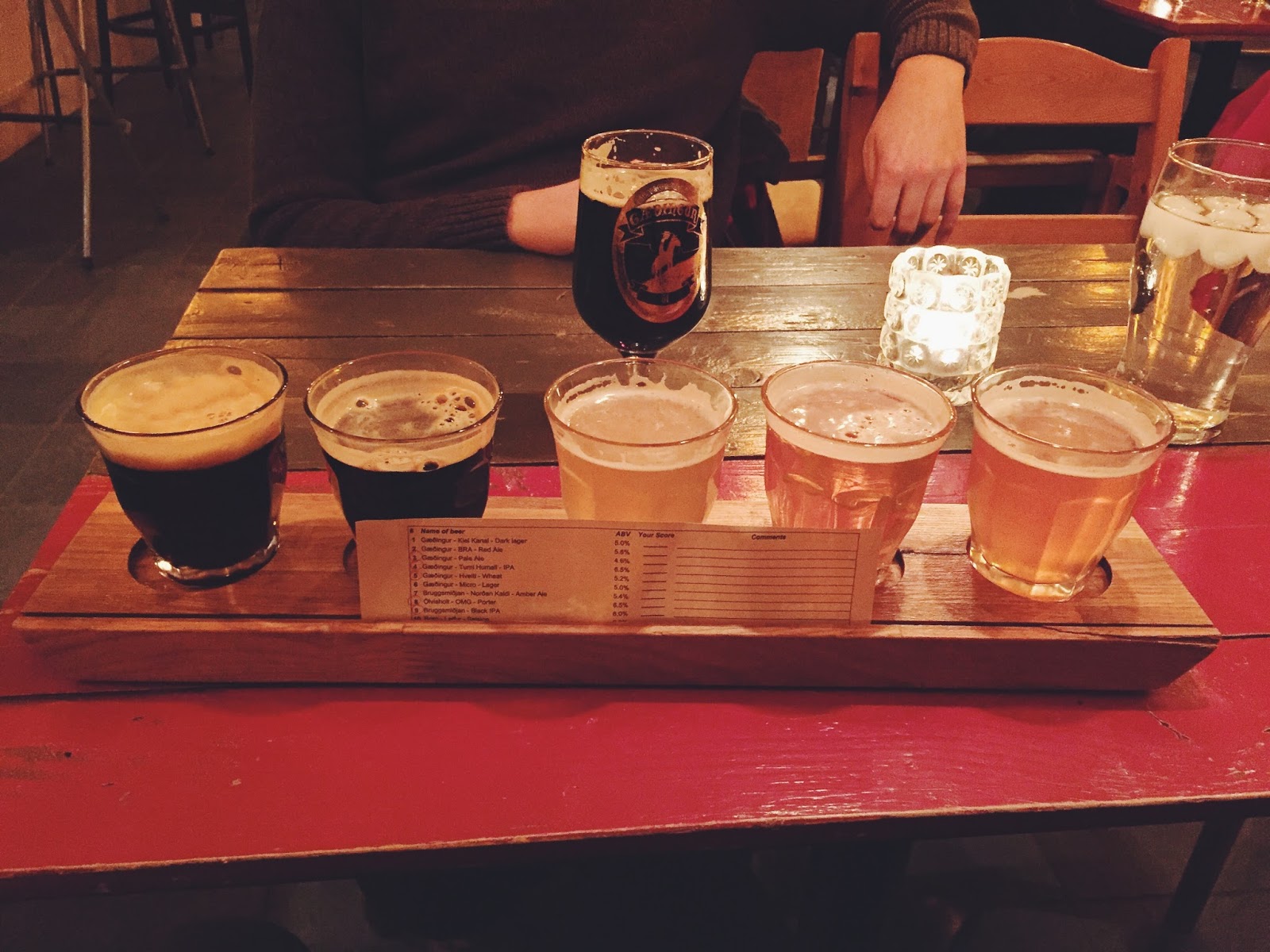
Flight of Icelandic beers at Micro Bar

A tip I picked up from Kaleigh’s excellent blog proved very useful – stocking up at the airport. Upon arrival at Keflavík airport, you’ll see a large duty and tax free shop which stocks a decent range of Icelandic beer in six packs. There are two good reasons to load up here – firstly, the prices are good and worked out to about £2.50 per bottle on our purchases, and secondly, buying beer in the city is not as simple as you’d expect. One of the conditions of Iceland’s uneasy relationship with beer is that normal shops can still only sell low-alcohol beers, and anything stronger must be purchased in the stated owned Vínbúdin stores. There are a couple of these in Reykjavik including one on the main shopping street, but I never once saw it open. So if you’re planning to take beers home or buy something to drink in your hotel, the airport is your best bet. There are duty free shops on the departures side that sell beer, too.

Our purchases here served as our introduction to Borg Brugghús, based in Reykjavik and common in bars and restaurants. Borg is actually a smaller enterprise within the large Ölgerðin brewery which makes Iceland’s mass-produced lager, Gull. This kind of arrangement rarely pays off in the UK but seems to be working beautifully in Borg’s case — they produce a huge range of varied, bold and ambitious beers. In bottled form we sampled Leifur, a saison brewed with arctic thyme and heather. It has a very earthy aroma and a moderately funky note in the flavour. The herbal and floral notes add some depth to the typical peppery saison characteristics, and the brisk carbonation is palate-cleansing and refreshing. Snorri, a witbier, also has artic thyme in it, which adds a delicious and satisfying depth to what can be an insipid style.


We arrived at the hotel just in time for happy hour at Uppsalir, the smart little adjacent bar. Luckily, happy hours are common in Reykjavik —  whilst I'm used to paying higher prices in craft beer bars and the prices in Iceland never made me jump out of my skin, it's certainly not cheap — and most of the craft-focused bars have them. The deal here was particularly good with two-for-one offers on draft beer, including a rotating pump dedicated to Borg. Garún, a wonderful imperial stout, was pouring on our visit — hugely rich and decadent, it was bursting with brown sugar, milk chocolate, caramel and vanilla, but also had enough of an austere booziness and a gentle acrid bitterness in the finish to balance it out. With dinner, I had Úlfur, a solid IPA with a floral hop character that reminded me of Thornbridge’s Jaipur, albeit with more of a caramel malt foundation.

Later, we headed to Kaldi, a buzzing bar operated by Bruggsmiðjan, the first microbrewery to open in Iceland in 2006, and serving only Icelandic beers. I had a few tasters of the brewery’s beers but none really appealed, so I ticked off yet another Borg offering with Úlfur Úlfur, their double IPA.  This was fantastic — although ostensibly a souped-up version of Úlfur, it was much paler, which allowed the hops to lead with deeply dank and resinous notes and lots of sticky orange.


The next evening, we decided to check out Mikkeller and Friends. I like to stick to local beer when I’m travelling, but I was intrigued to visit a Mikkeller bar, and the availability of exclusive ‘house’ beers twisted my arm. Of these, I had Hverfisgata Brown, a very smooth and clean brown ale with citrus and sherbet notes alongside fresh peach and apricots. The rest of the extensive selection was largely dominated by To Øl, with more Mikkeller and a couple of Warpigs beers available, too. The bar itself was a bit too achingly hip to enjoy and felt a bit sterile and stuck-up; we only stuck around for one, although our round was free due to a problem with the card payment system!


I much preferred the atmosphere at Micro Bar. Originally, the bar was situated in the Center Hotel, but has now moved to a larger, cosy basement space just across the street. All of the taps are dedicated to Icelandic beer, including a handful from the Gæðingur brewery that run the place. I opted for a tasting flight which included several of these. Hveiti is sold simply as ‘wheat beer’ and tasted more like a Belgian wit than a German weizen, with a tangy citrus finish that tasted like juicy orange flesh. Sadly, the Pale Ale that followed was ropey stuff, with a dirty, yeasty flavour that wiped out any suggestion of hops. Strange, then, that Tumi Humall, their IPA was so good, and so clean — dank pine followed by sticky mandarin and mango. After skipping the Bruggsmiðjan beers at Kaldi, I sampled their Black IPA here and, although not as hoppy as I’d expected, I really enjoyed it. It had the appropriate focus on smooth, chocolatey depth of malt flavour over aggressive roast, with a peachy hop character in the finish.

The final beer on the board was OMG Súkkulaði Porter from Ölvisholt Brugghús, based in the countryside about 45 miles outside Reykjavik. This was a slightly sweet and very rich and creamy porter, with a slight nutty quality that makes me think it may be made with oats. I came across Ölvisholt again the next day when we took a day-trip to the amazing Sólheimajökull glacier. On the way back we stopped for dinner at Hotel Anna, a lovely restaurant and hotel on a farm in the middle of nowhere. In need of sustenance and warmth after a long day of fresh air and exercise, I had some delicious vegetable soup and a bottle of Lava, Ölvisholt’s smoked imperial stout. I didn’t get a huge amount of smoke from this, and what there was seemed to fade fast as my palate adjusted. Luckily, the stout itself is fantastic – rich, warming, gently roasty and ever-so-slightly acidic, especially recalling red wine in its dry, tannic and tangy finish.


Our final destination before leaving Reykjavik was Skúli, a warm and welcoming bar in the centre of town. This was directly opposite our hotel on a courtyard, though there are no really obvious signs — I didn’t realise it was there until I looked it up on Google maps and found it was 100ft away from where I stood. Micro Bar is just down the street, and Kaldi and Mikkeller are both less than 10 minutes away — Reykjavik is very compact. Five of the taps are dedicated to Icelandic beer, mostly from Borg, with others pouring beers from the likes of Mikkeller, Founders, Stone Berlin and To Øl. To close the trip, I drank Tilraunalögun, Borg’s artic berry saison, which was an absolute treat, deftly balanced between sharp and sweet, recalling Rodenbach’s sensational Caractére Rouge.


Even this isn’t the complete picture — I didn’t have time to visit Bryggjan Brugghús, a brewpub situated near Reykjavik’s marina. That such a tiny city has so much to offer beer-wise is pretty amazing, really, and though it may be hot springs, geysers and glaciers that send you Iceland, looking forward to some great beer in the evening makes any holiday better. Skál!

Wednesday, 16 November 2016

Sign of the times : new beers from Harvey's


The ‘crafty’ rebrand of a traditional brewery is, at this point, a recognised phenomenon. From the addition of a hop cone to the logo that adorns Shepherd Neame’s otherwise unchanged and increasingly tired range to 'craft' sub-brand such as Thwaite's Crafty Dan, there’s an almost palpable desperation for relevance amongst national brewers of brown beer. Such efforts verge from the cynical – give an old beer a new name and funk up the typeface a little bit and bingo, craft beer – to the sincere yet misguided, with only Adnams and Fuller’s generally thought to be successfully bridging the craft/trad divide.

Harvey’s of Lewes, East Sussex, would rank amongst the breweries I’d least expect to employ a modernising makeover. Their approach is thoroughly old-school, and they persevere with such near-extinct styles as sub-3% milk stout in the Mackesons vein and brown ale coloured with caramel, both packaged in 25cl ‘nip’ bottles. And yet, at this year’s Great British Beer Festival, Harvey’s revealed a sleek new look, both updating their visual style and forging a coherent brand identity amongst their numerous seasonal releases. More astounding was the announcement of two new beers to be packaged in kegs as well as cans, and this news is accompanied by a namecheck for Beavertown and BrewDog on their website.

Alongside the snazzy new branding and newly pressurised containers comes a new slogan – “we wunt be druv”, an expression in local Sussex dialect meaning “we won’t be driven”, as if to assert that Harvey’s continue to do things on their own terms. In fairness, I should stress that they are in no way claiming to produce ‘craft’ beer, and there is a definite continuum between their existing beers and the new range. Still, there’s no denying that these new beers are targeting a new audience. Large family brewers may be flailing to recover diminishing sales, but having operated as an exclusively local brewery, Harvey’s are now making a conscious decision to extend their reach, extending their sales area beyond the current 60 mile radius.

I have slightly mixed feelings about this. In Lewes, I’ve found that even pubs who clearly aren’t focused on beer quality or choice are likely to deliver a superb pint of Sussex Best. This is because there’s an immense sense of local pride surrounding the brewery. Best is the default beer for a generation of drinkers – my brother works as a barman in Brighton and says it is common for men of a certain age to order a pint of Harvey’s without first scanning the bar to check whether it is on sale, often indignant if it isn’t available. It is a beer tied to a place – if you travel to Sussex, you might seek out Sussex Best, knowing that you’re unlikely to find it elsewhere. Increased availability may dampen that magic.

It’s also hard to gauge exactly who these kegged beers are aimed at. I can see the logic behind Golden Bier – golden ales have long been considered a potential converter for lager drinkers, and cool, carbonated keg dispense will strengthen that link. Malt Brown, however, seems misguided. Modern beer remains all about hops – perhaps, actually, it is increasingly about hops – so the focus on malt, together with the reference to that most unglamorous of colours, makes them seem a little out of touch. I can’t see existing Harvey’s fans ordering this over their cask beers, and can’t see cask sceptics ordering a beer called Malt Brown, either.

The most sensible move in this revamp is canning Sussex Best, a beer with existing cult appeal which, until now, has only been available on draught (Blue Label, a bottled beer, is ostensibly a version of Sussex Best, but doesn’t taste particularly similar to me). It pours a familiar coppery brown, with a thin white head that fizzes intensely before disappearing altogether and the aroma is carried by malt, together with just-ripe plums. The taste is, as ever, mysterious – I get a slightly different impression every time I drink Sussex Best, which isn’t to say that it frequently changes, but rather that it has an unusual flavour profile that seems to suggest different things with each pint. Recently, I’ve tended to think of tea – black, possibly with a slice of lemon – and wholemeal toast. As with several Harvey’s beers, there is the faintest suggestion of tartness – small enough that you may find you’re still debating whether it’s really there by the time your glass is drained – which adds complexity. The carbonation in the canned product is gentle, replicating a well-conditioned cask and deftly avoiding the distracting fizz which dogs many bottled and canned bitters. 


Predictably, Gold Bier is a good shade lighter and with its generous, tight head, resembles a pilsner in appearance. On the nose are cereals, but with a hint of plum which suggests a familiar yeast strain. The initial taste is underwhelming – bland and watery, though there is an edge of toasty malt and Digestive biscuits before a lemony, bitter aftertaste. This lingering bitterness sends you back for more, but each subsequent gulp is a little disappointing, bringing a kind of empty absence of flavour that recalls alcohol free lager. And yet for all that, by the time I finished the glass I realised I’d been rather enjoying it. It’s a beer that doesn’t reward analysis – it all about sessionable drinkability, and I could happily have cracked another. 

Malt Brown is fairly dark, edging into stout territory save for some reddy-brown patches around the edges of the glass. It instantly reminds me of the brewery’s phenomenal porter, though without the harsh and acrid brown malt edge. Smooth milk chocolate dominates and, paired with a distinct malty tang, it recalls a malted chocolate milkshake. Surely they’re missing a trick not marketing this as a chocolate porter?


Harvey’s does have something of an image problem. Some of my craft-educated friends challenge the perception of Harvey’s as a fine brewery as received wisdom and don’t think the beers stand up to their reputation. These people can be sceptical of cask beer, but it’s not just that - but put a pint of Golden Bier, dispensed from a keg, in front of them and I don’t think they’d change their minds about Harvey’s. I’m with those who consider the likes of Sussex Best and Old Ale legitimate classics, and I don’t think a shiny keg font will ever tempt me away from these beers.

Wednesday, 17 August 2016

Brighton Brewer's Market


Great keg beer isn’t easy to find in Brighton. There’s plenty in specialist pubs and bars, of course, but walk into your average boozer and you’re likely to find three or four handpumps, often dispensing excellent local beer, whilst the keg lines remain dominated by the usual macro lagers, Guinness and cider. Whilst pubs with brewery/pubco/chain ties might have some freedom to choose from either SIBA’s supply list or a pre-approved selection of breweries, I suspect this freedom doesn’t extend to kegged beers, subsequently making kegs harder for small breweries to sell. But with more established breweries like Burning Sky selling in kegs for a few years now and the likes of 360, Gun and Arundel now moving into this area, there’s an emerging demand for locally produced and full-flavoured keg beer.

I love cask beer too, of course, and would never state a general preference for either dispense method. Notably, the organisers of the Brighton Brewer’s Market, an outlet for local kegged beer, promoted the event without denigrating cask, and most of breweries pouring there produce cask beer too. It was a welcome chance to redress the balance a little bit and experiment with styles perhaps better suited to the keg format. Set in Yardy, a small courtyard adjacent to the Marwood coffee shop on Ship Street, there was food grilling at one end and beers pouring from a converted piano at the other.

Having written about Beercraft, the small pilot brewery based on the Watchmaker’s Arms premises, I was delighted to finally sample a couple of brewer Jack’s wares. A 3.2% Table Beer was seriously impressive – its easy-drinking light body and brisk carbonation made it really refreshing on an (occasionally) hot and sunny afternoon, and the hop flavour and aroma crammed into such a small beer is amazing. It’s truly sessionable in the sense that it’s difficult to stop at one – my plan to try as many different beers as possible was abandoned as I went back for two more glasses of the Table Beer.


There was also Zeit Weisse, a hefeweisse born out of a collaboration between BeerCraft and Brewtorial. This was excellent, too, familiar in its classic Bavarian yeast character – banana and clove – but a little different at the same time, with some gentle soft vanilla flavour in the background and just a touch of sharp fruitiness.

Brewtorial’s Logic Engine American Pale Ale recently won first place at the London and South East Craft Brewing competition, and I can see why – it’s an impressive beer. I want to say that it tastes like fruity sweets – Fruit Pastilles, or maybe Fruit Salad chews – but that would give an impression of cloying sweetness, which is far from the case. It is bursting with citrus and tropical fruit flavours, though, with a gentle bitterness and a beautiful full body that makes each gulp super satisfying.

The dream would be for a greater number of Brighton’s pubs to kick off a couple (just a couple!) of the big lagers, halt the creeping presence of pseudo-craft sub-brands from large breweries, and extend their support for local breweries to the keg fonts. In the meantime, Brighton Brewer’s Market will be back on the first Saturday of August, and again in September.


Monday, 20 June 2016

Drunken sailor

As I mentioned in my previous post, I was recently in Barcelona for the Primavera Sound festival. Though I've never considered myself a nautical type, we ended up staying on a (moored) boat because it was cheap and extremely convenient for the festival. The purpose of the trip wasn't beer, and it wasn't a wander by day, booze by night holiday either. Still, I did get a chance to stock up at BeerStore, a bottle shop I'd highly recommend - its well stocked in general, but heavily promotes local beer. Each evening, I sat on the deck with a couple of bottles, enjoying the last of the sun before heading out to the festival and its plastic cups of rancid Heineken. Here's what I thought of those beers.


Guineu - IPA Amarillo
On a previous trip to Spain, I was really impressed by a double IPA Guineu brewed in collaboration with the Bavarian BrauKunstKeller. On the strength of that, I opted for two of their IPAs from the bulging Beer Store shelves. This one is resolutely old school in approach – British IPAs seem to have become paler and paler over the past few years, but this pours an attractive hazy red-gold, with a thick, tight white head. Peach and orange aromas jump out immediately, with lots of peach carrying into the flavour along with apricot and some grapefruit. There’s a savoury element to the beer which almost recalls tomato (possibly a characteristic of some of the darker malts? I often get the same thing in red ales) which sounds weird but does kind of work, and the finish is notably bitter but not excessively so. It reminds me of the IPAs doing the rounds when I first fell in love the style – not-so-pale, not afraid to bump up the IBUs – and it definitely still hits the spot.


I was hoping for something like a white IPA, my current favourite pseudo-style, from this, but it doesn’t have any of the estery or phenolic flavours of either a Belgian wit or a German weisse beer, seemingly brewed with a standard ale yeast with wheat mainly contributing some extra body.  There’s a sweet-ish candy sugar thing going on which, along with the hops, presents as a summery stone fruit character before a long, bitter finish. It’s kind of non-descript and a little disappointing given the label’s reference to dry-hopping – it doesn’t have that juicy, amped up hop flavour and aroma you’d expect, possibly because the malty sweetness refuses to let the hops sing.


The motivation stated on this beer’s label is refreshment in sticky Barcelona weather, and in that respect, Apassionada absolutely knocks it out of the park. A passion fruit beer in the generic ‘sour’ category, its flavour is incredibly vibrant and has all of the freshness and complexity of the fruit itself. A restrained honey sweetness, a floral note, rich tropical juiciness and a light tart finish. It’s deftly managed - any sweeter and you could almost believe you were drinking a can of Rio rather than a beer, any more acidic and it would become hard work – and extremely accomplished.


How could I resist that branding? And the BrewDog-aping isn’t the only British influence on this beer. Described as an English-style bitter on the back of the label and table beer on the front, it has a super-pale malt base (100% Marris Otter) and a big, juicy hop character in an otherwise relatively small beer. I could be wrong, but I’d wager that this is modelled on The Kernel’s majestic Table Beer. The aroma is beautiful, a big burst of sherbet, and in the mouth there are tangerines and grapefruits and something almost herbal or botanical which recalls gin. For one of the lowest-ABV beers on the shelf, this is packing a huge amount of hop flavour and was undoubtedly the best beer of the whole trip.


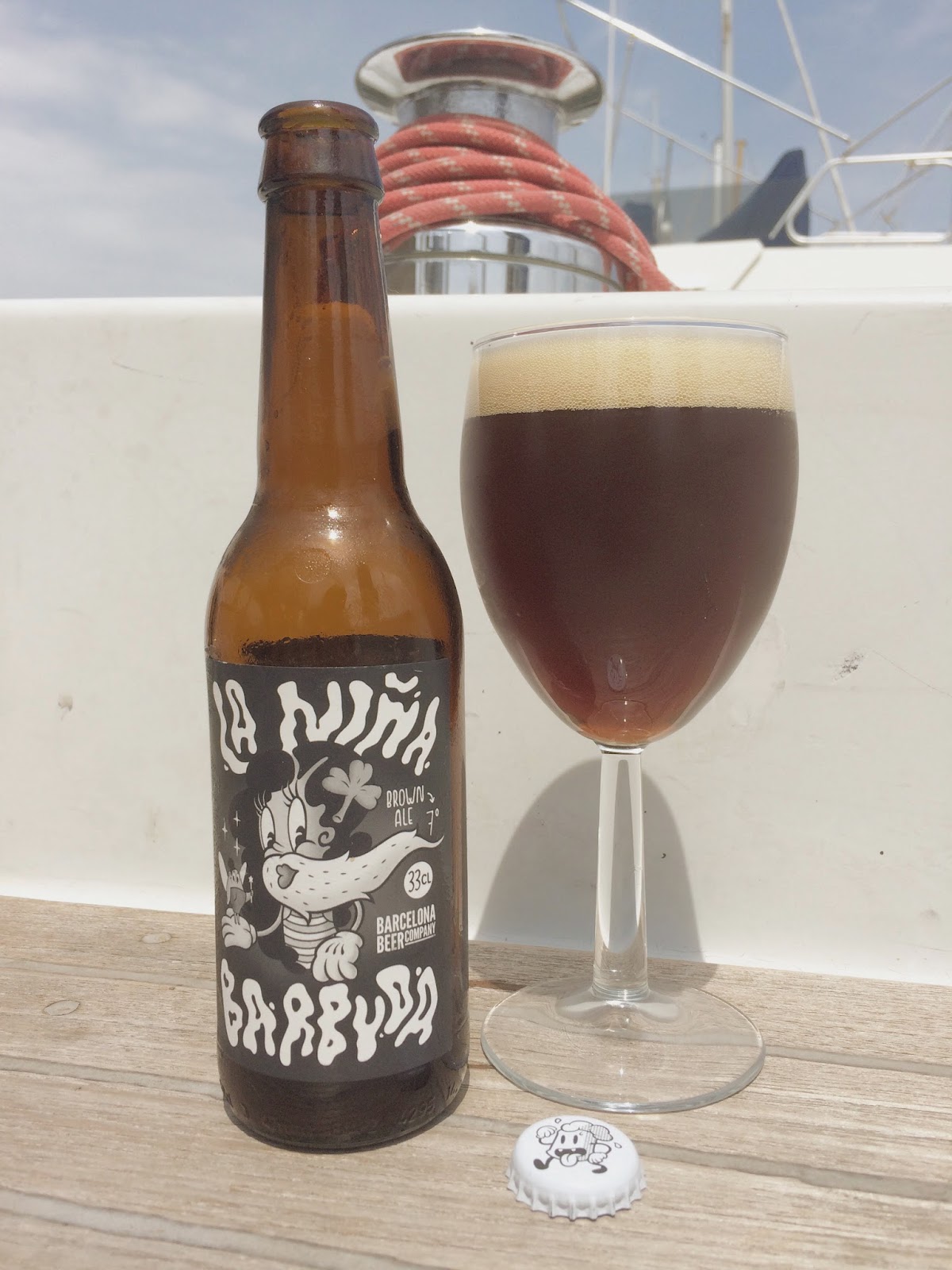
One of a healthy number of brown ales on offer, La Nina Barbuda pours a translucent cola-brown with a tight off-white head. There’s wholemeal bread and boozy Christmas pudding on the nose, and the flavour is exactly what I want from a modern brown ale – cola, cereal, savoury cereals and the peach and clementine flavours characteristic of a meeting between New World hops and darker malts. Its drawback is its pointlessly high 7% ABV – some mouthfuls have a kind of boozy spikiness which just clashes with the otherwise smooth flavours. Knock this down to 5% and you’d have an excellent brown ale.


I was drawn in by the beautiful label on this beer – not the best way to choose, but faced with hundreds of bottles from unfamiliar breweries, what else do you have to go on? This is just one of the reasons why beer branding is important. This is far, far darker than I’d like an IPA, veering towards amber ale territory. The malt brings a kind of caramel and candy floss foundation for a smooth mango hop character before a slightly spicy and bitter finish. There’s great promise here -that tropical hop flavour is gorgeous, but I’d suggest lighter malt character would accentuate it a little further.

Having recently re-read this old post from Mark Dredge on the 'pale and hoppy' cask ale, a style that's remained prominent in the UK, I started to ponder my reservations with the malt character of a couple of these beers. Many modern British breweries favour a very pale malt base, at least in beers which prominently showcase American and Southern Hemisphere hops - consider the Juicy Banger and the latest breed of  IPAs favouring ever-later hop additions and geared towards massive, booming hop aroma and flavour (the Cloudwater DIPA and BrewDog Born to Die series spring to mind here). It's telling that the beer I most enjoyed was the BeerCat, which acknowledges a British influence - I like beers like this, and they're also what I've become used to drinking. I hope this doesn't come across as a suggestion that this is what beer should be like - I'm just stating a preference.

Sunday, 12 June 2016

Cat Bar, Barcelona


Hot on the heels of my recent trip to Valencia, last week I was back in Spain. This time Barcelona was the destination and, since we were there for the Primavera Sound music festival, there was considerably less time available for beery pursuits. I didn't even scratch the surface of what seems like an interesting beer city, but on the first night before the festival properly kicked off, we stumbled across Cat Bar. We found it whilst researching vegetarian-friendly restaurant options, and I jumped at the chance to check out a bar with a fully vegan kitchen and a broad range of Spanish craft beer.

It’s a fun place - cramped and candlelit, all mismatched furniture and low ceilings, just on the right side of the bohemian/divey spectrum. The burgers we ate were fantastic, and even if the dominant accents around the tables were British and American, the draught beer is heavily skewed towards the local. I drank the Powerplant saison from Barcelona’s own Edge brewery, which was sadly drastically under-attenuated and under-carbonated and should be approached as a faintly phenolic pale ale to avoid disappointment. There are some nice lemon and lime flavours, with just a hint of juniper and pepper. It stood up well to a big, bready burger and patatas bravas with lots of paprika, which is high praise.

Also from Edge was Padrino Porter, a beer with a rich, decadent chocolatey malt depth that suits after-dinner drinking. There’s a certain earthy, Shredded Wheat hop character (East Kent Goldings?), but also a hint of New World fruitiness before a light bitter finish. It’s a little thin bodied for the style, but was also served at a temperature that suits the close Barcelona evening which makes this less of an issue. I'm rarely so refreshed by a dark beer.

Paying my tab on the way out, I decided to take advantage of the pub’s CAMRA discount, more for the novelty value than the 60c it saved me – I always forget about it and so have never used it at home, and I like the idea of doing so in Spain at a bar serving precisely no cask beer. I'd guess that not many people redeem this generous offer as it completely baffled the bar staff. The British ex-pat proprietor seemed delighted to oblige, though - he explained that there's only one bar in Barcelona that sells cask, as few bars have cellars and the climate means that a cask goes off almost instantly. He did reassure me that all his beer was KeyKeg - "beer in a bag!"

I also stocked up at Beer Store, a great bottle shop recommended to me by Joan at Birraire, via Steve at Beers I’ve Known – thanks guys! Since all conventional accommodation in the immediate vicinity of the Primavera site books up within minutes of tickets going on sale, we ended up staying on a boat in a nearby port. Heineken is the only beer available at the festival, so I established a routine of sampling the wares of Barcelona’s craft breweries on the deck before consigning myself to the Dutch fizz. A separate post detailing those nautical brews will follow soon.

Monday, 16 May 2016

Who shares wins pt. III


About a week before we were due to meet up to share some special bottles, something scary happened. Splashing out on a pint of Gamma Ray at the Evening Star, I found the hop flavour oddly muted. In fact, it tasted like a pint of sparkling water with the tiniest dash of hop oil dropped in. It wasn't the beer – it was me. I’d been feeling a little sniffly all week, and consequently getting no aroma at all. Given the upcoming occasion, I decided I to blitz my body with every remedy I could think of. To de-congest my nose, I held my head over a bowl of VapoRub dissolved in water, which makes your face feel simultaneously freezing cold and boiling hot, with the added sensation of someone holding a hairdryer over your eyelids. My ears felt a little blocked, and your ears, nose and throat are all connected, right? In with the ear drops, then, along with some warm salt water to gargle with, calming down my swollen throat. My five-a-day became seven or eight or nine as I piled all the veg I could conceivably fit on my plate each evening. Anything to avoid cracking open a carefully guarded bottle of beer and then failing to taste the delights within. It worked, anyway, and my palate was soon restored to full power.


What better way to celebrate than Burning Sky’s Cuvée Reserve? Cuvée is a blend of the brewery’s highly regarded Saison a la Provision and imported Belgian lambic, and this extra-special incarnation then rests further in an oak barrel over lambic lees. It has a strong, funky farmyard aroma with a hint of rustic cider. It is still recognisably a variation on a la Provision, and many of this beer’s flavours carry through - tart and juicy green apples hit immediately, then lemon, dill and the phantom of the Chardonnay barrel that houses the saison. A tart finish suggests the quinine bitterness of tonic water. It’s a fascinating, extremely accomplished and, most importantly, delicious beer. I'm endlessly excited to have a brewery of such ambition and invention just a few miles from my front door.

Next was Her Majesty 2015 from Yeastie Boys. Though Yeastie Boys are now brewing at BrewDog for the UK market, this beer is imported from their native New Zealand, and brewed at Invercargill. It’s a pale ale, but doesn't look like one – the addition of beetroot gives it a pinky-purple hue, and it looks gorgeous in the glass. The addition of the beets gives a notable soil-like aroma, but there’s blackcurrant on the nose, too, along with some rose. There’s a slight earthy undertaste – the brewery reckon you won’t taste the beetroot, but I beg to differ – and loads of rich, dark berries – blackcurrant, blackberries, cranberries – over a smooth caramel malt foundation. There’s a dry and bitter hoppy finish, but the hop flavours are a little muted, perhaps owing to the age of the bottle (around 6 months). It’s an interesting and tasty beer, but it doesn't blow any of us away.


Another New Zealand beer followed – Tuatara’s Black Mojo Espresso. Unsurprisingly, there’s a bit whack of coffee on the nose, with chocolate and toffee closely following. The taste has an earthy note, and there’s an unexpected hint of peaty smoke in there. Coffee flavour in stouts often mingles with roasted malts, but there’s little roast here, and the espresso quality is smooth and low in bitterness. The decadent silky body is the final triumph in an extremely impressive beer.


To finish, I pulled out a bottle of Brew By Numbers Barrel Aged Traditional Porter (12|04). I was given this just before Christmas in 2014, and it is just approaching its suggested best before date, meaning it has been in the bottle for almost two years. The bottle conditioning has made it quite lively, threatening to gush over if never quite doing so, and there is a slightly distracting fizz which takes away from the body of the beer. The flavour is beautiful, though, with the Jim Beam barrels that housed the beer contributing a lot, but never overpowering the base porter. There’s lots of vanilla and a rounded-out booziness that isn't hot or spiky, and the base beer brings spades of dried fruit and rich dark malts. Masterful barrel aging from a brewery I'm beginning to think of as one of the UK’s best.

Nervous thought: are posts like this remotely interesting? I always enjoy reading similar things on others' blogs, but it all seems a bit insubstantial and basic now that I've written it all out. I hope someone gets something out of it other than a list of beers, anyway.

Thursday, 14 January 2016

Brown ale: some final observations


Since starting this blog, I've rattled on about brown ale a fair amount. I feel I've done the subject to death, but I've also spent so much time obsessing over it that I still have things to say. Despite the stylistic diversity of brown ale, there are noticeable trends within the style. As the final word on brown ale for this blog, I propose a series of sub-categories. Bear in mind I'm not taking myself totally seriously in this – brown ale is obscure enough as it is without being chopped up into micro-styles. It’s just a way of presenting the continuities across the various examples of the style I've tasted in the past year or so.

I still try any new brown ale I see. If a local pub tweets that they’re serving one, or a brewery announces they’re making one, I’ll be making mental calculations as to how I can get to try it. It’s a uniquely fascinating style precisely because nobody seems to agree on exactly what it is. 
***
Your average beginners guide to beer styles tends to split brown ale into two categories – the sweet, low-gravity ales of the South of England, and the stronger, dry brown ales of the North. The truth is more complex; from the re-emergence of the style in the 1920s onwards, the beers were diverse and did not observe this imaginary north/south divide.

As brown ale stands today, archetypal examples of both the sweet/mild and strong-ish/dry versions remain. Mann’s Brown Ale, despite originating as one of the strongest examples of the style, now sits at 2.8% ABV and tastes largely of cola, treacle and toffee. Harvey’s Bloomsbury Brown, also at 2.8% has a strong caramel flavour, and may well be a relic of the days in which brown ale got its colour from caramel. I've never encountered any further examples of the low-gravity version of brown ale, and it’s easy to see why they fell out of favour – they’re interesting as a curiosity, but are bland and not very beery.

Newcastle Brown Ale remains the most commonly cited example of the stronger version. These beers are often dry and often described as ‘nutty’, although I've always thought this this is the power of suggestion at play – the phrase ‘nut brown ale’ is sometimes used to refer to the colour, but I've rarely detected a nutty taste. Newky Brown isn't a good beer, and it’s a shame it’s the only example of the style you’re likely to find in mainstream outlets. Far better is Samuel Smith’s Nut Brown Ale, which has a very dry quality that even veers towards red wine, and a deep, savoury malty body. (Edit; see here for some further interesting background on Newcastle Brown Ale from Martyn Cornell - "not, in any meaningful sense, a brown ale.")

Modern craft breweries have reinterpreted brown ale in several ways. The first sub-group pays homage to the traditional English brown ale, whilst not belonging to either the Mann’s or Newcastle camps. These beers are defined by a soft, comforting malt profile, which might include hints of caramel or toffee, milk chocolate, blackcurrants or blackberries or cola. A little roasted malt may creep in, but this will be more restrained than a porter or stout, and the beers are of a medium body. New-world hops might add a bitter, citrus finish but this will be subtle. Good examples I've tasted recently include Dirty Kitty by Denmark’s Beer Here and Maduro from Cigar City. Port Brewing’s Board Meeting deserves a mention for using these qualities as a foundation for a massive hit of coffee and rich chocolate – it’s terrific.

The ‘American brown ale’ style will take these characteristics and significantly amp up the hops, but not in a way that overpowers the malt backbone. Dark Star’s Rockhead is the best example of this I've tasted, and Fourpure's Beartooth is excellent, too.


Some beers call themselves ‘India brown ale’. What you’re getting here is obvious – a big hit of hops. This is generally my least favourite incarnation, though some are better than others, mainly because the brown ale base is wiped out and you end up with something closer to a black IPA. I would place BrewDog's recent “hopped-up brown ale” prototype in this category – I thought this was a poor beer all round, and tasted of little except overly bitter hops that left a citrus washing-up liquid taste that lasted for ages. Others whose tastes I trust found a lot more to it, so maybe I had an off bottle or my taste buds had an off day - either way, I stand by the assessment that the hop profile dominates everything else. Weird Beard’s No More Bright Ideas, whilst it tastes great, offers little to the brown ale enthusiast – it’s a very dry beer, bursting with vibrant and zesty hop character, but this renders the malt base irrelevant.

There is also a small breed of what appear to be brown ales, but aren't. When I wrote about Brighton Bier’s Free State, billed as “21st century brown” here, I remarked that the nevertheless delicious beer had very little ‘brown’ quality. Brewer Gary Sillence got in touch with me to clarify his intentions - “My main ambition was the break down the mainstream perception that brown beer means dull or old fashioned”, he said, and the beer was never intended to be received as a brown ale as such – his alternative tagline was “brown beer for a new generation”.  Magic Rock’s The Stooge, though billed as an American Brown Ale, seems to be doing much the same thing. It’s a far lighter shade of brown than most examples of the style. You might call its shade 'chestnut' – closer to a bitter (that's it in the photo at the very top of the first, if you'd like to see for yourself). And it drinks like a bitter, too, albeit one hopped with assertive US varieties alongside earthy British staples – the luscious malt character has an easy-drinking crispness to it that doesn't belong to brown ale. Are we at a point when the agonisingly unglamorous name ‘brown ale’ is more fashionable than ‘bitter’?
***

I don’t know it just seems this way because I've been actively looking for them, but I'm sure I'm seeing more brown ales than ever recently. With talk of a hop shortage, are breweries falling back on malt-driven styles such as this? In any event, I promise not to drone on about it any longer.

Wednesday, 25 November 2015

A date with Darkness


Whilst I do my fair share of thinking about (and drinking) beer, I don’t really do very much beer-related stuff. I don’t even go to pubs as often as I probably should, never mind travelling the country to do so; I have never been to a tap takeover, beer dinner, or even a beer festival. There are many reasons for this, but after breaking this drought at Dark Star meet-the-brewer event at Brighton’s North Laine Brewhouse last week, I'm determined to change that pattern.

The North Laine is a great space – part US-style brewpub and restaurant, part Bavarian beer hall, and can hold a lot of people, so it’s great to see them putting their extra capacity to good use with events like these. As we arrive, there’s already a small group clustered around the hand pumps at the end of the bar. Initially, we’re greeted with bad news – Dark Star’s head brewer Andy Patterson is in bed with the flu and won’t be making it. Luckily, one of the other brewers, Amir (new to the brewery after stints at Beavertown and Hackney), and director Paul Reed are here instead.

These are exciting times for Dark Star. For as long as I've lived here, their beers have been ever-present on bars across Sussex, but their reach is far greater than that of a small regional brewery. Alongside the Partridge, near the brewery, and the Evening Star in Brighton, they’re looking to open several new pubs – the first site, in Horsham, is scheduled for early next year. They also reveal this evening that they've outgrown their facilities in Partridge Green and are starting to look for new, larger premises.

Equally exciting for me is the launch of their new seasonal – Rockhead, an American brown ale, and I dive straight into a pint as people continue to arrive. I’d tried this recently from keg at the Star and was very impressed – served this way, the body is full and creamy, thick without becoming hard work. The cask version this evening is even better – it’s in fantastic condition and the hops taste hugely fresh and vibrant without threatening to wash out the foundation of warming malt. This balance isn’t always there in US-hopped brown ales, which can often come off more like black IPAs, but at the base of Rockhead are all the flavours I’m looking for in the style – caramel, cola, a little chocolate. The only American hop here is Amarillo, which lends a peachy sweetness, whilst Australian-grown Citra and a trio of British fuggles, Goldings and Admiral bring citrus bitterness.

Once everyone’s here, Paul and Amir each give a brief talk, giving some background on the brewery and their range of beers. There’s a raffle draw, in which I win a pint – I choose Revelation, which tastes all the sweeter as it’s free. Amir tells us that they use a device called a ‘hoptimiser’ in making this beer – it’s like a giant tea bag which infuses the beer with hops without directly adding them, giving the beer a smoother quality. Makes sense to me – my pint is full of juicy hop flavour, but is in no way spiky or dry. It’s fantastic.

After some plates of food are brought out for everyone to share, we hear from Laine’s head brewer Nic Donald, who talks us through the beers made in-house here, along with a quick brewery tour. When Sidony asks a question about sour beer, he’s even generous to share a sample of a pink grapefruit beer, soured in the kettle with Greek yoghurt and a dunk from some grain sacks, that he’s brewed at one of the company’s London pubs. It’s very good and I’d be delighted to see something similar on offer at the North Laine.

Beer is, quite obviously, best in a social situation. That social situation needn't be anything more complicated than a group of people talking. Beer is also good at enabling such situations, and not only through its inhibition-lowering qualities. A glass of beer in everyone’s hand is a great leveller and conversation starter, and that’s why these kinds of events can offer as much to the greenest novice as they can to the hardened beer nerds. My new year’s resolution for 2016 ought to be to do more of this sort of thing.