
Showing posts with label samuel smith's. Show all posts

Monday, 8 February 2016

Who shares wins pt. II


With a couple of months passing since our last meeting, this weekend was time for another informal bottle share. Here's what we popped open.

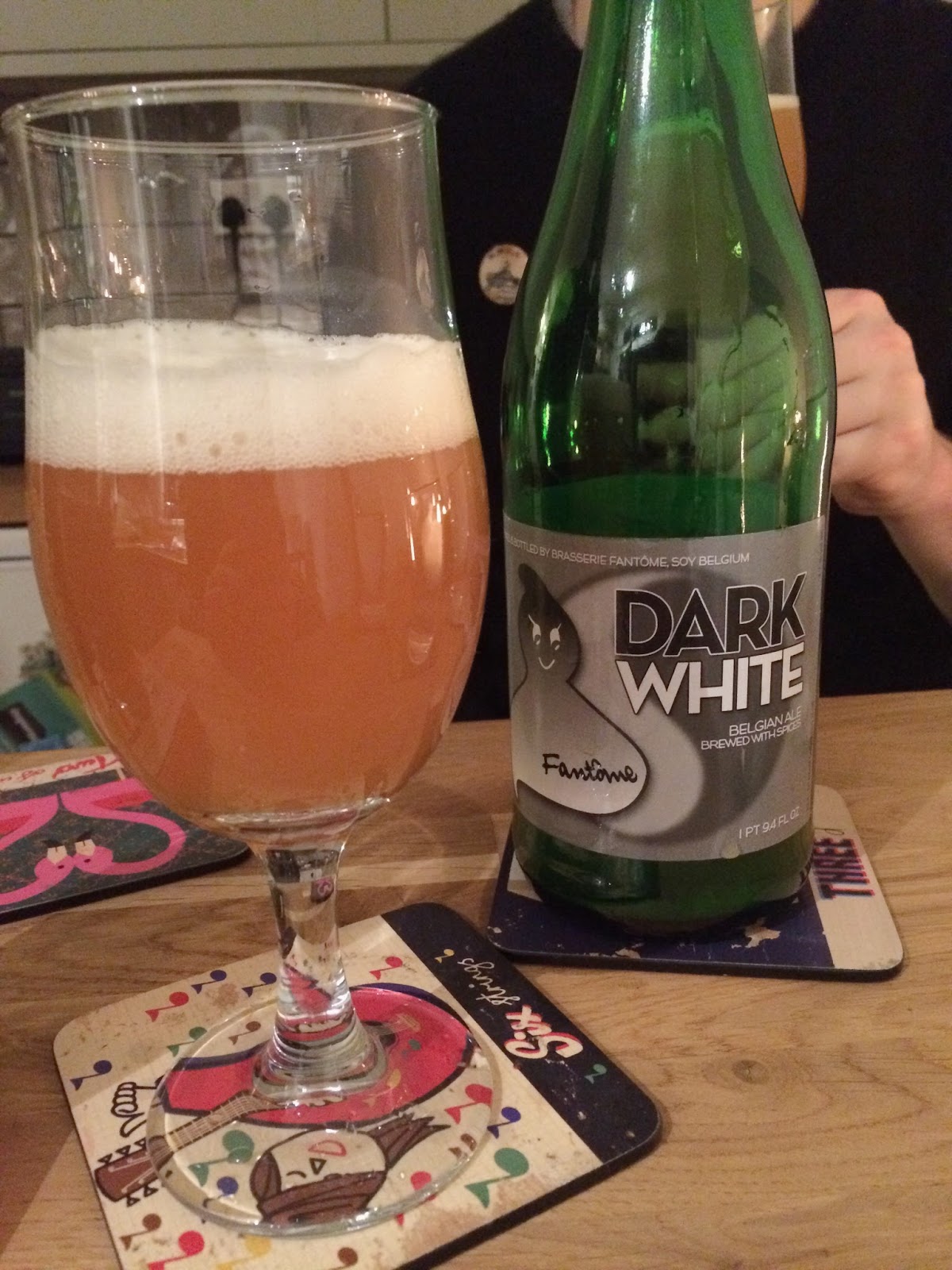
First up was one of my contributions, Dark White from Brasserie Fantôme. There's something appealingly mysterious about Fantôme - the bizarre, amateurish branding somehow draws me in, for one thing. There's the use of unusual ingredients - dandelions, for example, or a green tea which produces a beer that looks like a mad scientist's potion. The brewery's reputation is intriguingly patchy, too - Fantôme have their fanatic followers, but even these seem happy to use adjectives like "rough" and "dirty" to describe the beers. Those who are less keen seem to suggest that brewer Dany Prignon carelessly throws together his recipes with little thought as to what works and what doesn't.

Personally, this is my first taste of Fantôme - billed as a saison with spices, it appears to be brewed with black pepper. It pours a murky orange, possibly as a result of spending time in a suitcase as my Dad and brother brought it home from Brussels for me - it's had plenty of time to settle since, and there were no noticeable pieces of sediment floating around, but few pictures online look anything like as soupy as mine. The substantial white head is lively and fluffy and it has a strong nose of boiled orange sweets and farmyard funk. There are more oranges in the taste, along with oregano and pepper. The addition of pepper is deftly judged - it could easily be overdone, but rather than washing out the other flavours, it accentuates that classic saison dryness, combining with a lingering, zesty fruitiness in a quenching, bitter finish. Carbonation is surprisingly low here - I often think of brisk carbonation as a key feature in a saison, but this is a defining example of the style even without the bracing fizz. It's beautiful, and I'll be seeking out more Fantôme on the strength of Dark White.

Next was Samuel Smith's Yorkshire Stingo, a strong ale aged in oak casks that, if anything, seems to drink beyond it's 8% ABV. It's almost still, and we're not able to produce much of a head on our glasses, both factors contributing to the spirit-like nature of the beer - it does, at times, feel like something that should be sipped in small measures from a chunky tumbler. There's lots of treacle and toffee going on, along with raisins, some faint vanilla and an oaky depth from the barrel. Though it isn't as viscous or sticky as beers like this can be, the booziness is a little overwhelming - although bottle conditioned for a year before release, I'd be interested to see if another couple of years might pull it together.


Partizan Huff followed. A mysterious beer in that the label gives no indication as to style or any other information beyond the eye-popping 14% ABV. It is, in fact, a recreation of a particular ale brewed at Winchester College, which you can read more about here. Although a government laboratory analysed the beer, giving Partizan some guidelines as to what they hoped to achieve, I doubt the historical huff would have tasted much like this. Amongst others, a saison yeast has been used to simulate the original beer's dryness. The resulting character is strongly Belgian, not unlike the Fantôme saison, or leaning towards a strong tripel. The stated aim to highlight hop aroma whilst keeping bitterness low is certainly achieved, and there's an earthy hop background complimenting the flavours of candied orange peel and candy floss. Tasty as it is, it's a little hot, and would probably be more enjoyable at about half its strength.

I also had a chance to taste Beavertown and Evil Twin's XXX, an 'imperial mild' which I recently included in a round-up of bottled milds. Having written fairly exhaustively about it there, I won't repeat myself, but the beer's character has changed in the month or so since I tried it - the zesty grapefruit flavours from the hops have died down a lot, and we're firmly in barley wine territory now. It's still enjoyable, but I preferred it first time round.

Whilst the others shared a Kernel export porter and something from Innis and Gunn which was apparently reduced to pennies in a supermarket, I switched to water and concentrated on banishing an attack of hiccups. Another successful bottle share - though I'll be eating a more substantial meal before we start next time.

Thursday, 14 January 2016

Brown ale: some final observations


Since starting this blog, I've rattled on about brown ale a fair amount. I feel I've done the subject to death, but I've also spent so much time obsessing over it that I still have things to say. Despite the stylistic diversity of brown ale, there are noticeable trends within the style. As the final word on brown ale for this blog, I propose a series of sub-categories. Bear in mind I'm not taking myself totally seriously in this – brown ale is obscure enough as it is without being chopped up into micro-styles. It’s just a way of presenting the continuities across the various examples of the style I've tasted in the past year or so.

I still try any new brown ale I see. If a local pub tweets that they’re serving one, or a brewery announces they’re making one, I’ll be making mental calculations as to how I can get to try it. It’s a uniquely fascinating style precisely because nobody seems to agree on exactly what it is. 
***
Your average beginners guide to beer styles tends to split brown ale into two categories – the sweet, low-gravity ales of the South of England, and the stronger, dry brown ales of the North. The truth is more complex; from the re-emergence of the style in the 1920s onwards, the beers were diverse and did not observe this imaginary north/south divide.

As brown ale stands today, archetypal examples of both the sweet/mild and strong-ish/dry versions remain. Mann’s Brown Ale, despite originating as one of the strongest examples of the style, now sits at 2.8% ABV and tastes largely of cola, treacle and toffee. Harvey’s Bloomsbury Brown, also at 2.8% has a strong caramel flavour, and may well be a relic of the days in which brown ale got its colour from caramel. I've never encountered any further examples of the low-gravity version of brown ale, and it’s easy to see why they fell out of favour – they’re interesting as a curiosity, but are bland and not very beery.

Newcastle Brown Ale remains the most commonly cited example of the stronger version. These beers are often dry and often described as ‘nutty’, although I've always thought this this is the power of suggestion at play – the phrase ‘nut brown ale’ is sometimes used to refer to the colour, but I've rarely detected a nutty taste. Newky Brown isn't a good beer, and it’s a shame it’s the only example of the style you’re likely to find in mainstream outlets. Far better is Samuel Smith’s Nut Brown Ale, which has a very dry quality that even veers towards red wine, and a deep, savoury malty body. (Edit; see here for some further interesting background on Newcastle Brown Ale from Martyn Cornell - "not, in any meaningful sense, a brown ale.")

Modern craft breweries have reinterpreted brown ale in several ways. The first sub-group pays homage to the traditional English brown ale, whilst not belonging to either the Mann’s or Newcastle camps. These beers are defined by a soft, comforting malt profile, which might include hints of caramel or toffee, milk chocolate, blackcurrants or blackberries or cola. A little roasted malt may creep in, but this will be more restrained than a porter or stout, and the beers are of a medium body. New-world hops might add a bitter, citrus finish but this will be subtle. Good examples I've tasted recently include Dirty Kitty by Denmark’s Beer Here and Maduro from Cigar City. Port Brewing’s Board Meeting deserves a mention for using these qualities as a foundation for a massive hit of coffee and rich chocolate – it’s terrific.

The ‘American brown ale’ style will take these characteristics and significantly amp up the hops, but not in a way that overpowers the malt backbone. Dark Star’s Rockhead is the best example of this I've tasted, and Fourpure's Beartooth is excellent, too.


Some beers call themselves ‘India brown ale’. What you’re getting here is obvious – a big hit of hops. This is generally my least favourite incarnation, though some are better than others, mainly because the brown ale base is wiped out and you end up with something closer to a black IPA. I would place BrewDog's recent “hopped-up brown ale” prototype in this category – I thought this was a poor beer all round, and tasted of little except overly bitter hops that left a citrus washing-up liquid taste that lasted for ages. Others whose tastes I trust found a lot more to it, so maybe I had an off bottle or my taste buds had an off day - either way, I stand by the assessment that the hop profile dominates everything else. Weird Beard’s No More Bright Ideas, whilst it tastes great, offers little to the brown ale enthusiast – it’s a very dry beer, bursting with vibrant and zesty hop character, but this renders the malt base irrelevant.

There is also a small breed of what appear to be brown ales, but aren't. When I wrote about Brighton Bier’s Free State, billed as “21st century brown” here, I remarked that the nevertheless delicious beer had very little ‘brown’ quality. Brewer Gary Sillence got in touch with me to clarify his intentions - “My main ambition was the break down the mainstream perception that brown beer means dull or old fashioned”, he said, and the beer was never intended to be received as a brown ale as such – his alternative tagline was “brown beer for a new generation”.  Magic Rock’s The Stooge, though billed as an American Brown Ale, seems to be doing much the same thing. It’s a far lighter shade of brown than most examples of the style. You might call its shade 'chestnut' – closer to a bitter (that's it in the photo at the very top of the first, if you'd like to see for yourself). And it drinks like a bitter, too, albeit one hopped with assertive US varieties alongside earthy British staples – the luscious malt character has an easy-drinking crispness to it that doesn't belong to brown ale. Are we at a point when the agonisingly unglamorous name ‘brown ale’ is more fashionable than ‘bitter’?
***

I don’t know it just seems this way because I've been actively looking for them, but I'm sure I'm seeing more brown ales than ever recently. With talk of a hop shortage, are breweries falling back on malt-driven styles such as this? In any event, I promise not to drone on about it any longer.

Tuesday, 6 January 2015

Brown ale pt. 2 : Three 'traditional' brown ales


Brown Ale #1 - Newcastle Brown Ale


It makes sense to start here, doesn't it? Newcastle is likely to be the principle point of reference in many people’s idea of what brown ale is. It is also the only brown ale I was able to find in any supermarket or mainstream off license in Brighton. And, aside from anything else, I haven’t tasted it in years. After deciding to include it in this post, I had to think about whether I knew I didn't like it, or simply suspected it wasn't very exciting. I know I've drunk it before, but I think my main motivation for doing so was to appear more interesting by choosing something other than lager; I didn't make any tasting notes, put it that way.  Still, I’m determined to give it a fair chance and reserve judgement before I objectively taste it.

The first thing you’re likely to notice about Newcastle Brown Ale is that it isn't especially brown. When I imagine this beer, I’m picturing something akin to the water in the River Tyne; murky, maybe even a little gloopy. In fact, there’s an attractive translucence about it, and indeed the brewery are said to have tinkered with the colour for some years in an attempt to make it more visually appealing. This might explain the clear glass bottle, too. I don’t think I’ve ever tasted a lightstruck beer, but nevertheless, clear glass is always a warning sign for indifferent brewing.

The nose is dominated by malt, and actually reminds me of lager more than anything. As the beer warms, the aroma gets a little grassier, maybe with a little hay, too, but there’s not much going on here. And the taste isn't exactly a revelation, either. It’s surprisingly sweet, and again, the most prevalent flavours are those you’d expect from a much lighter beer; lager-like malt dominates, with a slight lingering bitterness from the hops. If you try really hard, you might detect the slightest notes of stewed apples, ground almonds and hazelnuts. But that might just be wishful thinking. Imagine a drink that’s half Belgian dubbel and half tap water and you’re getting close.

Bland though it may be, this beer is at least refreshing, especially considering its usually consumed at temperatures far below those usually recommended for ale (mine spent about 45 minutes in the fridge before drinking, for what it’s worth). But my bottle is borderline flat, and the mouthfeel is thin and flimsy; it makes for easy drinking, but it’s fundamentally unsatisfying.


Would I drink it again? I might, if I happened to be stuck in a terrible pub where the only alternatives were awful mass-produced lagers. But I’d rather drink almost anything else. The bar is certainly set very low for the remaining brown ales in my selection.


And to follow, how could I resist Harveys' tongue-in-cheek “tribute”, featuring the eponymous castle on the label? My relationship with Harvey’s has been up and down; I've found some of their beers extremely disappointing and bland and some of them wonderful. I despised their Best Bitter for years until a revelatory few pints just before Christmas (in a student bar serving nothing but Best, Carlsberg and Guinness, of all places) confirmed that it is a terrific beer worthy of its reputation, and I suspect my disappointment with it in the past was due to poor conditioning in local pubs.

Harvey’s version of brown ale pours much darker than Newcastle’s. It is almost opaque, looking something like a porter or stout. The aroma shares characteristics with several of the brewery’s beers – perhaps it’s the house yeast I’m recognising here. It’s slightly vinous, or maybe closer to malt vinegar. The taste, thankfully, is more palatable than this would suggest, however, with black treacle, plums and some bread and cereal notes.  There’s a little sweetness, especially as the beer warms, with the slightest hint of chocolate. The mouthfeel is much more substantial than the Newcastle, thicker and with a pleasing tingle of carbonation on the tongue.

Given the choice, I’d probably opt for the more robust porter from the same brewery, but this is a very enjoyable beer, particularly well-suited to a wintery Sunday afternoon on the sofa.


If you’re looking for traditional examples of pretty much any indigenous British beer style, Samuel Smith’s beers tend to provide a good guide. Not every beer in their portfolio is great, but several are; Taddy Porter is a favourite, and I’m also very partial to their Imperial Stout, full of flavour at a very low ABV for the style. It makes sense that they’d brew a straight-up brown ale and, somehow making it sound even less exciting than it already does, they call it Nut Brown Ale.

It pours a caramel colour, far darker than Newcastle but nowhere near stout territory. The nose has more of that vinous quality I noted in the Harvey’s, mixed in with treacly malt and a little walnut. The flavour recalls wholemeal bread, and actually reminds me of biting into a nut; it’s very dry and bitter. If that doesn’t sound like a ringing endorsement, I’d also point out that it’s very refreshing. The lingering bitterness in the finish and aftertaste reminds me very much of red wine, and drinking this I even get a little of the warm feeling in the chest that I get whenever I stray from the grain over to the grape.

It’s not the most exciting beer in the world, but for sheer drinkability, I’d rate Sam Smith’s the highest of the three traditional brown ales I've tasted. The red wine comparison and absence of overly bold and intrusive flavours make me think that this could accompany a wide variety of foods, and indeed the label suggests pairing it with dishes as diverse as roast grouse and biryani.

To conclude… it’s difficult to take a great deal away from this mini-tour of traditional brown ales. Newcastle Brown Ale has very little in common with the other two beers I tasted, but that’s to be expected from a beer produced by a multinational corporation rather than a small regional brewery. There were some characteristics shared by both Harvey’s and Sam Smiths; that molasses-like malt flavour is present in a somewhat muted form in certain porters, but is a key feature of both of these brown ales. Could it be a defining feature of the style? Both beers have a certain moreish dryness, too. Beyond that, there’s not much going on to define what I mean what I say brown ale. I’d try more to get a broader cross section if I could, but further traditional examples are simply not available in my area (I had hoped to sample at least Mann’s, which I understand is sweeter, but it doesn't seem to make it down to Brighton.) For the ‘modern’ breweries I’ll be sampling next, the canvas is almost blank.