
Showing posts with label evil twin. Show all posts

Monday, 8 February 2016

Who shares wins pt. II


With a couple of months passing since our last meeting, this weekend was time for another informal bottle share. Here's what we popped open.

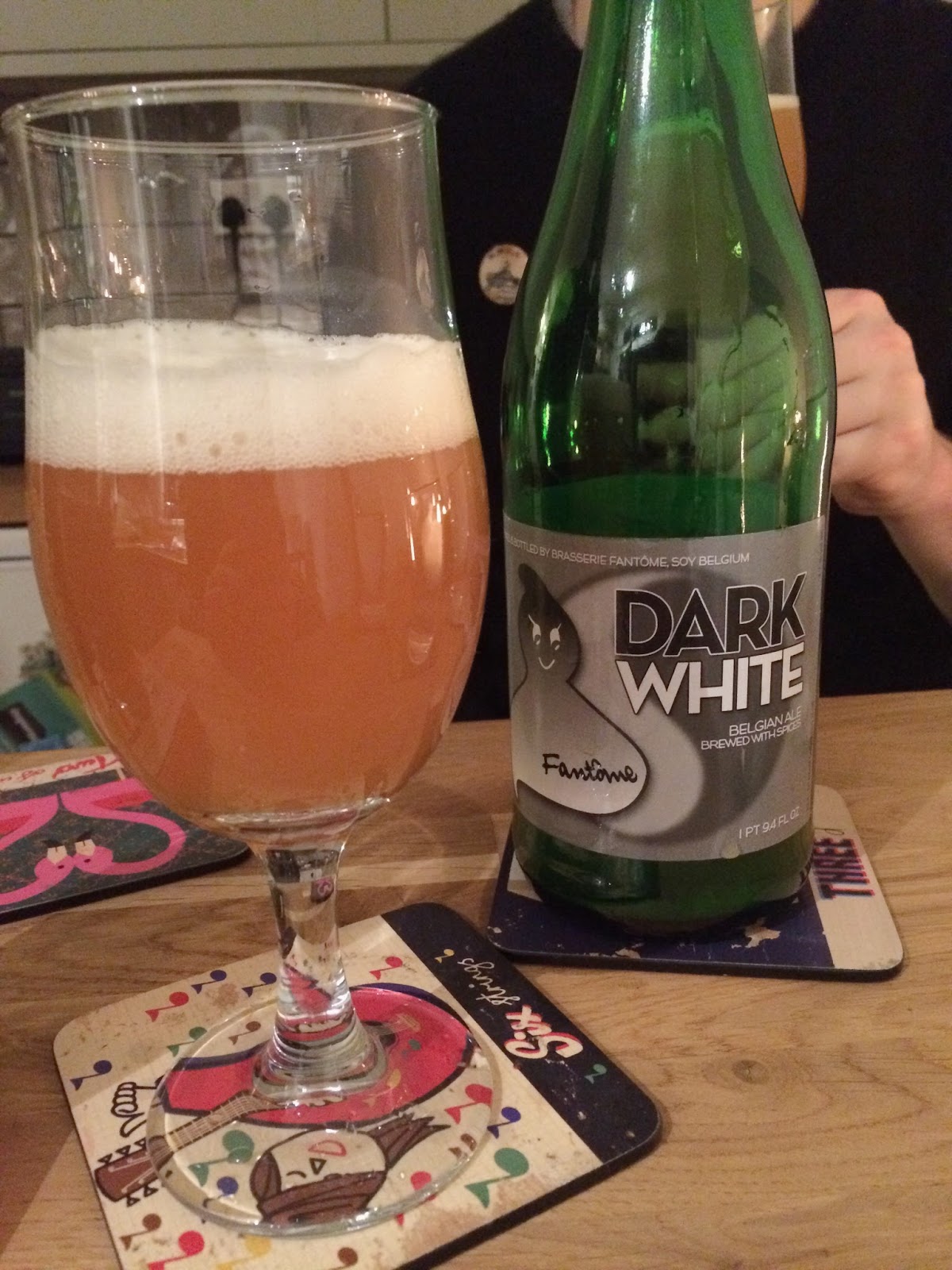
First up was one of my contributions, Dark White from Brasserie Fantôme. There's something appealingly mysterious about Fantôme - the bizarre, amateurish branding somehow draws me in, for one thing. There's the use of unusual ingredients - dandelions, for example, or a green tea which produces a beer that looks like a mad scientist's potion. The brewery's reputation is intriguingly patchy, too - Fantôme have their fanatic followers, but even these seem happy to use adjectives like "rough" and "dirty" to describe the beers. Those who are less keen seem to suggest that brewer Dany Prignon carelessly throws together his recipes with little thought as to what works and what doesn't.

Personally, this is my first taste of Fantôme - billed as a saison with spices, it appears to be brewed with black pepper. It pours a murky orange, possibly as a result of spending time in a suitcase as my Dad and brother brought it home from Brussels for me - it's had plenty of time to settle since, and there were no noticeable pieces of sediment floating around, but few pictures online look anything like as soupy as mine. The substantial white head is lively and fluffy and it has a strong nose of boiled orange sweets and farmyard funk. There are more oranges in the taste, along with oregano and pepper. The addition of pepper is deftly judged - it could easily be overdone, but rather than washing out the other flavours, it accentuates that classic saison dryness, combining with a lingering, zesty fruitiness in a quenching, bitter finish. Carbonation is surprisingly low here - I often think of brisk carbonation as a key feature in a saison, but this is a defining example of the style even without the bracing fizz. It's beautiful, and I'll be seeking out more Fantôme on the strength of Dark White.

Next was Samuel Smith's Yorkshire Stingo, a strong ale aged in oak casks that, if anything, seems to drink beyond it's 8% ABV. It's almost still, and we're not able to produce much of a head on our glasses, both factors contributing to the spirit-like nature of the beer - it does, at times, feel like something that should be sipped in small measures from a chunky tumbler. There's lots of treacle and toffee going on, along with raisins, some faint vanilla and an oaky depth from the barrel. Though it isn't as viscous or sticky as beers like this can be, the booziness is a little overwhelming - although bottle conditioned for a year before release, I'd be interested to see if another couple of years might pull it together.


Partizan Huff followed. A mysterious beer in that the label gives no indication as to style or any other information beyond the eye-popping 14% ABV. It is, in fact, a recreation of a particular ale brewed at Winchester College, which you can read more about here. Although a government laboratory analysed the beer, giving Partizan some guidelines as to what they hoped to achieve, I doubt the historical huff would have tasted much like this. Amongst others, a saison yeast has been used to simulate the original beer's dryness. The resulting character is strongly Belgian, not unlike the Fantôme saison, or leaning towards a strong tripel. The stated aim to highlight hop aroma whilst keeping bitterness low is certainly achieved, and there's an earthy hop background complimenting the flavours of candied orange peel and candy floss. Tasty as it is, it's a little hot, and would probably be more enjoyable at about half its strength.

I also had a chance to taste Beavertown and Evil Twin's XXX, an 'imperial mild' which I recently included in a round-up of bottled milds. Having written fairly exhaustively about it there, I won't repeat myself, but the beer's character has changed in the month or so since I tried it - the zesty grapefruit flavours from the hops have died down a lot, and we're firmly in barley wine territory now. It's still enjoyable, but I preferred it first time round.

Whilst the others shared a Kernel export porter and something from Innis and Gunn which was apparently reduced to pennies in a supermarket, I switched to water and concentrated on banishing an attack of hiccups. Another successful bottle share - though I'll be eating a more substantial meal before we start next time.

Thursday, 7 January 2016

Going mild

Perhaps unconsciously inspired by Boak and Bailey’s recent bottled mild taste-off, I seem to have amassed a small collection of these myself. Mild has always been a curiosity to me, fuelled by the fact that it’s rarely seen at all in this part of the country. Bottled mild also seems to be uncommon – as I learnt recently, this probably dates back to the time when breweries primed their mild for bottling and labelled it brown ale – though brown ale was not necessarily always the same as mild, bottled mild was nevertheless rare. And anyway, mild in its modern form (low ABV and easy drinking) is strongly associated with sessions in the pub rather than supping on the sofa. That’s not to say it doesn't work in bottled form, as proven by the following thoughts on four beers, none of which were less than decent.


In 2012, Pretty Things brewed two milds in collaboration with Ron Pattinson. Both were based on archival Barclay Perkins recipes; the first, from 1838, was strong (7.4%) and highly hopped, whilst the post-Second World War beer demonstrates the effect of the war on brewing, having dropped to just 2.8% and using only a fifth of the hops of the previous incarnation. “This is mild as we know it today”, read Ron’s notes on the label, “a low-gravity, lightly hopped, dark beer.”

Having read about the beer on Ron’s blog, I was excited to find it for sale at Beers of Europe. I had assumed that a second batch had been brewed since then, and might not have taken the punt had I known the bottle was almost four years old. Mild – especially a low-alcohol one with light hopping – isn’t a style for the cellar, and I was a little worried about how it might have held up.

As it turns out, all was well. An initial musty flavour had me fearing the worst but, if I'm not mistaken, this is a characteristic of the hops. I found a similar flavour recently in a pint of Kent’s KGB bitter, an East Kent Goldings-heavy brew. It’s earthy, a little like tobacco with an edge of Shredded Wheat, and it’s not unpleasant. The pour isn't as dark as I expected – a dark amber rather than brown or black, with a fluffy with head. Golden syrup aromas burst from the glass, along with some marmalade. A thirsty first chug is dominated by that earthiness, accompanied by slightly sweet and nutty malty flavours which suggest toffee and marzipan, and the finish is dry and bitter with a slightly chalky, mineral aftertaste.

There’s a tingle of carbonation on the roof of the mouth, but too much – it remains soft and smooth, closer to a cask pint than your usual effervescent bottle, and if the body is a little thin, that smoothness more than makes up for it. I know poncing around with tasting notes, which isn't really appropriate for a mild from 1945 even if I think the beer is interesting enough to justify doing so. But, drinking this, it’s easy to see why modern milds were so popular – it’s tasty, but easy to drink and moreish with it.


Sadly I don’t have a bottle of Pretty Things’ 1838 mild to compare, but I do have this, a 9.5% monster based on an 1839 recipe from an unnamed London brewery. This may be pretty far removed from what we recognise as mild today, but the fact that this beer is billed as an ‘imperial mild’ still raises a smile. Even if we accept the word ‘imperial’ as simply a synonym for ‘strong’, doesn't using an archival recipe suggest that this is just what mild was like at that time? Perhaps with two hip breweries involved, they felt they needed to give the beer a craft makeover.

The pour is a slightly hazy burnt orange, and spicy citrus fruit (more marmalade) and Cointreau aromas rise from the glass. Take a sip and the beer seems to slip around in your mouth, the alcohol revealing itself in a slick, viscous mouthfeel, and orange peel spiciness fizzes on the tongue. There are zesty, bitter grapefruit flavours too which suggest vigorous hopping, alongside savoury bread-like malt notes before a hot, boozy finish that recalls desert wine.

The alcohol is a little harsh for my tastes, and whilst I understand that milds aren't necessarily mild in strength, it’s a bit odd to place a beer that tastes like Fuller’s Golden Pride in amongst beers a third of its ABV. I enjoyed it well enough, but I think its best approached as a curiosity.

On an unrelated note, when I saw that gypsy brewer Evil Twin had collaborated with Beavertown, I assumed the beer was brewed at the London brewery. According to the bottle, though, it was brewed at Westbrook “for Evil Twin”. And, since the recipe wasn't original, I can’t help but wonder what either of the breweries who put their name on this beer actually did towards making it.


I think of mild as primarily a dark beer, though it needn't necessarily be so, and so Thwaites Champion is much more what I expect from a mild than either of the previous beers. It pours a deep brown with deep red edges and beautiful, creamy off-white head which lasts throughout the glass. There’s very little on the nose save for a slightly unpleasant metallic note (I’m not drinking straight from the can, before you ask). Some berry sweetness makes itself apparent immediately, followed by malty caramel. There are some slightly vegetal hops in there, too, and a dry, quenching finish. The body is thin as you’d expect at 3.2% ABV, but that doesn't slip away in an unsatisfying away, instead demanding another thirsty glug. It’s not really a beer to think too hard about, designed as it is to be unchallenging but flavoursome, and it’s doing a good job in that respect. Probably tastes best on the fourth pint.


Another dark-ish offering here, with a little red-brown hue. As I poured it into the glass, an intense fruit ‘n’ nut aroma wafted towards me, recalling Chimay Bleue. As I poked my nose in proper, all I got was caramel, and lots of it. Stout-like roast malt flavour jumps out on the first sip, suggesting liquorice or very dark roasted coffee. Again, there’s some dank, slightly vegetal hops which, even if it doesn’t sound it, is pleasant and adds depth of flavour, and the finish is dry and hugely burnt-tasting and bitter. It’s basically a variation on a stout – an astringent, roasty stout rather than a smooth chocolatey stout, and you certainly can’t accuse the brewery of failing to pack sufficient flavour into a low ABV beer. Given the choice, I’d take the subtlety of Thwaites’ version over this, which is maybe a bit too much of a bitter smack in the mouth to be really sessionable.

Monday, 25 May 2015

On tour with The Soft Walls - pt.1

For the past couple of years, I've been playing guitar in the live incarnation of my good pal Dan Reeves’ home recording project, The Soft Walls. In May, we were lucky enough to embark on an 8-show European tour supporting the excellent Viet Cong from Canada. As if this prospect wasn't exciting enough, my heart skipped a beat when the list of dates came through, as the tour took us through some of Europe’s most exciting beer locations, too. And whilst beer wasn't the purpose of the trip, I would surely have a bit of free time for a whistle-stop tour of the local brews between shows. What follows is a run-down of what I drank during the trip.

Tap list at Hoppy Days, Amsterdam. Just visible is the cat I befriended as I drank.
We begin the tour feeling a little haggard after a night on the Murphy’s Irish Red on the overnight ferry between Harwich and the Hook of Holland. Arriving in Amsterdam and driving around searching for the venue, we pass a branch of the Gollem beer café as well as an intriguing brewpub with fermentation tanks in the window. After breakfast and a stroll around the city, neither location can be found in a midst of issues with maps and depleted iPhone batteries. Instead, we settle down for a couple of glasses of La Chouffe at a local café, and I enjoy a glass of Zatte, a tripel from Amsterdam’s Brouwerij 't IJ, in a pleasant canal-side bar. This a beautiful beer, up there with Westmalle as far as I'm concerned. The venue hosting tonight’s show is next store to an Italian restaurant slash craft beer bar called Hoppy Days, so I head over there to wind down after our set. Many of their beers are Italian, though a few are Dutch, and the barman couldn't be more helpful in guiding me to a selection. I choose Heavy White Zen from Pampus, another Amsterdam brewery. It’s a wit beer hopped with Sorachi Ace, with an unusually tart finish which sets it apart from your average wit.

Foreground - Evil Twin Sour Bikini. Background - crazy traditional Danish band at Fairbar, Aarhus.
Hannover is all about bottles of Herrenhauser, the decent local lager, and Franziskaner dunkelweiss. I barely leave the venue, and have fun hanging out and watching Viet Cong play a blinder. The next show is in Aarhus in Denmark, as part of the Pop Revo festival which takes place in several venues across this small and pleasant student town. I didn't have any beery plans here, but there’s some down time after we play, and a quick internet search directs me to Fairbar, a stylish bar serving only Danish beers on tap. The vibe here is a marked contrast to the rowdy, drunken (though very friendly and accomodating) students attending the festival – a band is playing presumably traditional Danish music on acoustic instruments - including what I think is a lute – in period dress, whilst a respectful crowd watch appreciatively. The music might not be my thing, but it is at least an antidote for my ringing ears after our loud set. I opt not to ask the bar staff for advice as I don’t want to talk too much over the band, so plump for a beer I've heard of – Evil Twin’s Sour Bikini. This is the sourest Berliner Weisse I've ever had, dominated by lemon, but husky kiwi and tart raspberries add background, and it’s delicious. After that, I'm craving some juicy hops, so go for LagerManden from Humleland in Risskov, a US-hopped IPL. Perhaps the residual sour sensation from the previous beer distorts the taste, but it’s incredibly sweet at first, all candy floss and baked peaches. But the more I drink, the more zesty grapefruit bitterness I find, and the soft carbonation makes it incredibly, perilously drinkable. I end the night by watching Jad Fair and Norman Blake (of Half Japanese and Teenage Fanclub respectively) play some beautiful love songs together, accompanied by a bottle of the rich and complex Limfjords Porter, brewed by Thisted.


Berlin is our next stop. After our gig, we have a couple of days off here, and the band members are joined by our girlfriends/boyfriends/wives/children, wherever applicable. Amongst countless bottles of Rothaus Pils and Tegernseer Hell, a few of us travel to Wedding, across the city, in search of the Eschenbrau brewpub. I’ve been wanting to visit for a long time, and their pils doesn’t disappoint; it has a full, even creamy body, with a decent bitterness and deep savoury flavour. The aftertaste is husky and bread-like, with just the slightest hint of green vegetables. I love lager, but it very rarely knocks me out the way this one does. The woman serving is complaining that today’s beer is difficult to pour, and this may explain the lack of carbonation in the glass of dunkel that follows – I’d have liked a little more, though I enjoy its blend of caramel wafers, mocha and butterscotch all the same. Finally, the weizen carries the same husky, savoury quality as the pils, but with an aftertaste of tart green apples, and is delicious and very moreish.  There are reportedly countless amazing beer locations all across the city, but I’d highly recommend Eschenbrau for solid examples of classic German styles in a charming location. I’ll certainly be back some day.

To be continued...