Monday, 12 October 2015

Sorachi onion soup


French onion soup with IPA – that was the idea that leapt into my head one afternoon, whilst daydreaming at work.  Not French onion soup accompanied by IPA – I mean with the beer in the soup, as part of the broth. There’s nothing new, of course, and as I googled the term I discovered I’m not the first to have the idea. But I did come up with a twist that I figured was worth a try – what if I was to use a single hop Sorachi Ace IPA? It’s an unusual and divisive hop that, to me, is a big burst of citrus (lemon and clementine) with a herbal edge which recalls dill. The fruitiness will match the tang of the cheese toasts which sit, oozing on top of the broth, whilst that savoury element is a natural partner for the herbs in the soup.

Beers showcasing Sorachi Ace aren't as unusual as they used to be, though they tend to stick to the saison style (the eponymous examplefrom Brooklyn Brewery, Wild Beer’s Epic Saison, or Adnams' version for Marks & Spencer – all great beers). The only beer I've come across that fits the bill is Weird Beard’s Sorachi Face Plant, so that’s what I'm using here.

As a guide, I referred to Felicity Cloake’s ‘perfect’ French onion soup recipe, making certain changes where necessary. I'm not using any cider or brandy, as I don’t want to confuse the flavour of the beer, and I'm using vegetable stock in place of beef, as I don’t eat meat. I'm also using cheddar cheese for my toasts – not very French, I know, but I love cheddar with sweet onions and I think it’s a perfect foil for hop bitterness.

The Ginger Pig, whose recipe I initially found, suggested that the chosen beer shouldn't be “too gutsy”. This is clearly not the case for the 8.6% beast I'm using. There is a lingering, boozy bitterness in the finished dish but, I would suggest, no more than there would have been had I added a nip of brandy at the last moment, as many recipes suggest. To me, it isn't too much, especially in combination with the cheese toasts, and a taste of the beer on the side pulls everything together beautifully. If you don’t want this bitterness, something like Adnams' Marks & Spencer saison, or Bristol Beer Factory’s Sorachi, a more subtle golden ale, might make a good substitute.

This recipe takes time, but it’s not labour intensive – most of the time, you can be elsewhere while the dish cooks.

INGREDIENTS (makes 2 small, starter-sized portions or one main course)
80g butter
5 onions (based on the medium-sized ones in a kilogram bag)
1 tsp plain flour
1 tsp balsamic vinegar
Pinch of dried thyme
1 bay leaf
300ml vegetable stock
200ml beer (Sorachi Face Plant or other Sorachi Ace beer)
1 tsp sugar
6 medium-thick slices of baguette
Grated cheddar cheese

METHOD

  • First, prepare the onions by peeling, halving and finely slicing.
  • Melt the butter in a large pan over a low to medium heat. When it’s melted, add the onions. Fry for a few minutes, then sprinkle with a generous pinch of salt. Stir frequently for about 10 minutes, until they begin to become soft and translucent.
  • Stir in the thyme and bay leaf, then turn the heat right down and put a lid on the pan. This will retain the moisture and help the onions to soften and caramelise quicker. They’ll still need at least an hour – 90 minutes if possible – until they’re a rich caramel colour.
  • Add the flour to the pan and stir for a minute or so. Now add the vinegar and roughly half of the beer along with the vegetable stock. If your flour has gone lumpy, you may need to use a whisk at this point. Simmer the broth for around another hour until it has significantly reduced, which will allow for the addition of the remaining beer at the last moment.
  • While the soup reduces, heat the grill and toast your baguette slices on both sides. Set these aside. Grate as much cheese as you dare to top the toasts later.
  • When the soup is looking thicker, heat the grill again, ready to grill the cheese toasts when the soup if finished.
  • Add a teaspoon of sugar to the broth, which will counteract some of the bitterness in the beer. Check the seasoning, and then stir in the remaining beer. Keep the heat very low, and stir just long enough to heat, but not reduce any further.
  • Ladle the soup into bowls. Top with the toasted baguette slices, then cover in grated cheese. Place the bowls under the grill until the cheese is melted and bubbling.
  • Serve, ideally with a glass of the same beer you used to cook as an accompaniment.  

  • Monday, 5 October 2015

    Two brown ales; Brighton Bier and Fourpure

    Usually, I wait until I've tried five or six new brown ales and post a bulletin on my latest finds, as I did here and here. On this occasion, I thought I’d better get in quick with my thoughts on two (I think) limited edition beers whilst they’re still around.


    Brighton Bier are having a great 2015. Having installed a brand new brewery, they’re going from strength to strength, and at this point have gotten extremely good at packing juicy hop flavour into their beers. Tasting Free State in cask conditioned form, I felt like the beer in front of me just could not possibly taste any fresher – the hops are so upfront, but at the same time, don’t smack you around the chops with bitterness. My guess, at the time, was the hop bill was a mixture of US and Southern Hemisphere hops – “something like orange and lime pith which seems like a Southern Hemisphere thing”, I wrote in a note on my phone, whilst also picking out a lychee tang that suggested Citra. I was wrong on both counts – this is a single hop beer made with Equinox, a new US variety from the same breeders that brought us Mosaic, Simcoe and the aforementioned Citra. The citrus pith thing is a kind of lingering fizzy sensation on the tongue, slightly dry and always encouraging another sip. A complex malt base brings a full, mealy body that’s pitched perfectly for my liking – not heavy going, but never feels like it’s slipping away too easily.

    I do have one slight issue, though. Had I been accosted in the pub, blindfolded and asked to taste this beer without knowing what it was, I would have confidently told you it was a pale ale. It’s brown in appearance, sure, but it’s a strange experience whereby the image of the glass you’re drinking from and the taste of the beer in your mouth don’t seem to match. Maybe, once the glass has warmed a little and once I go specifically in search of it, I can detect a hint of caramel, a little chocolate. Don’t get me wrong – this is a great beer, probably the best I've tasted from this excellent brewery and one I could drink endlessly. I just like a suggestion of something dark in my brown ale.


    In one of my first posts on the subject of brown ale, I featured a seasonal from Fourpure called, simply, American Brown Ale. This beer served as a prototype for Beartooth, an improved version under a new name and in a new can. I enjoyed it a lot first time round, though my review seems to dwell on a dryness that isn't really there in the new version. It’s still bitter, but well balanced, and full of juicy hop flavour as well.

    It’s a very handsome pour – dark brown, bordering on black, with a thick and creamy beige head, and an enticing aroma of fresh citrus fruits hits you immediately. The flavour is a delicate balancing act between malt and hops – there are husky, cereal-like flavours in the background, with a little roasted bitterness that brings coffee and the faintest hint of smoke. The hops, which recall grapefruit and small, sweet oranges – satsumas or tangerines - are harmonious with this malt backbone, neither element threatening to overpower the other. It’s wonderful, and you should drink it whilst you can.

    Monday, 14 September 2015

    Weird pubs in Brighton and Hove: The Neptune


    I've been living thirty seconds away from the Neptune for the past six months. Now, with just a few days to go until I move house, I thought I’d better satisfy my curiosity and finally take a look in the first in an occasional series of weird pubs around the city.

    Several weird things about the Neptune are noticeable in a glance. The cool ornate sign is one, and the general weather-beaten appearance (it’s just off Hove’s seafront) another. When the front door is shut, which weather dictates it usually must be, you can’t see in very clearly. Pubs like this always look shut even when they’re open, and always have me anticipating an American Werewolf in London-style entrance. The Neptune also bears the branding of a Courage tied pub, intriguing since this brewery no longer exists. I had assumed that there were no more Courage pubs, though an internet search suggests there are – the Courage beers are, after all, still available, now brewed by Wells & Young. But none of them are on sale here.

    Not that I was interested in drinking them anyway, especially since the cask selection in the Neptune is pretty solid – ignore the Abbot Ale and you can choose from Harvey’s Best or beers from Kissingate and Franklins, also local. My pint of Franklin’s Smoked Porter isn't brilliant – there’s a little acidity that I'm not convinced should be there, even if the smoke flavour is bang on – but whatever this says about my prejudices, I expected a rancid pint of unlovingly selected, uncarefully kept, twiggy brown beer, so I was happy.

    The place is small. Not too dingy, not too much stale beer smell. Harvey’s towels not doing much to soak up the spilt beer on the bar. Reasonably busy – mostly locals, I guess, since most seem to know each other. Lots of saucy Sid James-style laughter around the room. The bloke next to me has something to say to his mate about my beer selection, but I can’t quite catch it. At first I think he’s saying its expensive - £3.50 a pint – and then that it’s a strange choice for a first pint. I'm just having the one, which might put me in the minority in this venue. The atmosphere isn't unfriendly anyway. I take a seat at the bar, far from the only singular male drinker adopting this position, whilst half-reading my book and soaking up the ambience.

    I've been sat there a while, minding my own business, when the lights behind me dim. A lady in silver trousers has stepped up to a microphone on a corner stage.  There’s  live music here twice a week. “Hello”, she says in a thick Irish accent, “is everybody feeling alive?” The following account of what happened next is pasted verbatim from a text conversation I had with a friend immediately afterwards. It’s not my best writing but I feel the breathlessness of the prose communicates the situation well;

    “They had some Irish woman about to sing on stage in there and she said “is everybody feeling alive?” and then some bloke said “we will be”. Then the barman said really loudly “we will be when you get that kit off” and I drank my drink really quickly and left.”


    This is the thing with these slightly down-at-heel locals pubs – the people romanticising their existence and role in the community and the people defending them from the threat of closure of pubco buyouts aren't, I suspect, often the same people drinking in them. I want places like this to exist, but I’d be lying if I said I was comfortable here. In any case, pubs need custom to survive, and the Neptune has plenty of that this Sunday afternoon, so I doubt they could care any less whether I'm in there with my head in a book, killing the vibe. 

    10 Victoria Terrace
    Kingsway
    Hove
    East Sussex
    BN3 2WB

    Monday, 7 September 2015

    A brief history of brown ale


    In my last post about brown ale, I mentioned a post on Ron Pattinson’s Shut Up About Barclay Perkins blog which alluded to certain historic brown ales as bottled versions of mild. Most beer books will contain a fairly brief summation of brown ale’s past, but this was a new one on me, and made me realise how little of the style’s history I actually knew. What details I stumbled across were initially confusing and hard to piece together. The answer was, obviously, to search the term ‘brown ale’ on Ron’s blog and sift through the results. If you want to know the facts about the evolution of a historic beer style, Ron Pattinson really is your man. His research is based on extensive trawling of brewer’s records and, whilst some interpretation may occasionally be required, I think it’s safe to assume any information posted at Barclay Perkins is documented fact.

    For my own benefit, I decided to compile a brief history of brown ale as I now understand it, based on Ron’s blogs on the subject. I may have misinterpreted certain things, and I don’t claim to understand the tables of numbers or certain technical information he posts, but the basics I’ve discovered there have helped straighten the story out in my own mind and are hopefully fairly accurate. If you’re a more seasoned beer expert than I or have a head for figures, Ron’s work will be right up your street.

    ***
    Brown ale began life in the 18th century, when it was available as either Common Brown Ale, or the stronger Stitch. At this time, ‘ale’ and ‘beer’ were distinct from one another – beer was stronger, and heavily hopped to prepare it for a keeping period of 9-12 months. Ale was lightly hopped, and drunk as soon as the cask cleared. Common Brown Ale and Stitch were both made from brown malt. Around the turn of the century, the increasing popularity of porter saw these styles died out. Brown ale ceased to exist for around a century.

    Mann’s were the first brewery to revive the style, and it returned to the mainstream again in the 1920s. Though all were very different to the original brown ales, these modern versions were stylistically diverse. The commonly accepted split between weaker, sweet beers from the South and strong, drier beers in the North is quickly debunked by Ron’s findings – many Northern brown ales were low in alcohol and Southern beers strong. Newcastle Brown Ale was one of the few stronger brown ales to survive, whereas Mann’s, one of the strongest brown ales in the 1930s, ended up with an AOV of just 2.8%. When writers like Michael Jackson later came to write about the style, these were the principle examples on the market, which may have contributed to this imagined divide.

    There is a link between brown ale and mild, especially in the South.  Many breweries bottled their dark mild as brown ale, though the beer was primed differently for the bottle. This could explain why brown ale was almost exclusively bottled, and mild usually draught. Exactly why bottled dark mild wasn’t simply called dark mild isn’t clear. Brown ale is absent from the brewing records of certain breweries who are known to have sold them, and this is because it was brewed exactly as the breweries’ dark mild. This was far from the case for all brown ales, though – many were far stronger than any mild and brewed to their own recipe. Some breweries also brewed a stronger version known as Double Brown Ale. The colour of these modern brown ales was not imparted by brown malt, nor roasted malts, but from dark sugar or caramel. In cases where mild was bottled as brown ale, caramel may have been added.

    And finally, an expression that always confused me - Nut Brown Ale, which appears on beer labels to this day. This describes the colour of all kinds of brown beer - it does not specifically refer to brown ale, and is certainly not a distinct sub-style - and was used in traditional poems and songs, especially those heard at public feasts.

    ***
    Conversation for your next dinner party, eh? I've often noted how vague the definitions of brown ale are and how different one can taste from another, and it would seem it has always been this way. Please do let me know if I'm confusing any of the details here, and thanks to Ron for his invaluable research.

    Tuesday, 25 August 2015

    The Meantime/Grolsch controversy

    Meantime is not blending London Lager with Grolsch, it was revealed today. This rumour, first reported on Beer Insider, always seemed too weird to be true. The truth is still pretty weird, though - as reported by the Morning Advertiser, a "liquid" is, occasionally, brewed at Grolsch's brewery in Enschede in the Netherlands and sold as London Lager. It is, reportedly, identical to the beer brewed at Meantime's facility in Greenwich. Except that Greenwich is in London and Enschede is in an entirely different country.

    I have many thoughts on this subject, and I'm sure I'll be just one of hundreds of bloggers expressing their disappointment. For what it's worth, I like/d Meantime. Some of their beers were important 'gateway' discoveries for me and, even if I don't drink many of them any more, a few remain absolute corkers, especially the IPA. About 18 months ago I went on their brewery tour, and the beers all tasted amazing from the brewery tap. I reserved judgement when they were taken over by SAB Miller (interesting reflections on which here and here), reasoning that it wasn't necessarily an act of evil if it didn't affect the quality of the beer.

    Meantime's branding relies heavily on its London roots. The brewery name refers to their Greenwich location. As well as London Lager, they also have a beer called London Stout and another called London Pale Ale. They sell merchandise with the word 'Londoner' emblazoned on it.  If you make a geographical location an integral part of your brand, customers will inevitably be disappointed to learn that the beer in their glass was brewed elsewhere. Meantime must know this, and that's why we're just learning about this now.

    This is particularly worrying because it smacks of big, corporate business. Meantime are far from the first craft brewer to contract brew at other facilities. But why not be upfront and honest about it, especially if, as they claim, the arrangement is only temporary? Because they know their loyal customers won't like it, and because they know it looks like a money-saving measure imposed by SAB Miller.

    But amongst these heartfelt concerns, a more trivial issue troubled me when I first heard the rumours of the London Lager/Grolsch blend. I didn't like the idea that I might have consumed a beer which contained Grolsch, in however small proportion, without realising it. Surely a big, important craft beer connoisseur like me, I reasoned, has a palate refined enough to instantly reject the slightest hint of macro lager in my glass. Had I been handed such a beverage, I'd have instantly thrown my glass against the wall and rinsed my mouth out with Rosé de Gambrinus. I doubt I'm the only drinker to have arrogantly concluded, "that can't be true - I'd have noticed" when they heard this rumour. Or perhaps the craftiest of craft drinkers wrote off London Lager as bland and undistinguished a long time ago. I've always quite liked it myself.


    Just to be totally clear, again, London Lager has not actually ever contained Grolsch, But, if Meantime had been even more dastardly and decided to blend their beer with Grolsch, could they have got away with it? Would drinkers tell the difference? Would the better beer elevate the cooking lager, or would the macro fizz overpower the 'craft'? I decided to conduct a little experiment. I would pour half a bottle of London Lager into one glass, and, in another glass, blend the Meantime beer with Grolsch. Then I'd close my eyes and ask Sidony to hand me a glass without telling me which was which. I didn't taste either beer prior to conducting the experiment, and it's a long time since I drank either.

    I'm happy to report that I correctly identified the London Lager/Grolsch hybrid. It was more watery and less crisp. London Lager has earthy English hops, a slight honey note and warm, soft malt, but the version with Grolsch lost all of these subtleties and gained an unpleasant metallic tang. A glass that was 90% Grolsch to wasn't improved by the inclusion of 10% London Lager, and a glass that was 100% Grolsch was very ropey indeed.

    What is my point? Confirming the superiority of my palate, of course, and having a little fun. I can say, from experience, that I'm very glad that London Lager has not ever been blended with Grolsch, because the results would have been very poor. But I also doubt I'll be buying another bottle of this, or any other Meantime beer, in the foreseeable future. You can be absorbed into a multinational corporation if you insist, but it might not help you understand your own brand.

    Monday, 24 August 2015

    Imperial brown ale

    In the months since I started this blog, I've paid particular attention to brown ale. I try to order brown ale or buy a bottle whenever I see it, because it’s an interesting style that I think is underused and underrated. Few brown ales I've tried taste alike, and the style is very loosely defined, which leaves more space for brewers to get creative – hence the existence of ‘imperial’ brown ales.

    Style pedants will hate this term, of course. ‘Imperial’ refers to the extra-strong stouts brewed for export to the Russian imperial court in the 1700s. Brown ale never made such a journey, but the term has come to denote a stronger and altogether bigger version of just about any style from pilsner to saison. So imperial brown ale isn't a style with any tradition behind it, but one that’s been invented by brewers looking to experiment with the humble brown ale.

    The two examples in question here are big beers – Nøgne Ø's Imperial Brown Ale is 7.2%, MRS Brown 9.5%. The brown ale story begins with Mann’s, now just 2.8% (though originally stronger), whilst encompassing big boozy beasts like these, and that’s just another example of the diversity I love in the style.


    This beer contains vanilla, pecan and maple syrup. Sounds like a recipe for a delicious breakfast cereal  rather than a great brown ale, but I’ve often found where Siren are involved, the wackier ingredients do tend to work with the beer. Not only that, but it’s aged in bourbon barrels, too, so we can expect flavours far removed from your average brown ale.

    The beer pours very dark, almost black. There are translucent brown edges around the glass when held up to the light, but otherwise this looks much more like a porter or stout. The aroma is strong bourbon, vanilla and appetising, fresh chocolate. My first impression after a tentative gulp is of the sheer complexity of the beer – there are so much flavours going on at once - more chocolate and vanilla, toasted marshmallow, dark berries. The maple syrup only comes through as the beer warms, and is sweet and earthy and delicious, a little like caramel. The pecan is present towards the second half of the glass, too, and brings a certain bitter and dry quality. There’s warming whisky and a bitterness like dark chocolate in the finish.

    It’s a beautiful beer, harmonious despite its complexity. The high ABV works with the bourbon flavours – yes, it’s boozy, but then it’s a beer with a pronounced whisky influence. Approached as a brown ale, though, it doesn't offer much – in fact, it almost begs the question of whether you can blow up a brown ale in this fashion without leaving the style behind. If this had been labelled a porter instead, I doubt it would have raised any eyebrows, though there isn't a roasted malt quality in MRS Brown. In any case, the style is really only used a base for the additional flavours – you’re never going to drink this and think “this is a great brown ale”, because the experience of drinking it is all about taking a sip and saying “oh I get the maple syrup now… and there’s a bit of pecan.” In any event, the most important thing is this – it’s a great beer.


    Turns out you can inflate a brown ale whilst staying true to the style, as that’s exactly what Nøgne Ø have achieved here. Its colour is far more befitting a brown ale, and the aroma of caramel and currants is familiar although the ‘imperial’ nature of the beer brings a big whiff of booze, too.

    Though it's brewed in Norway, stylistically this is somewhere between British and American takes on brown ale. The hops, for example, are a mix of East Kent Goldings, Chinook and Columbus, and the yeast is a traditional English ale strain. Honestly, I didn't get much of the C-hops, not even much bitterness. At the same time, it’s not sweet, just dominated by malt flavours rather than hops. Sherry, vanilla and toffee along with the elevated ABV give an impression of a soft and warm beer, and it’s satisfyingly full-bodied without being viscous and oily as strong dark beers can be.

    Monday, 17 August 2015

    Brown ale roundup

    In my last brown ale round-up, I linked to a Beervana article about the use of caramel colouring in Newcastle Brown Ale. I may have misunderstood the situation - I thought the controversy was based on the use of an additive to obtain the beer's colour, but in fact it was based on health concerns around the colouring in question, 4-MEI. In any case, we hopefully all agree that artificial colourings used in the likes of Coke and Pepsi don't belong in beer.

    Another thought-provoking development in the world of brown ale is this post from Ron Pattinson, in which he shares a recipe for Adnams XX mild from 1950. Here, Ron says that Adnams Nut Brown Ale would likely have used the same recipe, though primed differently for the bottle. This reminded me of a conversation I had with @WestBromEL after my initial brown ale posts. He'd always been told that brown ale was essentially bottled mild, and it is true that mild is rarely bottled. No beer books on my shelf mention any such link between mild and brown ale, but clearly there was such a relationship at one time. Anyway, here are some brown ales I've been drinking lately, starting with an old classic.


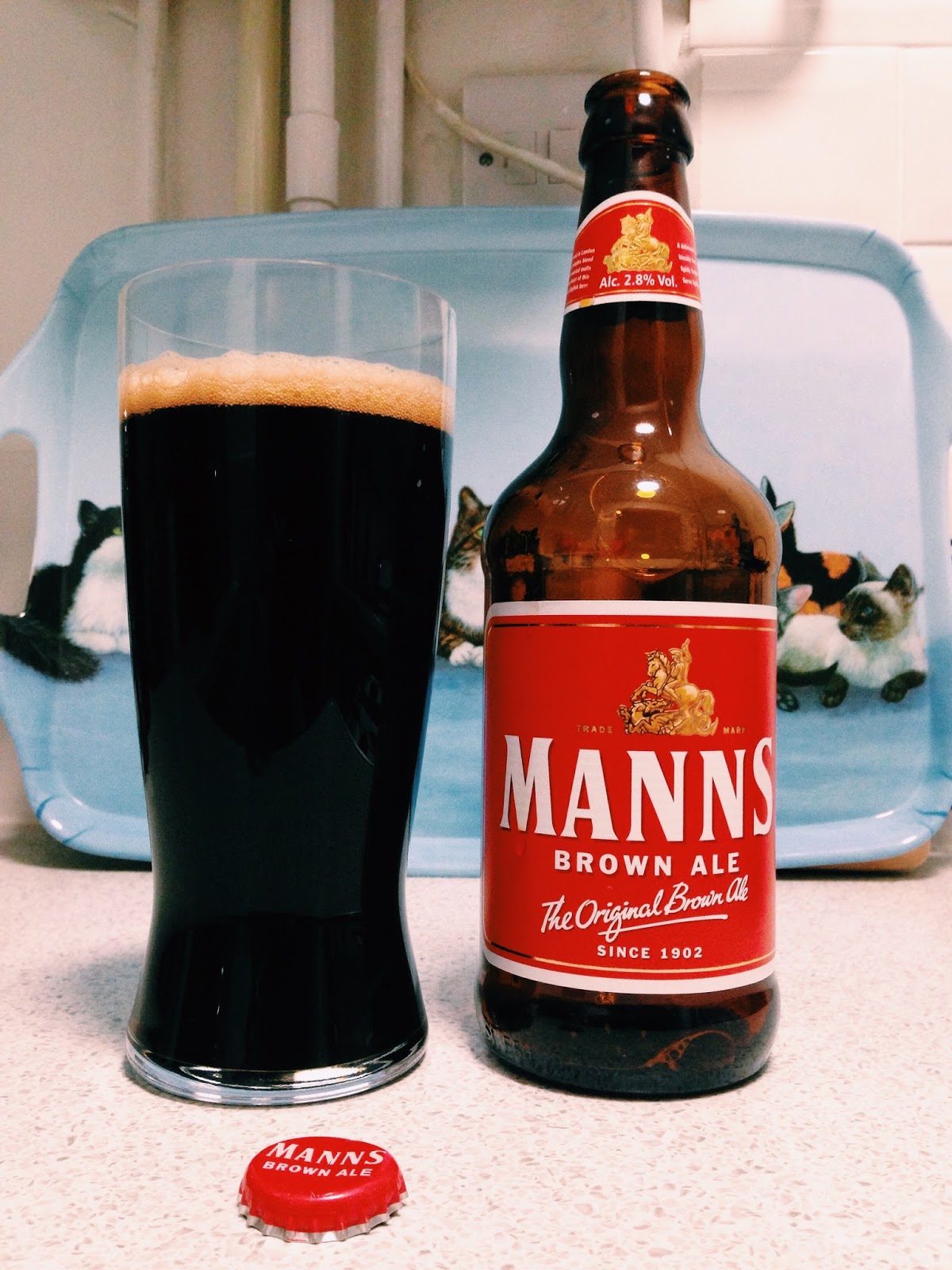
    For months, I couldn't find Mann’s Brown Ale anywhere. I wanted to include it when I did my initial brown ale round-up in the early days of this blog, but nowhere near me stocked it. Eventually, I found myself in one of those enormous ASDA superstores when I clocked Mann’s bottles on the shelves, and became consumed with excitement which I knew, even at the time, would inevitably outstrip the quality of the beer. I was mainly just curious – Mann’s is often cited as an example of a now near-extinct breed of brown ale, a counterpart to the likes of Newky Brown. You’ll find little bitterness and no dry finish to Mann’s – it was reportedly considered close to a soft drink at one time, which I can understand. It’s not just the meagre 2.8% ABV, it’s also the sweetness and easy drinkability. It is refreshing and thirst quenching, but in much the same way water is, and not very much like beer is. It also tastes an awful lot like cola to me, with a finish that recalls sparkling mineral water, and hints of treacle and toffee flavour.  I can’t imagine anyone ever thinking “I think I’ll have a nice beer” and then enjoying drinking this.

    Thornbridge Charlie Brown (peanut butter brown ale)
    My hand has often hovered over Charlie Brown in bottle shops, but something always stopped me taking the plunge. It’s a brown ale with peanut butter and, whilst I love brown ale and love peanut butter, I somehow couldn't quite believe it could be as great as it sounds. Still, I eventually had to try it. Upon pouring, the peanut aroma is immediately evident – it doesn't really smell of peanut butter, but more like raw peanuts with the husk still on. I was expecting more peanut on the initial taste – this is more like a brown ale that heightens the peanut butter flavours that are usually to be found somewhere in beers of this style, rather than providing a massive peanut butter hit. That’s fine – I still want it to taste of beer, otherwise I’d just eat a peanut butter sandwich.  Trouble is, I'm not overly enamoured with the base beer – the body is too thin to work with the peanut butter richness, and there’s an unpleasant, slightly vinegary acidity in the background that also clashes. I was a little disappointed, but not because brown ale and peanut butter don’t go together – I just don’t think this is a great brown ale to begin with. 


    North Laine Brewery Deadwood
    This one is currently available in cask-conditioned form at Brighton's North Laine brewpub so, if you're interested, you should probably get over there and try it while you can. And it is definitely worth a try, even if my pint wasn't without flaws. The beer is aged in bourbon barrels (edit: it's actually aged on bourbon-soaked oak chips, not in a barrel), which in principle is an excellent idea - it's usually stouts that get this treatment but, since your average brown ale is a little lighter-bodied, you're less likely to end up with anything so thick and oily as certain barrel-aged stouts. The bourbon profile in Deadwood is expertly judged, never overpowering the beer - the whisky brings honey and vanilla, and the time in the wood brings a dry, red wine-like finish. The further down the glass you get, the less prominent the bourbon notes, and bitter chocolate and grassy hops come to to foreground. Unfortunately, my pint was let down by a lack of body - it lacked the smooth, substantial mouthfeel I'm looking for from cask ale, and felt thin and watery. I'm hoping to try it again while its around - perhaps my complaints are simply due to the inconsistency of the cask, and it is otherwise a very good beer.

    So far I've mainly been interested in British-brewed brown ales but, since there aren't huge numbers of them, I'm going international with this time. I’d heard some good things about Norway’s Lervig, but unfortunately, their brown ale is a dud. There’s a little toffee, a little chocolate and, if you swill the beer around in your mouth desperately looking for it, a touch of hop bitterness. But overall, it’s watery and bland.

    I was expecting a powerfully hopped American brown ale from this, but it’s actually a more nuanced beer. The recipe is inspired by brown ales from the brewery’s past which, in turn, shows a strong British influence – liquorice, treacle, caramel and fruit cake are all in there, bringing to mind something like Harvey’s Bloomsbury Brown if it were twice as strong. A more modern twist is the use of Citra hops, which didn't exist when Anchor was brewing these early beers. Initially, I couldn't get any of the hop flavour at all, but it comes out as the beer warms, with a subtle gooseberry tang. It may not have the hop hit I was expecting, but this is a great beer.

    I have a big soft spot for Triple fff, as they are responsible for what I think was my first ever encounter with cask ale, many years ago. Whilst a little south of legal, I once entered an establishment in the brewery's home town of Alton, Hampshire and, in a bid to convince the barman I was surely of proper drinking age, asked for a beer recommendation. He suggested Moondance, their Best Bitter. I professed to love it at the time, though I wonder now how much I truly liked it and how much I was just pretending to be a grown up. I’d certainly love to try it again.

    And, perhaps fittingly, Triple fff are the outfit behind what I think is my first taste of cask brown ale – all the others I’ve tried have been from kegs, bottles or cans. In fact, I think hoppy brown ales might work best from casks; I’ve always found well-hopped beers softer and more rounded in cask form compared to the spikier, punchy keg equivalents. Both versions have their merits, but the smoothed-out hops in this beer work nicely with the malt flavours – the balance is perfect. The malt brings caramel and toffee along with a big hit of wafer biscuits, with tangerines from the hops. It’s excellent.


    The Kernel Brown Ale
    The Kernel's interpretation of brown ale pours disappointingly black. I'm worried I'm in for a thin-bodied porter. But then, as I go for a sip, dark ruby colours slosh around in front of me - that's better. The nose is a big whack of cereals, and the first sip is full of roasty, toasted malt flavours. It actually is a little like a porter, though perhaps medium-bodied where a darker beer might be thicker. In fact, it's the perfect body for a brown ale according to my preferences. Some caramel and toffee inch the beer away from porter territory, and there's a citrus zing in the finish; although the label doesn't tell us which hops are included, I'd guess something American and beginning with C. This is delicately done, though - it's not an American brown ale, it's a modern British version which looks to the US for influence. I like it a lot.

    ***

    I've also recently come across a couple of brown ales with the audacity to call themselves 'imperial'. They'll get their own post next week.